Monetary Literacy & Mastery Foundation

Monetary Literacy & Mastery Foundation

money.forumspark.net

Join the Monetary Literacy & Mastery Foundation to understand how money, banking, inflation, and central banking really work. Free educational resources, community discussions, and structured learning for sound money principles.

24 members 265 topics 1K replies
rockfleece ·Financial News & Discussion ·5 months ago
California's 'Wealth' Tax Is Coming For Everyone

If you own property in California, you're not safe. A new ballot measure will empower the state to confiscate a percentage of the assets of any resident, even though its initial provisions don't communicate that intent. California's "One-Time Wealth Tax for State-Funded Healthcare, Education, and Food Assistance Programs Initiative," which has already qualified for the November ballot, is even worse than it appears.

It's not as if appearances aren't bad enough. The explicit intent of the initiative already chased at least six billionaires out of the state in 2025. Moved to Florida are Google co-founders Larry Page and Sergey Brin, along with PayPal co-founder Peter Thiel. Nevada is now home to billionaire Don Hankey, and Texas has welcomed former Uber CEO Travis Kalanick. Famed director Steven Spielberg has moved to New York, apparently concluding even that deep blue state is a safer bet than California. Just the departure of these six men has lowered the potential take from the wealth tax by an estimated $27 billion.

A Hoover Institution study claims that another 20 California billionaires have already made departure plans and will leave immediately if the initiative is approved by voters. One of the initiative's many diabolical provisions is that it will apply retroactively to anyone living in the state after January 1, 2026, but unlike the six who got out in 2025, this next tranche of would-be exiles have been advised by their attorneys that the initiative's retroactivity will not survive a constitutional challenge.

Other details of this initiative are likely to survive court challenges, and they reveal a stunning level of aggression toward wealth. If you live in California, and this bill is approved by voters, you will have to pay a "one-time" tax of 5 percent of your "covered assets" valued over $1 billion. "Covered assets" include unrealized gains in the value of stock owned by employees of private companies. It is unlikely the framers of this initiative didn't understand the implications of this provision. Valuations of private companies are subjective, volatile, and illiquid. An employee with stock options valued at a few billion in the last private equity round could be assessed tens of millions of dollars in wealth tax on money they don't actually have access to, based on a value that could plummet at any moment.

It gets worse. The language of the wealth act provides for what amounts to unrestricted escalation of its reach, something that will surely become necessary when high earners are driven away, taking their taxable assets with them. Built into the 2026 Billionaire Tax Act is the right of the state legislature to amend its provisions with a two-thirds vote. That would include lowering the $1 billion threshold, replacing "one-time" with an annual assessment, and eliminating the exemptions currently present for real estate and retirement accounts. The wording of this initiative is purposely designed to give the state legislature the authority to override the property tax protections afforded by Proposition 13, passed by voters in 1978 and one of the only obstacles left that prevents the state from stripping the state's middle class of assets they've earned and stewarded over generations.

It is ridiculous to think California's state legislature cannot muster a two-thirds vote, anytime they wish, in order to extend the reach of the "Billionaire Tax Act" down to "millionaires," which, in California, is almost anyone who has owned their own home for more than a decade. In both houses of California's state legislature, 75 percent of the seats are held by Democrats. The overwhelming percentage of Democrats in California, and, for that matter, a sizable portion of the state's dwindling contingent of Republicans, are controlled by the state's powerful public sector unions. And more than anything else, these unions have one guiding principle: grow government, because bigger government means more membership, and more membership means more dues revenue. That's the reason that the top 10, if not the top 50, largest contributors to winning campaigns for seats in the state legislature are all public sector unions.

To grow support for more government, you must grow dependency on government, and to that end, California's state legislature has engineered a perfect storm. Every decade, more regulations buried small emerging competitive businesses, allowing the biggest and most politically compliant businesses to gain captive markets. And in complying with the state's overregulation, lacking competition, these politically favored businesses passed the increased costs of regulatory compliance on to their customers. Voila, California's energy, water, transportation, higher education, housing, and all government services became increasingly unaffordable. And as households, by the millions, could no longer afford to survive economically, government aid stepped in to fill the gap.

The numbers support this assessment. Between 2010 and 2025, when the state's total population only increased incrementally by about 1.5 million people, the number of participants in California's taxpayer-funded food aid benefits soared from 3.7 million to 5.5 million, and the state's Medi-Cal enrollment exploded from 7 million to 15 million, over one-third of the population.

Everything California's state government has done over the past 15 years has exploded commensurately. The state General Fund in 2010 was $87 billion. In 2025 it was $228 billion. Even adjusting for inflation, spending more than doubled when the total population barely budged. And what of this population?

Over the period from 2010 to 2025, nearly 10 million people moved from California to other states. The people moving into California and the people choosing to remain in California are increasingly characterized as either high-income residents who can withstand the high cost of living or low-income residents who depend on government assistance. California's Gini Coefficient, at 0.49, puts it in a virtual tie with New York and Connecticut as the states with the worst income inequality in the nation. To claim this is the fault of billionaires is a convenient lie, promulgated by the very politicians whose own policies were the true cause.

It ought to be clear to anyone who has spent any time in sunny California, a place blessed with literally every scenic amenity imaginable from alpine peaks to sandy beaches, the best wine on earth and spectacular coastal cities, that the only thing that could possibly induce them to not want to live here permanently would be an overtly hostile government. And that's exactly what has happened. Every major challenge California faces is the product of a government that has decided to serve itself instead of the people.

The model of "democracy" that California has perfected can be summed up in one sentence: overregulate an economy to make life unaffordable without government handouts, then win elections by promising more government handouts to people who can't live without them. It is unsustainable, because as the old cliche goes, pretty soon you run out of other people's money. The exodus of California's wealthiest residents is the latest iteration of this doom loop.

Far removed from idealistic fantasies sold to voters, this is the reality of progressive politics in California. Given half a chance, it will be exported to the rest of the nation.

https://amgreatness.com/2026/06/03/californias-wealth-tax-is-coming-for-everyone/

25 replies 2K Read more →
MoneyMan ·Teaching Resources ·1 day ago
The Money Detectives: The Kingdom of Paper Promises
Monetary Literacy & Mastery Foundation Presents
🔎 The Money Detectives

The Kingdom of Paper Promises

A complete illustrated mystery about money, trust, and what happens when a kingdom makes more promises than it can keep.

COMPLETE GRAPHIC NOVEL  •  6 CHAPTERS  •  72 ILLUSTRATED PAGES

Can a kingdom print its way to prosperity?

When Maya and Ethan enter the mysterious kingdom of Valoria, everything seems possible. The royal treasury can issue more Crown Notes, new projects are underway, and the kingdom appears to be growing richer.

But something doesn't add up. Prices are changing. The words on the money have changed. And behind the treasury doors, the detectives discover a troubling difference between what the kingdom has and what it has promised.

Follow Maya, Ethan, and the Money Detective through secret ledgers, bustling marketplaces, the royal vault, and the king's council as they uncover who benefited first, who faced the consequences, and what makes a monetary promise worth trusting.

Now available in our illustrated library

Open the Book. Follow the Clues.

Read The Kingdom of Paper Promises in our dedicated Money Detectives Illustrated Library, where you can select a book and explore its chapters. The library also features The Case of the Vanishing Value.

📖 Read in the Illustrated Book Library
Choose The Kingdom of Paper Promises when the library opens.

📚 Two Illustrated Adventures, One Library

The Money Detectives Illustrated Library brings our full-length stories together in one place:

Book One — The Case of the Vanishing Value
An illustrated mystery about purchasing power and the money we use.
Book Two — The Kingdom of Paper Promises
Six chapters and 72 illustrated pages exploring currency, promises, and trust.

Prefer the original PDF, or using a browser that doesn't display the library's embedded viewer? Open The Kingdom of Paper Promises PDF directly.

💬 Join the discussion: If you lived in Valoria, what would convince you to trust a Crown Note? And what would you want to know about the promises behind it?

A Money Detectives educational adventure from the Monetary Literacy & Mastery Foundation.

MoneyMan ·Financial News & Discussion ·3 days ago
What Is Money? Debating MMTers

Issuing money is theft. And and a more precise way of putting it is slavery. If I own a form of money, but you have the ability to print more of that money, you're essentially stealing my purchasing power. Until Bitcoin came around, we had no choice.

>> Money. Most of us spend our lives thinking about it, earning it, spending it, worrying about it without ever asking who creates it, who regulates it, and who that system was built to serve. The central bank cannot force money on the population. They don't print money and just drop it by helicopters. It does not work this way.

>> You could tax the rich. Taxing the rich basically reduces their purchasing power. Today, we're asking who controls money.

>> Before we start, tell us where you stand on today's topic. Share your thoughts with us in the comments here on YouTube. I'd like to welcome our guests. Pelvina Chernva is the president of the Levy Economics Institute. Jason Hickle is a professor at the Autonomous University of Barcelona and Sephedin Amus is an economist and author of the Bitcoin Standard. A very warm welcome to the three of you. Thank you for joining us.

>> Thank you.

>> Thank you. Thank you for having us.

>> I'm very excited about this conversation. I am going to learn a lot myself as somebody who is not an economist talking to three very uh accomplished and enlightening people talking about money in our time today. I'm going to ask you a lot of stupid questions. So, please bear with me because I want to learn as much as I can from the three of you and maybe towards the end you all can help me restructure my investment portfolio.

But no pressure, [laughter] can we begin with you? When we talk about money, what does that word actually mean?

>> Money is a medium of exchange. What defines it is that it is a good that is not acquired for its own sake. You don't acquire it to consume it and you don't acquire it as a capital good. You don't acquire it in order to produce other things. The first is a consumption good. The second is a capital good. Money is a different category of good which is acquired purely to be exchanged forward. And this gives it specific properties that are different from other prop from other goods.

But I think the most important fact to understand about money is that it is just another market good and therefore there's a supply, there is a demand and then all of the rules of economics apply to it. And I think a lot of the confusion around money comes from trying to force people into not seeing it as another market good to to then claim that all the rules of supply and demand and the basics of economics do not apply to it.

But anything can be used as a medium of exchange. You can decide to use anything as a medium of exchange as long as you don't consume it, don't use it in production and then exchange it for something else. The question then is what succeeds as a medium of exchange. And I think history shows us there are very clear properties for what makes for a good medium of exchange or what makes for a bad medium of exchange. And in my book, the Bitcoin standard, I argue that the most important property is the increase in the supply of money.

Ultimately, that matters more than anything because a money whose supply increases quickly will be devalued to the point where it cannot function as money. Whereas a money whose supply doesn't increase quickly will continue to maintain the wealth that is stored in it, will continue to function as money, will continue to reward the people who use it. So a fast increase in the supply of money destroys the ability of money to function as money. I think this is an enormously important thing and this explains a lot of the world's problems over the past century where we went from using a money that was limited in its supply growth which is gold to using government money which is much more unlimited in supply growth.

It grows at a much faster rate, creates a lot of uh price inflation, creates a lot of funding power to give more money and power to the government at the expense of the citizens and has financed wars, death, destruction and devastation. All of it because of this very dangerous, very destructive and very murderous idea that government gets to set what money is and government is the arbiter of what money is, which is false and downright criminal, I should say.

>> Well, there's there's got to be a lot here we're going to unpack. Uh, Pavina, what makes money work, function in a society? What is it about the concept of money that allows us to agree on the value of anything? Well, I think it's important to distinguish between money as objects versus money as um units of measure. If I were to say what money is, I would concentrate on its um aspect as a social technology, if you will, that money emerges through the history of time as a way for us to track economic activity, as a way of measuring debts to each other, uh prices, equivalences.

So when you look at how money emerged through time, historical time, uh you would be hardress pressed to find a society that didn't have some kind of standard that was established, usually with the help of some authority. How you and I decide what we owe each other um what our debts are going to be priced in is some kind of um measurement. So the first function I will stress for money would be the unit of account. And you know, it's normal that most people think of money as the object uh that they carry in their wallets, uh the coins that jingle in our pockets, but really um money is just the name for financial instruments, I use.

So think of money as um centimeter, as a foot. Think of money as just the name for for debts. So when you say a dollar, it's not really the uh material manifestation of dollar that is so crucial, but who sets the standard of that we are going to measure our prices and our debts in dollars or in euros. And when you then look through time, you notice that money is not only a social technology, but it also is um part of nation building.

It's part of how um governments manage a polity. Um and so there is a reason why governments are involved in the creation of money. In the modern world, the currency is a public monopoly. Um but that has been a long historical process of nation building um gaining independence from you know foreign powers and acquiring some kind of capacity to manage your economic affairs. So this is what we would call for example monetary sovereignty where um money will be created with the financial institutions that we have built Federal Reserve treasuries.

We issue currencies and um and there is a reason why money is not uh fixed because we need it to be flexible to facilitate growth in economic activity. Now, that word sovereignty is important and we're going to get there because I think a lot of the conversation is about that topic about independence and about sovereignty and about freedom ultimately and who has it and who doesn't have it. But I heard from two the two of you two different slightly different definitions of money, a good and a measurement, which is really interesting.

And Jason, I wonder listening to these two what you agreed with, what you disagreed with.

>> It's interesting. I mean, I suppose probably I'm closer to Pablo's position here. Um, I think one of my worries about uh about Dice position is um I'm not actually sure that we want to think of money as something that should be a uh a permanent store of value in the way that say Bitcoin is that we would speculate on and things like that. Um we can get into that later, but I think that the thing that I would want to add to both of these is simply to say that um that money is not just a neutral thing.

It's it's a highly politically charged thing. Uh it's it's shot through with power imbalances. And I think this is what makes money really interesting, right? the fact that um the money has this incredible power which is the power to effectively mobilize production, right? Like all of us uh you know who work, we receive our wages in uh in a particular currency. Uh and because we need to buy things with that currency, we're incentivized to do more work to get those to get that the currency to uh to buy things we need to do like buy a house or pay for rent or buy food.

So there's there's there's demand for this currency which is what drives us to to seek it. And so whoever is issuing the money uh therefore has power to mobilize our labor right like our labor but also our resources our our collective planet's resources and so there's a crucial question here which is that who who controls the money issuance um and what do they mobilize to do with it um and I think this this is where the rubber hits the road really right so it's not it's not necessarily neutral there's power relations that are at stake and the main thing here is that um technically uh Pavina is absolutely right that that governments or states have a have a monopoly over the issuance of currency.

It's a public monopoly. However, under capitalism, they actually relinquish some of that monopoly power and they franchise it out to commercial banks. And so, commercial banks then under capitalism have the right have the ability to uh to to create money when they uh when they make loans. And so, a huge amount of money in our in our economy is actually created by commercial banks. Now, when now when they create money and make loans, uh what's the purpose for them?

uh they're effectively lending to capitalist enterprises with the objective of making profit. And uh and so as a result, a ma a massive amount of our labor and our collective productive capacities, our factories, our resources, our energy, uh our land is mobilized around uh producing things that will maximize the profits of the capitalist class. And I think this actually leads us to very severe problems. Um for example, we mobilize uh effectively um in a kind of a perverse way, right?

We we have massive production of things like SUVs and fast fashion and private jets because these are highly profitable to capital. But we have chronic underprouction of obviously socially necessary things like affordable housing or renewable energy or agroecology uh things like that because these are much less profitable to capital or not profitable at all. And so I would say the question here really is um is is who controls money in in any given given economy. And specifically the problem we face now I would say um is not money as such but rather uh money in a capitalist economy uh where production is organized around profit maximization not around human needs because I mean think about it we have tons of productive capacity think about the labor that we collectively uh possess um right think about the resources and factories and technologies that we have we could do anything we want

like the social crisis that we have we can we can solve immediately the ecological crisis we have we can solve immediately these are not difficult things to to solve. Uh the main problem is simply that our productive capacities are not mobilized to do those things because they're not profitable and instead they're mobilized to do other things that benefit the profits of uh of those who uh control the means of production, those who own capital. And I think that's the main problem we need to focus on.

>> Safe, I can see you writing things down. I I wonder what you have to say

>> a lot. First [laughter] of all, let me begin by uh saying initially you said u it's money is a unit of account and it always has to be there always has to be an authority that set it and I think this is categorically false. Um gold has existed as money before any single government that exists today had existed. Gold was money and gold continued to be money after all of the world's governments have gone out of business and it continued.

So the Roman Empire collapsed but the gold continued. Gold continued to be as money. So the emergence of gold as money predates the emergence of any state. We have records of people using gold as money before any states existed. And even more importantly to debunk this claim is the clear idea that within societies say the government can impose a specific monetary standard. This silver coin or gold coin or whatever it is. But inter societies between societies there is no single authority that decides.

And yet trade happens. So how does trade happen between strangers who don't live under the same rules under the same authority? The answer is money that exists outside of the state and that's what gold is. Gold is money regardless of whether the state allows it to be money or not. Now the second point is um you said essentially that issuing issuing money is a way of mobilizing labor which is an wonderful Orwellianism but it's a very wrong way of putting it.

Issuing money is theft and and a more precise way of putting it is slavery. if I own a form of money, but you have the ability to print more of that money, you're essentially stealing my purchasing power and taking it to you. Now, if I signed up willingly to um if I was stupid enough to sign up for a form of money that is built to allow you to steal from me, then you could say that's not stealing.

That's just me being an idiot. But in our modern world, we have no choice. We Well, until Bitcoin came around, we had no choice. You had to sign up to the government's money. You had to sign up to being stolen. And you had to sign up to being lectured by economists paid by that stolen money to tell you why that stolen money is for your own.

>> Okay, I just ask a clarifying question. Are you talking about inflation when you talk about theft? Is that what you're referring to?

>> Increasing the supply of money. Increasing the supply of money, devaluing the existing devalues the existing

>> through inflation is what you're talking about.

>> Through increasing the supply, anything whose supply increases its value declines. So

>> So this is the idea of governments having the ability to print money and and and circulate that into their economies.

>> Exactly. It's marketed as if it's a way of mobilizing labor as if it is something that is inevitable that it has to happen. And as you said, you know, we need to increase the supply of money. I think this is the most pernicious misunderstanding of money and it's extremely dangerous because you don't actually need to increase the supply of money because money is unique among all goods in that its quantity is irrelevant to its performance of its function.

In other words, having more tables, more water, more apples, more steak is good because that allows us to meet more people's needs for these goods. With money, it's not the case. We don't need a specific quantity of money for money to perform its function because money's function is purchasing power. And purchasing power is something that is psychological that can be stacked into money without increasing the supply. In other words, you could run the entire world economy on a money supply of a billion dollars or a trillion dollars or hundred trillion dollars or $1.

Doesn't matter. You can just divide the dollar down into smaller and smaller units. You don't need to increase the supply because the purchasing power that can be stored into every unit of supply can be increased. So the only function that is served by increasing the supply of money is just redistribution. It's theft. It's theft from the vast majority of people to the government's central banks. [snorts] And let's face it, the economists that get paid from the inflation to justify this, but [laughter] that's not something.

>> Well, I mean, listen, I I have two I I have two against one, so I got to [laughter] swing.

>> There's actually going to be a lot of agreement between the three of you. I'm I'm certain of it, but I want to stop on this on this point. And Pavina, um, we hear a lot about supply and demand in the way that our economists talk, the way that our government officials talk. What does that actually mean and how does that change the value of money that I have in my bank account?

>> The Bitcoin Standard podcast is sponsored by Crowd Health. Crowd Health is the Bitcoiner's answer to fiat health insurance. If you listen to the show, you've probably heard me rail against the problems of modern healthcare and health insurance. Crowd Health is not insurance. It negotiates with healthcare providers on your behalf and gets you much better rates by offering to pay them cash upfront without having to go through the expensive bureaucracy of modern healthcare insurance. It disintermediates large insurance companies who have the wrong incentives and are constantly raising costs.

I've known Crowd Health CEO Andy Shunover for years now and I've spent quite a bit of time grilling Andy on their model. I've hosted him twice on this podcast and asked him about it and you can listen to those episodes. I think it's a great way to bypass some of the many failures of the modern health care system. If you want to understand how Crowdalth works, go to joincrowalth.com/webinar and sign up for the next live webinar and ask Andy your questions directly.

And when you're ready to join, go to joincrowalth.com and use code safe, that's sif, to get your first three months for $99 a month. Look, it's not the value of money is not about the supply and demand, but what uh it buys. Um let's just go back and just kind of systematize our categories first. Um the very first forms of money that were invented, ancient Mesopotamia, clay tablets, not precious gold, not precious metal. Throughout most of the history of time, money has not been precious.

clay tablets were little ledgers where they notify what you're entitled to two goats, a bushel of wheat. Um, the Mesopotamian palaces organize their production by basically tracking the equivalences of these commodities and money is connected with the origins of writing, the origins of accounting. It was a technology to track economic activity, not to usurp. There are distributional effects. I think I agree with this that as a society we choose who produce, who consumes, where that goes. And when I say governments, I don't mean nation states.

I talk about some kind of governing authority. It could be your priest. It could be the temple that basically figures out, you know, how many chickens get sacrificed, right? And we track, money was created to track that production of the debts, more specifically the debts. What do I owe you? Um, and in the modern world, money is actually debt. It's not a thing that we just print away. While there is printing of currency, that is really not the essence and the heart of money.

Money is debt. Anyone can create money. The point is to get it accepted. I'm quoting an economist Hyman Minsky. The point is to get it accepted. I can issue you an IOU. Will you accept my IU? I promise to pay you something. What will you accept? A cup of sugar or a dollar or a brick of gold? What would you take? And I would venture to say that you would take that which is most acceptable elsewhere in the economy which is what is the final means of payment and that tends to be in the modern world currencies and we can go through the history.

I think Jason is right that money takes a completely new form under capitalism because it becomes a singular obsession right it becomes it so is removed from the basis of economic activity. It looks like it's lubricating our transactions but it's really um it is created in the act of creating credit and that has been throughout time that money is an IOU um and there are private IUs and you can denominate them in bitcoins and you can denominate them in currency uh various currencies which is the most acceptable and it has to do with the arbiter with the um in the modern world the nation state that sets the unit of account the ones that taxes in that unit of account and thus compels the rest of society to transact and denominate our transactions in that ultimate um uh unit clearing.

So I agree taxation has distributive capacities right this the state taxes us but not because it needs its own currency but it because it needs resources to provision for whatever we can conceive as the public purpose and you may say it's for military exploits and you can say for public investment but there is an a crucial function that the state functions to potentially provision for the for the society that it it governs. Can you explain this idea of debt and and credit and and IUS?

What does that mean?

>> Yeah, I mean uh you know uh IOU means that uh there's an issuer and uh that would be the liability of the issuer and then there's going to be somebody who accepts it. So like I said, if I um issue a mortgage, right? That is your debt. As a banker, that is my asset, right? You could think of this as a form of money. If I issue um a um a a bank check to you, I'm a banker and I issue a deposit that is your asset but that is my liability.

The that piece of paper that you carry that bank check is what we call bank money. The bank can create add infinitum. It can create as many bank checks as possible. You can use that check to pay for your transactions but and you accept it because at bottom you are guaranteed that that will clear at par uh through the banking system by the banks exchanging reserves and those are the exclusive prerogative of the state. So the state is liable to um issue that which settles all transactions and it is also liable to accept it in payments to the state.

So you see um the the thing about money is that it has to be redeemable right it's not an object I think that's where the difference is the way I see money is that it is a social technology that is issued by you know creating um issuing an IOU or accepting a means of payment it's not just an object that we exchange uh with each other and this is I think a category era um only economists tell the story of barter no other scientists will talk about societies bartering with each other and one day they wake up and they say, "Aha, we need something to help us with barter transactions.

We need something that has inherent, you know, value, hence precious metals." Because uh first the archaeological evidence does not show any society that has existed um with barter but without money and it doesn't have we don't have any evidence of money originating just from pure barter transactions. money was already was already there. And so, um, I think we need to really move away from this notion that somehow we're transacting with something that has inherent value, precious metal value, and to start thinking about why societies issues IUs and credits to basically facilitate economic transactions.

>> Safe, I feel like you are going to disagree with Pavina.

>> Yes. First of all, uh clay uh was used as money and it wasn't used anymore because it's not scarce and it was used as a ledger, not so much the clay itself, but it failed as money because it is very easy to produce. And if you look at the history of money, you find the exact opposite. The only things that have ever worked as money have only worked as money because there was some because they were the hardest liquid goods to produce.

So whether it was seashells, they'd use the rare seaells in West Africa, they used the glass beads because they didn't have glass making technology. So glass was very hard to find in West Africa. And as soon as something stops being hard to produce, as soon as the wave is found of increasing its supply very quickly, like when glass uh flooded into West Africa, it loses its monetary role. And so this is why the world ended up on gold as money.

It wasn't a coincidence and it wasn't just because it's yellow and shiny. It's no coincidence that gold is the metal that has the lowest supply growth rate and also became money all over the world across governments intergovernments across history across thousands of years because it holds on to its value much better than the other forms of money. Now there's a fundamental misunderstanding here. MMT people keep saying money is debt, money is debt, money is debt. Now this is a very big mistake.

You can use debt as money. You can also use mugs as money. You can use microphones as money. You can use tables as money. You can also use debt as money. But historically or I mean categorically there's a fundamental difference. Debt is a liability for a money. A debt is denominated in money. Money is the thing itself in which the liability is denominated. A claim on money is not the same thing as money. A ticket to a football match is not the same thing as sitting in the seat and watching the football match.

And you don't create more seats in the stadium by issuing more tickets for the game. So this difference between the idea that money is just debt ignores the fundamental question. Okay. Well, if money is debt, what controls the ability of a person or an authority to continue to issue debt? So if money is debt, why can't I just continue to issue more and more IUS? I have $1,000 in the bank account. I'm going to keep issuing more and more IUs.

Why would people not accept? Why would people continue to accept them? Eventually I could buy everything by issuing IUS. Well, eventually there's going to come a point that my IUs are going to be devalued. people are not going to take them at face value because they're going to think there's no way this guy has all of this money. They're going to have to be devalued. So, what determines the fact that what allows these IUs to be used as money.

It's violence. It's government control. It's government violence. It's essentially a system of slavery that forces you to use these tokens and gives the government and the people who control the government and the banking um institutions, the banking cartel and banking monopolies. It gives them the ability to issue money that you are forced to use. So you're constantly having your wealth stolen from you to finance them. And of course this is presented as if it is being done in order to build the nation and in order to help society.

But really it is to help the bankers and to help the people in power. It is at the expense of the people in society. And of course this is the cause of inflation. This is the cause of the economic problems which then are used to justify more and more inflation, more and more money printing. But the question then comes back to it. How could you maintain IUS as money without force, without coercion, without putting people in jail for not using it?

Because if left to their own, people aren't stupid enough to use IUs that can be made at an infinite quantity. They always resort to holding something harder. That's why we see, you know, in always when you see high inflation, the currency collapses and people switch to a harder currency. You see it in Venezuela, they go to the dollar. We're seeing it with the dollar. The dollar is increasing in its quantity. people who are intelligent and can understand this have already switched to Bitcoin and it's benefited them.

This is a process that is always going to continue and unfortunately the role of the uh state financed economist in this is to continue to gaslight people into thinking no no no it's actually for your own good that you use money that is designed to steal from you because this is somehow socially necessary. Do your part get robbed to benefit your banking overlords. That's how we build a society. You brought up the idea of theft and I want to bring in Jason because I I want to know what you have to say.

Lots of things to say. The word Orwellian was was put on the table quite early on. This idea that economists are using language to basically gaslight us as ordinary people into accepting our fate being enslaved in a system that we have no control over. H that's a lot. But how do you respond to it?

>> There's so much to say here. Look, I mean not not all economists are the same first of [laughter] all. So So there's like there's there's orthodox mainstream neoliberal economists. We are against them, right? Then there's heterodox economists, Marxist economists, feminist economists. I mean, the idea that all economists run on some kind of conspiracy.

>> All the non-Austrian economists are in one [laughter] conspiracy,

>> some kind of conspiracy to get us all to like subject ourselves to the or the overlord paid by the central banks universities. If you're central bank, [laughter]

>> it doesn't it doesn't include us. Um but but but first of all, um I want to start with where we agree very strongly.

>> Yeah. which is that uh that clearly we we agree that this is a deeply undemocratic money system, right? Like this is my main problem with it. The money system is profoundly undemocratic and it shouldn't be because again uh as Pavina pointed out um money is a public good. It it can and should be a public good, but it's not in our current economy, right? And so in the current economy uh it's overwhelmingly controlled by the commercial banks.

Um and uh and and effectively I mean it's interesting that that that Scythe is kind of uh like keeps pointing to the state as the problem here, the government as the problem here. the government has effectively tied its hands actually and has given incredible amount of control to an independent central bank over which there's no political influence um or or very little like finance as major influence over the central bank and then of course the commercial banks that's primarily what what runs the money system right and

>> and that's because these banks then have the power to issue money to create money and put it into the into the system

>> the these are the overlords of finance you might say and and whoever and again like whoever is whoever controls finance is controlling production it's determining production uh and so the commercial banks are effectively um determining what gets produced and what doesn't get produced because they're they're making the loans uh accordingly according to what's important to them which is of course profit maximization and repayability etc etc. So things that are again not profitable are not going to get produced under this arrangement and this and this by the way explains the fact that we are failing very profoundly on in one crucial task which is uh which is to tackle climate change.

Um like this is a dramatic civilizational failure. uh our ruling classes have utterly failed us on this. Um the the the rich countries are not decarbonizing nearly fast enough to meet their obligations under the Paris agreement. Now why is that happening? Um we we have the technologies that we need, all the renewable energy technologies we need. We could easily decarbonize quite quickly actually. But there's there's a problem which is that uh finance is not flowing into green transition because it's not profitable enough.

And so uh it continues to flow into fossil fuels because fossil fuels are something like three to four times more profitable than renewables. So we produce more and more fossil fuels and inadequate quantities of renewables and as a result the world is burning around us. This is crazy and and why is this happening? Uh given the fact that uh like uh in terms of democratic support people overwhelmingly support strong climate action and renewable transition. We want this uh nobody wants to watch our world burn around us and yet it's not happening.

Why? Because the finance system is not under democratic control. And on this I very strongly agree with Scythe. The the only difference here is that um is that I would say like in order to address this problem, we don't need to abolish fiat currency and move to Bitcoin. We should talk about Bitcoin because I got problems with it. Um we can keep the existing money system but bring it under democratic control. And I believe this should actually address Scythe's main concerns here.

Uh and so that this way uh you know money becomes a a real public good. We can democratically determine how it gets invested and what gets produced with it, right? Um, and this way we're directing our collective labor and our collective resources in in socially beneficial ways rather than ways that only benefit a certain small fraction of uh of our society. And of course the economists that they pay [laughter] who are bad. I want to agree on that too.

2 replies 36 Read more →
MoneyMan ·Teaching Resources ·4 days ago
The Money Detectives: The Case of the Vanishing Value!
Monetary Literacy & Mastery Foundation Presents
🔎 The Money Detectives

The Case of the Vanishing Value

A fully illustrated mystery about banking, inflation, and why the same money doesn't always buy the same things.

ILLUSTRATED MYSTERY BOOK  •  49 PAGES  •  READ ONLINE OR DOWNLOAD

Where did the value of our money go?

What if the greatest mystery isn't where your money went—but why it buys less than it used to?

Something strange is happening in Cedarbridge. Prices are changing, familiar purchases cost more, and Maya and Ethan want to know why. With the mysterious Money Detective as their guide, they begin following the clues.

Their investigation leads through banks, local businesses, and everyday transactions, uncovering questions about how currency is created, what a bank balance represents, and why purchasing power can change over time.

Created for curious children, parents, homeschool families, and anyone who believes understanding money should begin early, this illustrated adventure turns important monetary ideas into a story full of discoveries, surprises, and questions worth discussing.

📖 Read in the Illustrated Book Library
Choose this book or The Kingdom of Paper Promises in the Money Detectives reader.

📚 A growing illustrated library

The Money Detectives Illustrated Library brings our longer adventures together in one reading space. Select a book to explore its pages and chapters. If your browser cannot show an embedded PDF, use the direct download links below.

Visit the Illustrated Book Library →

Prefer to keep a copy?

You can also open the original PDF or download the eBook edition directly.

💬 Join the discussion: Have you ever noticed something you buy regularly becoming more expensive? What clues would you follow to understand why your money buys less?

A Money Detectives educational adventure from the Monetary Literacy & Mastery Foundation.

MoneyMan ·Teaching Resources ·5 days ago
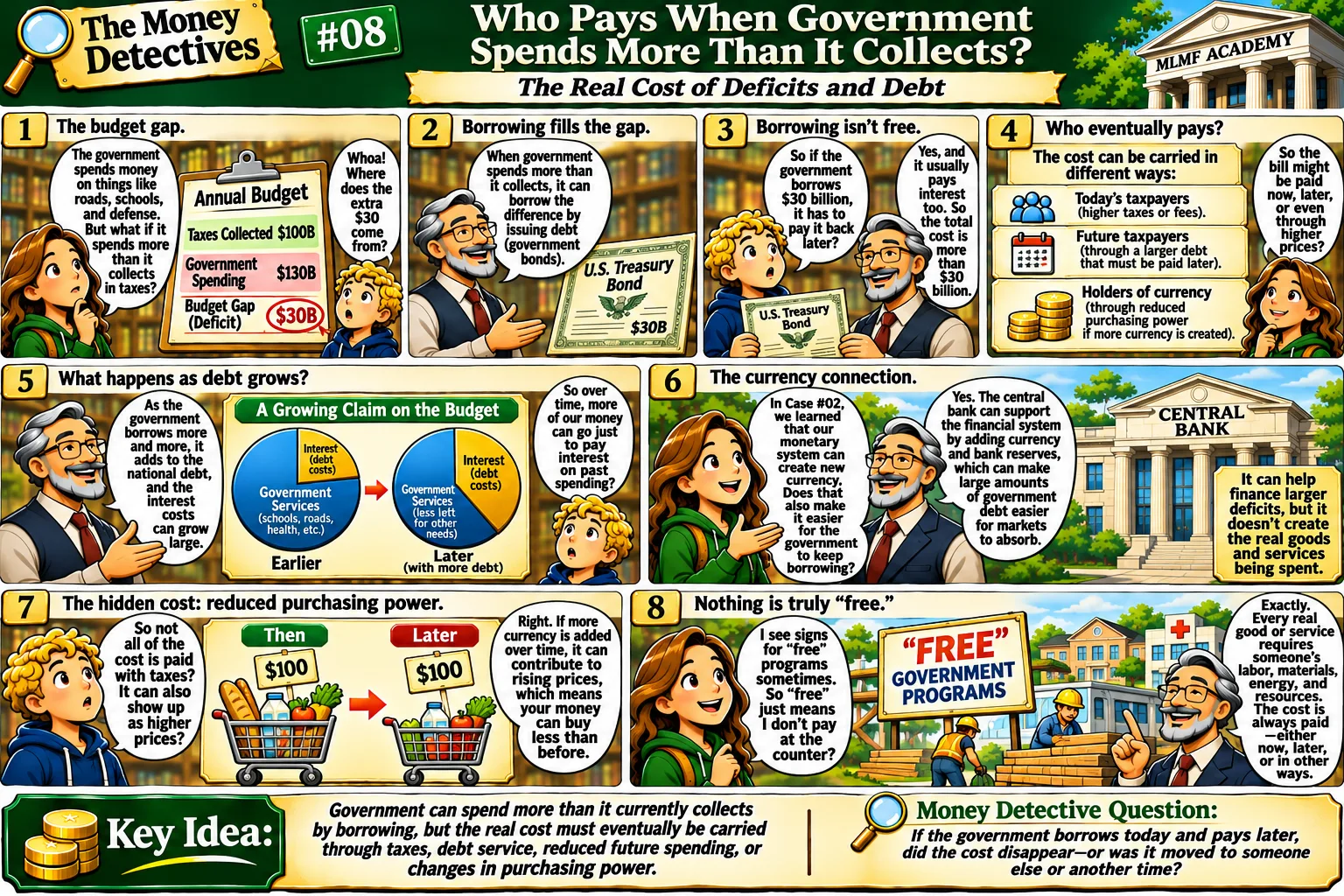
Teaching Pack 08: Who Pays When Government Spends More Than It Collects?

The Money Detectives #08 — Who Pays When Government Spends More Than It Collects?

Governments sometimes spend more than they collect in taxes. The difference is called a deficit, and it is usually covered by borrowing.

This comic introduces a simple but important question: if the government spends today and pays later, who ultimately carries the cost?

What This Comic Introduces

After reading, learners should understand that:

  • A deficit happens when government spending is greater than current tax revenue.

  • Governments can borrow the difference by issuing debt.

  • Borrowing creates future interest costs.

  • The cost of deficit spending can show up through taxes, future budgets, debt service, or reduced purchasing power.

  • Creating more currency does not create more real goods, services, labor, or resources.

  • A program may be free to the person receiving it, but the real resources still have to come from somewhere.

Money Detective Question

If the government borrows today and pays later, did the cost disappear—or was it moved to someone else or another time?

Encourage learners to think beyond the word “free” and ask where the labor, materials, energy, and resources needed for government spending actually come from.

For deeper study: Continue with MLMF’s lessons on government debt, monetary expansion, inflation, and purchasing power.

MoneyMan ·Teaching Resources ·1 week ago
The Money Detectives #06 — Who Gets New Money First?

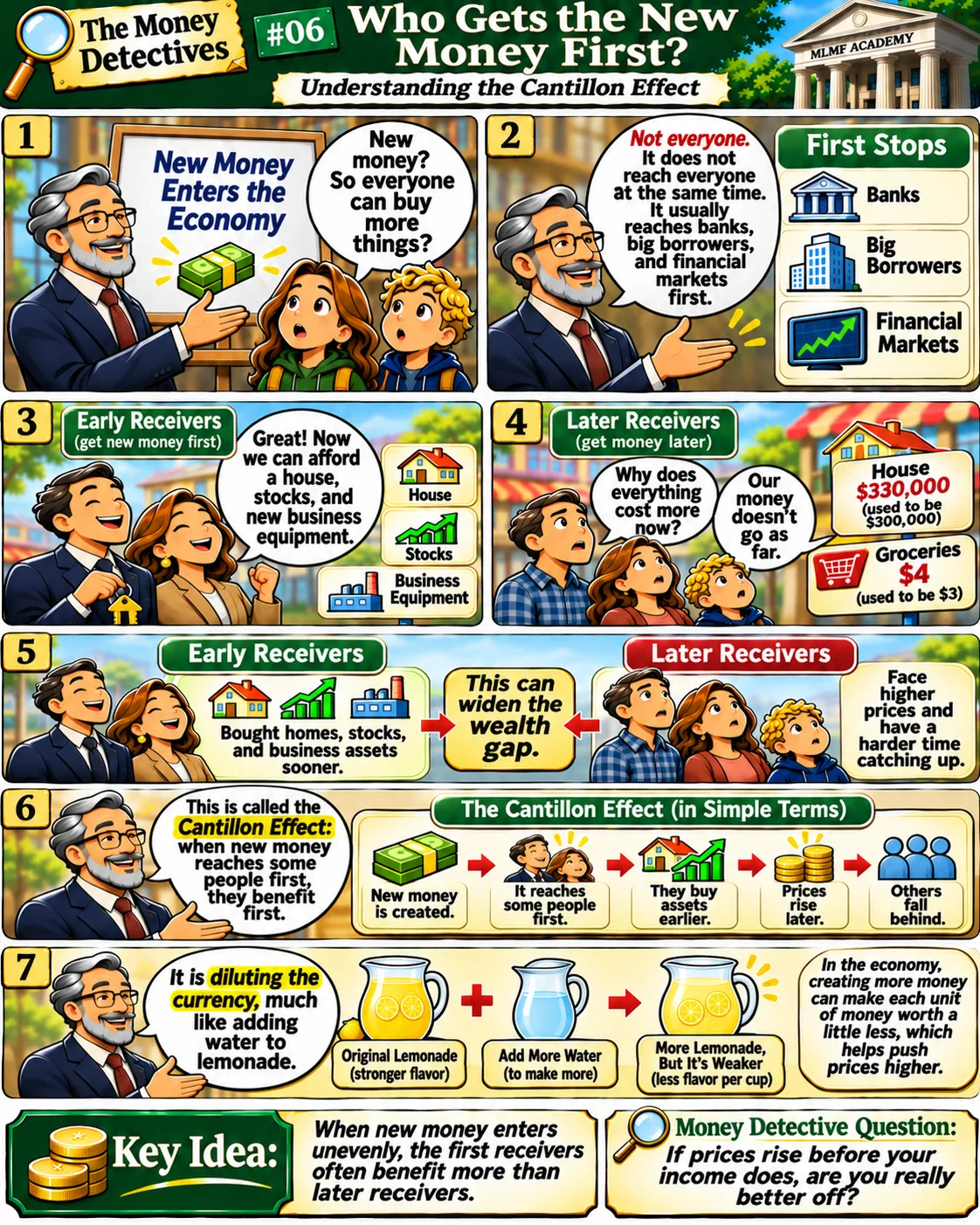
The Money Detectives #06 — Who Gets the New Money First?

When new money enters the economy, it does not reach everyone at the same time.

This comic introduces the Cantillon Effect—the idea that early recipients of newly created money can spend or invest before prices fully adjust, while later recipients may face higher prices before their own income catches up.

What This Comic Introduces

After reading, learners should understand that:

  • New money enters the economy through specific people, businesses, and institutions first.

  • Early recipients can gain additional purchasing power before prices fully rise.

  • Later recipients may face higher prices before receiving the same benefit.

  • This uneven process can contribute to a wider wealth gap over time.

  • Creating more currency can also dilute its purchasing power—much like adding more water to lemonade makes each cup weaker.

Money Detective Question

If prices rise before your income does, are you really better off?

Encourage learners to think about why the path new money takes through the economy can matter just as much as the amount created.

For deeper study: Continue with MLMF’s lesson on Money Creation & the Cantillon Effect and explore the Cantillon Effect Simulator.

MoneyMan ·Teaching Resources ·1 week ago
The Money Detectives #05 — Why Does My Money Buy Less?

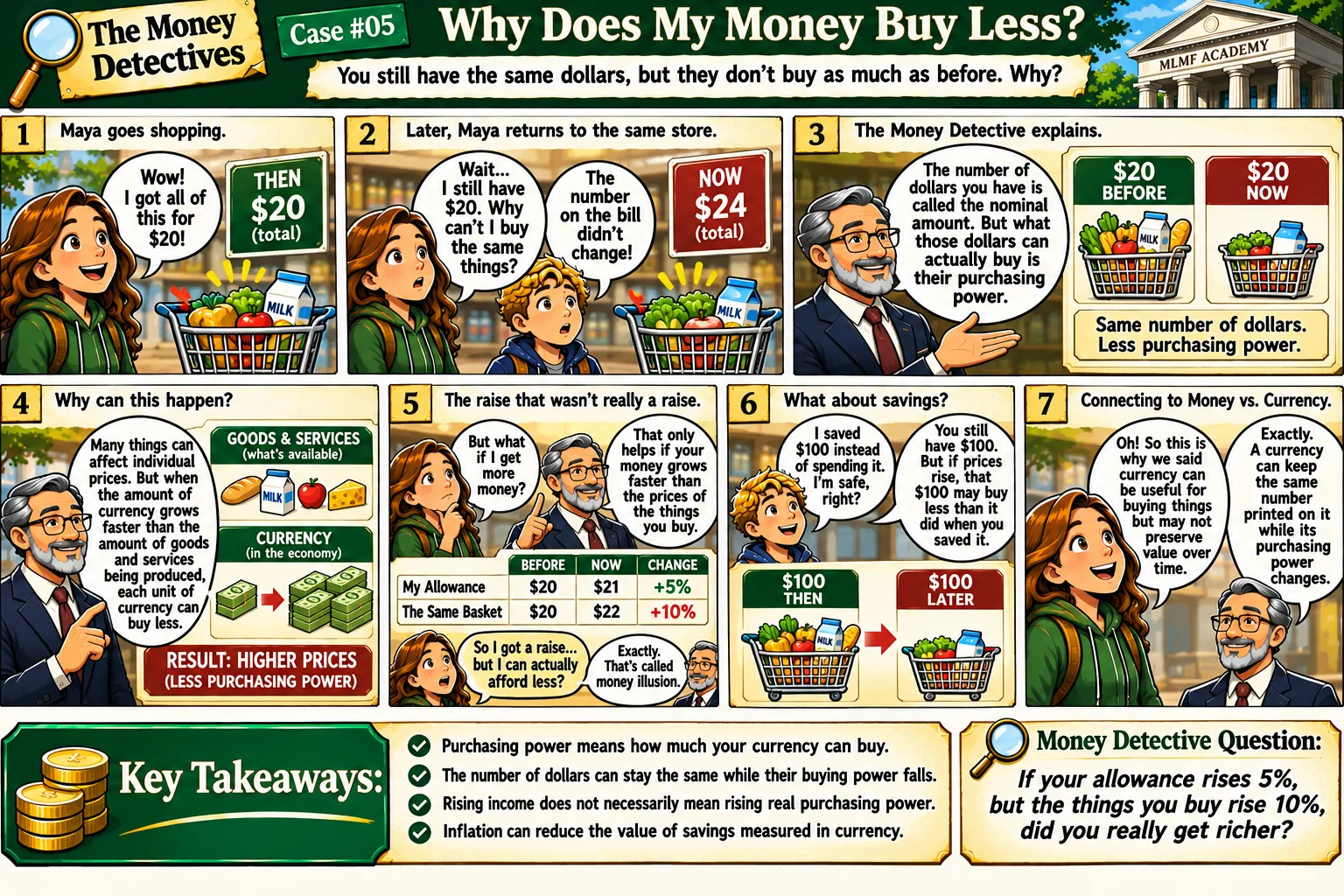
The Money Detectives #05 — Why Does My Money Buy Less?

You can have the same number of dollars and still be able to buy less with them.

This comic introduces the idea of purchasing power—the amount of goods and services your currency can actually buy. It also shows why a raise in dollars does not always mean a real improvement if prices are rising even faster.

What This Comic Introduces

After reading, learners should understand that:

  • Purchasing power means how much your currency can buy.

  • The number of dollars you have can stay the same while their buying power falls.

  • Rising prices can reduce the real value of wages and savings.

  • A larger paycheck does not always mean greater purchasing power.

  • Inflation can make the same amount of currency buy less over time.

Money Detective Question

If your allowance rises 5%, but the things you buy rise 10%, did you really get richer?

Encourage learners to think about the difference between having more dollars and being able to buy more with those dollars.

For deeper study: Continue with MLMF’s lessons and tools on inflation, purchasing power, and how changes in the currency supply can affect prices.

MoneyMan ·Teaching Resources ·1 week ago
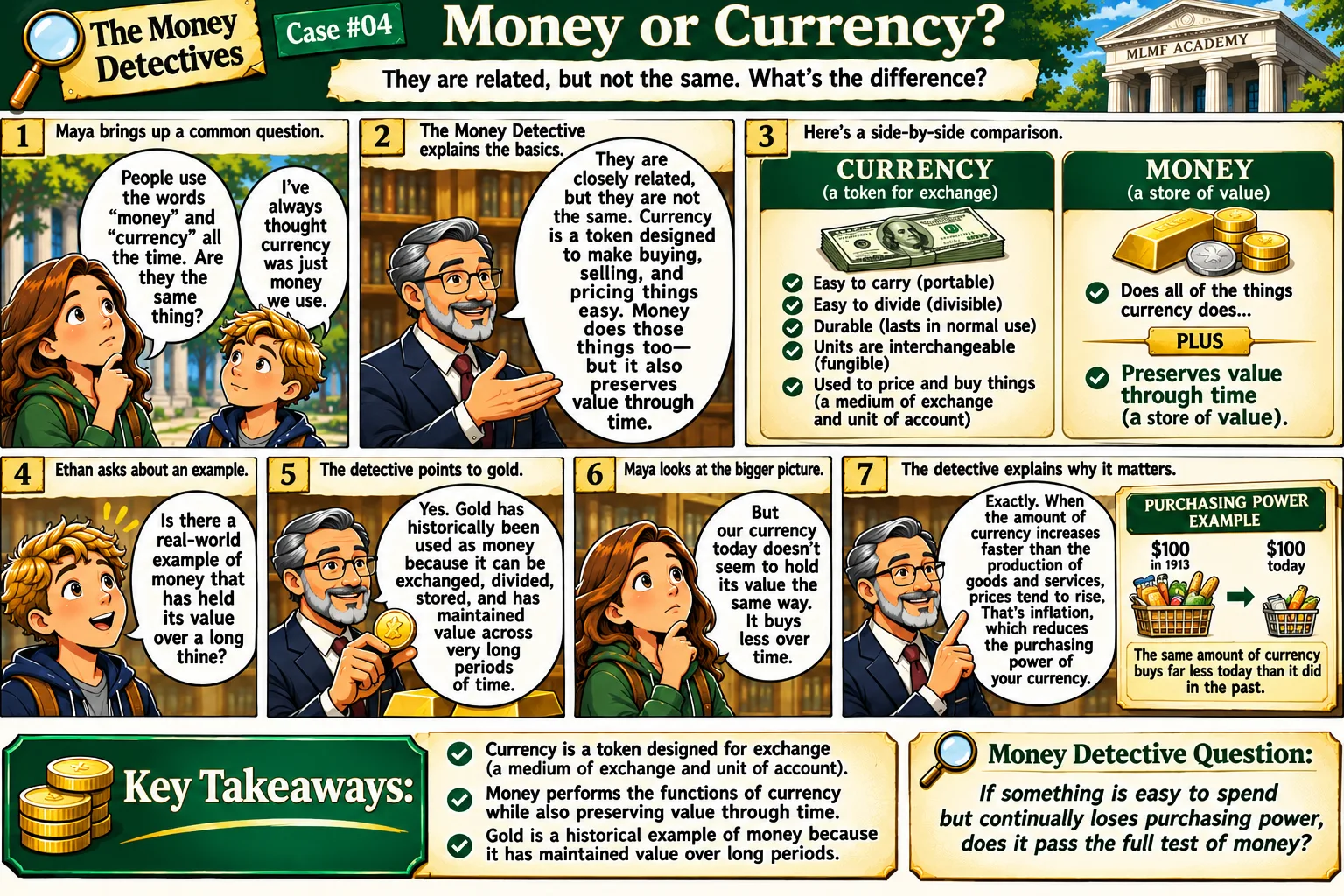
The Money Detectives #04 — Money or Currency?

The Money Detectives #04 — Money or Currency?

People often use the words money and currency as if they mean exactly the same thing. This comic introduces an important distinction.

Currency is designed to make buying, selling, and pricing things easy. It is portable, divisible, durable, fungible, and useful as a medium of exchange and unit of account.

Money performs those functions too—but it also serves as a store of value through time.

What This Comic Introduces

After reading, learners should understand that:

  • Currency is a token designed for exchange.

  • Currency helps us price and purchase goods and services.

  • Money performs the functions of currency while also preserving value over time.

  • Inflation can reduce the purchasing power of currency.

  • Gold has historically been used as money because it has maintained value across long periods.

Money Detective Question

If something is easy to spend but continually loses purchasing power, does it pass the full test of money?

Encourage learners to think about the difference between something that is convenient for exchange and something that preserves purchasing power over time.

For deeper study: Continue with MLMF’s full Money vs. Currency lesson.

MoneyMan ·Teaching Resources ·1 week ago
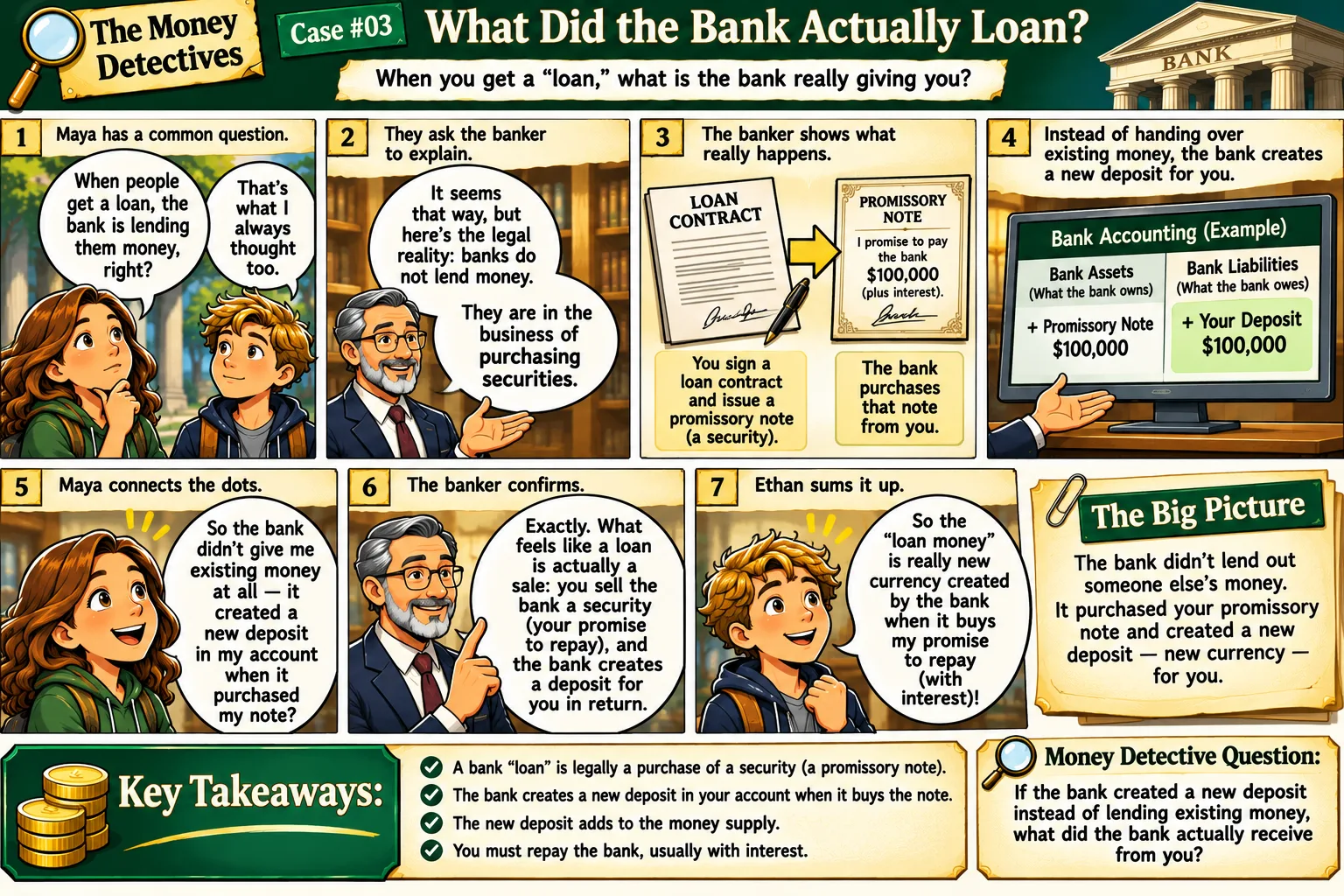
The Money Detectives #03 — What Did The Bank Actually Loan?

The Money Detectives #03 — What Did the Bank Actually Loan?

When someone gets a bank loan, it is easy to imagine that the bank is simply handing over money it already had.

This comic introduces a different way to understand the transaction.

When the borrower signs the loan agreement, the borrower issues a promissory note—a promise to repay. The bank accepts that note as an asset and creates a new deposit in the borrower’s account.

What This Comic Introduces

After reading, learners should understand that:

  • A bank loan is more than simply handing over existing money.

  • The borrower signs a promissory note promising repayment.

  • The bank records that note as an asset.

  • The bank creates a matching deposit in the borrower’s account.

  • The new deposit becomes newly created bank currency.

Economist Richard Werner describes this legal relationship as the bank purchasing a security from the borrower rather than lending out another customer’s deposited money.

Money Detective Question

If the bank created a new deposit for the borrower, what did the bank actually receive in exchange?

Encourage learners to answer in their own words before moving on to the full banking lesson.

For deeper study: Continue with MLMF’s lesson on how bank credit creation works and what happens on the bank’s balance sheet.

MoneyMan ·Teaching Resources ·1 week ago
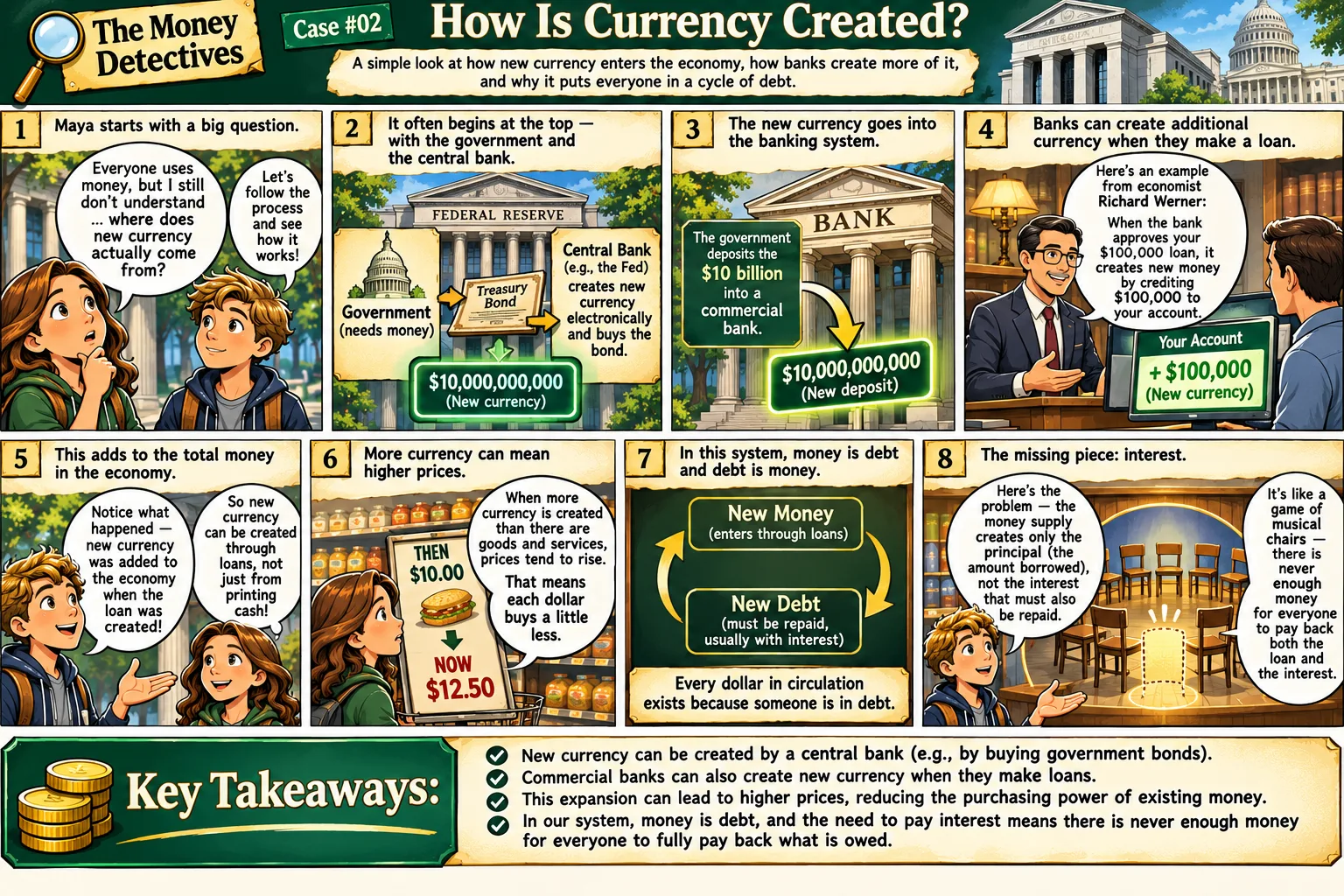
The Money Detectives #02 — How Is Currency Created?

The Money Detectives #02 — How Is Currency Created?

Where does new currency actually come from?

Most people imagine that banks can only lend money that already exists. This comic introduces a different part of the modern monetary system: new bank deposits can be created when a commercial bank makes a loan.

It also introduces how central banks can create new currency when purchasing assets such as government bonds.

What This Comic Introduces

After reading, learners should understand that:

  • Much of the currency used today exists electronically rather than as physical cash.

  • Central banks can create new currency through transactions such as purchasing government bonds.

  • Commercial banks can create new deposit currency when they make loans.

  • The newly created deposit is added to the borrower’s account rather than being transferred from another customer’s deposit.

  • Creating additional currency increases the amount of money circulating through the economy.

Economist Richard Werner has demonstrated this process by following the accounting of an actual bank loan: when a bank approves a loan, it can create a new deposit in the borrower’s account.

Money Detective Question

If the bank did not take the new loan money out of another customer’s account, where did the new deposit come from?

Encourage learners to explain the process in their own words before moving on to the full lesson on bank credit creation.

For deeper study: Continue with MLMF’s lesson on how commercial banks create currency when they make loans.

MoneyMan ·Teaching Resources ·1 week ago
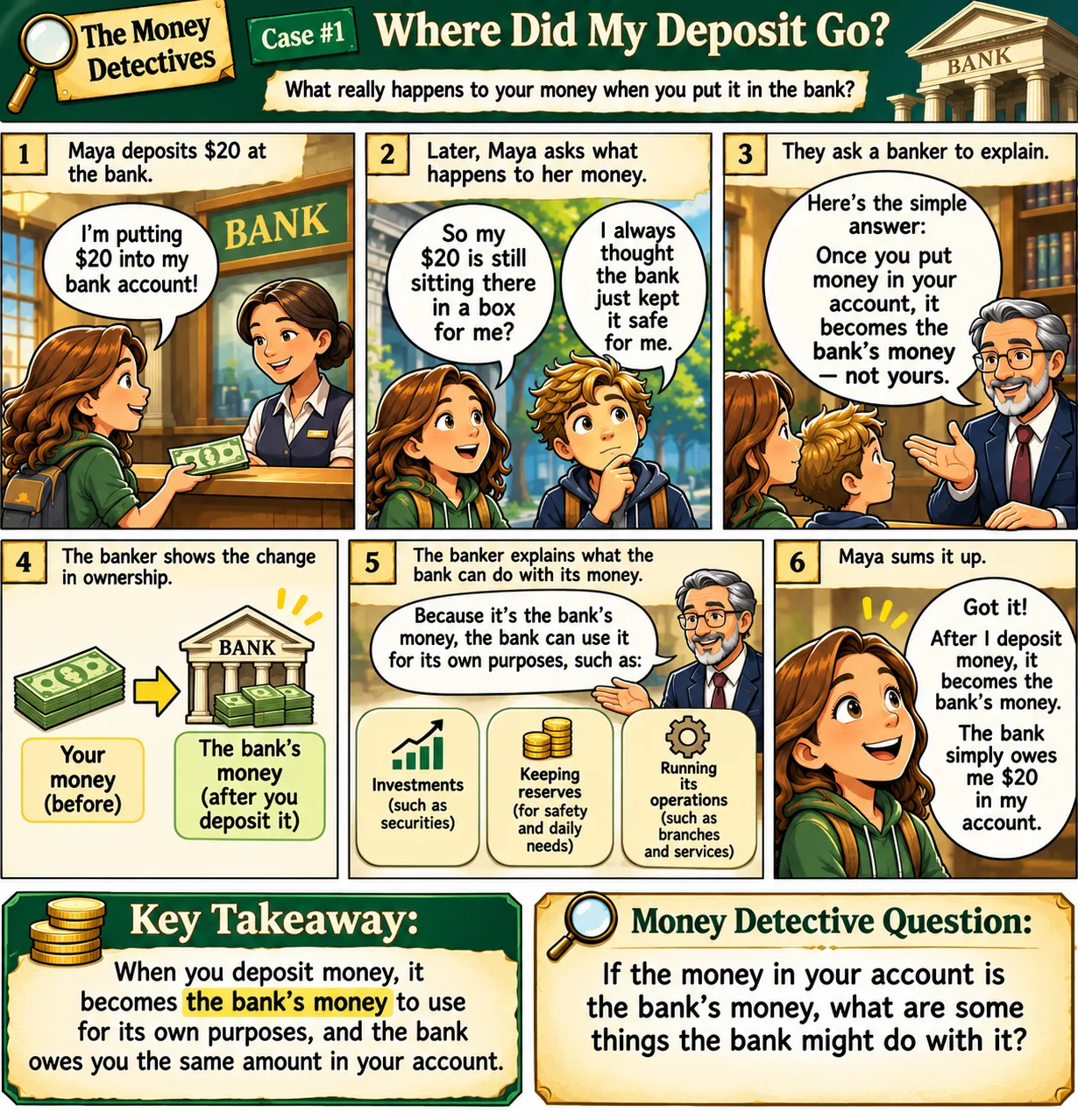
The Money Detectives #01 — Where Did My Deposit Go?

The Money Detectives #01 — Where Did My Deposit Go?

What actually happens when you put money into a bank account?

Many younger learners naturally imagine that the bank simply stores their money somewhere until they come back for it. This short comic introduces a different idea: when money is deposited into an ordinary bank account, it becomes the bank’s money, while the bank records an obligation to repay the depositor.

What This Comic Introduces

After reading, learners should understand that:

  • A bank deposit is not the same as placing money in a personal storage box.

  • The deposited money becomes the property of the bank.

  • The bank records a corresponding amount that it owes the depositor.

  • The depositor therefore holds a claim against the bank.

Money Detective Question

If the money you deposit becomes the bank’s money, what does the balance shown in your bank account represent?

Encourage learners to explain the answer in their own words before continuing to the related banking lessons.

For deeper study: Continue with MLMF’s lesson on why a bank deposit is legally a loan to the bank.

MoneyMan ·Teaching Resources ·1 week ago
Teaching Pack 06: What Do You Actually Own?
Teaching Pack 06

What Do You Actually Own? Understanding Counterparty Risk

Follow the rights, records, and obligations behind a coin, a bank balance, and a brokerage account. Discover who must perform, what protections apply, and how access or recovery can change under stress.

Ages 13–1815-Minute Core ActivityLessons, Books & Documentary
Connecting the Teaching Packs

Look Behind the Account Balance

Pack 02 introduced the deposit as a bank obligation. Pack 05 explored what a dollar amount can buy. Now examine the rights and dependencies behind what you hold.

This activity brings together the banking and securities lessons, the Counterparty Risk Map, and guided reading from David Rogers Webb and Murray Rothbard. It is designed for homeschooling, summer learning, classroom enrichment, and library groups.

01

Identify the Holding

Distinguish physical property, a bank deposit claim, and beneficial share ownership.

02

Trace the Dependence

Identify who keeps the records, owes performance, or controls access.

03

Test the Protection

Match the loss to the relevant protection and investigate its conditions.

Teach With the Cards and Follow the Sources

Use the core activity, then choose a reading or documentary extension.

01

Prepare the Activity

Level: Ages 13–18. The core uses simplified U.S. examples. The securities-law, book, and documentary extensions suit older learners. One adult and one learner can complete the activity.

Prepare: Allow 5–10 minutes. Share student pages 1–3 as reference cards and print pages 4–5 for each learner. Cutting the cards is optional. Use pencil and paper; a connected device is optional.

Read first: Review Banking Lesson 01: Your Bank Deposit Is Actually a Loan and parts 1–3 of Securities Lesson 01: Do You Really Own Your Stocks?. Use the Counterparty Risk Map to revisit the three holding types. The lesson provides the framework; the activity lets learners apply it.

Time: Fifteen minutes for the core. Add 5–10 minutes for assessment, 10 minutes for the shortfall model, or reading/viewing time followed by 15–20 minutes for source work. Do one extension at a time.

“

Ownership, Possession, and a Promise

Owning property, possessing it, and holding a financial claim are different relationships. A coin in your hand needs no bank to release it. A deposit is an amount the bank owes. Brokerage shares involve a beneficial interest held through a custody system.

Ask what you hold, who must act, and what protections apply if something fails. Legal rights can remain valid while access or recovery becomes difficult.

02

Identify, Trace, and Test

0–2 minutes: Read the explanation and predict whether an account balance tells the whole ownership story.

2–6 minutes: Compare the three asset cards and fill the table on student page 4.

6–10 minutes: Choose bank-failure Event 1 or missing-securities Event 2, then price Event 3. Consult the protection cards.

10–14 minutes: Discuss the three questions. Oral answers are fine.

14–15 minutes: Complete the exit sentence.

03

What Is the Legal and Practical Relationship?

Card A · A silver coin you hold

You legally own one genuine silver coin outright and keep it at home. It is fully paid for, not pledged as collateral, and no vault or fund holds it for you.

What is physically in your possession? Does anyone have to repay a debt or deliver the coin to you? Name a risk that still remains.

Card B · A $1,000 bank deposit

You have one ordinary savings account containing $1,000 at an FDIC-insured U.S. bank. You have no other deposits at that bank, no beneficiaries, and no unpaid interest to add.

What does the bank owe you? Are particular banknotes set aside as your property? Which protection card applies?

Card C · Ten shares through a broker

Your cash brokerage account credits you with 10 fully paid shares of a public company, held in street name. The broker is a SIPC member. There is no margin borrowing or securities-lending agreement.

Who records your beneficial interest? Who is named upstream on the issuer record? Which parts of the custody chain must work?

Use the table on student page 4. Identify the property or right, the institution or person whose performance matters, and a risk that remains. The examples are fictional; no real financial information is needed.

Online check: Open the Counterparty Risk Map and compare the Bank Deposit, Securities, and Gold & Silver sections. Record one correction or additional question.

04

What Failed, and What Did Not?

01
The bank fails

The bank in Card B is closed because it cannot meet its obligations. The $1,000 account and its eligibility are correctly documented. Identify the failed obligation and the applicable protection. Does the closure itself establish that the insured $1,000 is lost?

02
Shares are missing

The broker in Card C enters a SIPC liquidation. Records confirm the customer position, but some customer securities are missing. Identify the custody problem. What might restore property, and what extra facts would you need before estimating a final recovery?

03
The price falls

The company remains operating and all 10 shares remain correctly recorded, but their market price falls from $100 to $70 each. Calculate the new value and loss. Has the number of shares changed? Is this the same problem as Event 2?

04
The coin is stolen

The coin in Card A is stolen from its owner. No insurance or other recovery is assumed for this exercise. Name the risk. Did a bank, issuer, or broker fail to repay or deliver the holding? What responsibility came with direct possession?

05

Read the Scope of the Protection

1 · Bank deposits: coverage has a scope

Eligible deposits are insured up to $250,000 per depositor, per FDIC-insured bank, per ownership category. Deposits in the same category at the same bank are combined. FDIC insurance has U.S. government backing; it protects covered dollars, not their future purchasing power.

2 · Broker failure: return of customer property

In a SIPC liquidation, customer property is used to restore customer holdings. SIPC advances can help cover a shortfall, generally up to $500,000 per customer in a separate capacity, including up to $250,000 for cash. Eligibility and the kind of claim matter. Ordinary market losses are excluded.

3 · Shares: rights through a custody chain

The broker records you as beneficial owner. In a typical DTC arrangement, Cede & Co. is the registered holder on the issuer's records. A security entitlement includes rights against the intermediary and a property interest in the relevant pool. Asset-maintenance duties and general customer-priority protections apply, with important statutory exceptions.

Check the current FDIC explanation, SIPC guide, and SEC ownership definitions. UCC 8-503, 8-504, and 8-511 explain the property interest, duties, and priority framework. These are U.S. teaching examples; enacted law and account details matter in actual cases.

Three Questions to Work Through

Use the activity and the relevant lesson to support each answer.

01
How does possessing a coin differ from holding a bank’s promise to repay?

Name the property or right and the party whose performance matters.

02
How does a falling share price differ from missing customer securities?

Identify the loss before deciding whether a protection applies.

03
What would you ask before accepting “It is protected”?

Check the holding, triggering event, limits, and the institution or law behind the protection.

Student Exit Sentence
I hold … I depend on … to … A protection or remaining risk is …
06

Take the Questions Back to the Reading

Choose one route. Allow reading time, then 15–20 minutes for student page 6. Students record the edition and page, paraphrase the argument, apply it, and identify its scope.

Route A · Rothbard: Begin with What Has Government Done to Our Money?, Part I, section 12, Money Warehouses. Read the opening on printed pages 55–58 of the 2024 sixth edition, available through the Mises Institute. Compare the warehouse model with What Actually Happens in Banking Lesson 01.

Ask what a receipt for stored metal represents, what the custodian must do, and how that differs from an ordinary bank deposit. Keeping title to property does not eliminate dependence on someone else who stores it.

Route B · Webb: Begin with The Great Taking, chapter III, Security Entitlement, printed pages 9–15 in version 1.4. The author’s download page provides the edition. Connect it to parts 1–3 of Securities Lesson 01, then compare the general rule and exceptions in UCC 8-503, 8-504, and 8-511.

Ask which mechanism could affect recovery during a shortfall, which conditions must apply, and what further evidence supports a prediction about a widespread crisis. Distinguish the author’s argument from the text of a legal rule. Use the named section if pagination differs.

07

When the Records and the Assets Differ

Use the 300-share / 240-share illustration in the Counterparty Risk Map, then student page 7. Three customers each have a recorded entitlement to 100 shares. Only 240 shares are available.

For the classroom calculation, assume an equal proportional division, no competing claims, and no recoveries or protection payments yet. Find the total recorded amount, the available fraction, the allocation per person, and the shortfall per person.

Then ask: What information would be needed to estimate a final legal recovery? The imposed proportional split illustrates a shortage; it is not a forecast or a complete insolvency calculation.

08

Follow a Claim to Its Evidence

Use Stop It! The Great Taking after the securities lesson. The teacher should preview the film and select an excerpt about custody or legal priority. Allow viewing time separately, then around 15 minutes for the lower half of student page 7.

Record actual start and end timestamps. Paraphrase one claim, connect it to a lesson or book passage, and identify the primary source that supports it. Ask whether the evidence establishes a mechanism, its likelihood, or both.

If the site requests it, activate the video player yourself before using any available chapter controls.

09

Apply It to a New Situation

A. A vault stores a specifically identified silver bar you own outright. It temporarily stops deliveries. Do you have ownership, possession, or both? What risk is shown?

B. Explain why receiving the same dollar balance back may not restore the same purchasing power. Connect your answer to Pack 05.

10

Explain the Relationship and Its Conditions

Asset cards: A is directly possessed property under the stated assumptions. B is a bank repayment claim. C is beneficial share ownership recorded through an intermediary, with a security entitlement that includes legally recognized rights. In a typical DTC arrangement, Cede & Co. is the registered nominee upstream.

Event 1: The documented $1,000 eligible deposit is within FDIC coverage. Bank failure alone does not establish loss of the insured amount. Event 2: Missing securities require examination of customer property, claims, recoveries, and eligible SIPC advances; the final outcome is not specified.

Event 3: Ten shares fall from $1,000 to $700 in total value: a $300 or 30% market loss. All 10 shares remain recorded. Event 4: The loss is physical theft, not failed financial performance under the card’s assumptions.

Shortfall model: 300 shares recorded; 240 available; 80% availability; 80 shares per equal customer; 20 shares short per customer before further recovery. These figures do not determine the final legal payout.

Assessment: A: the customer owns the identified bar but lacks physical possession and depends on the vault for access. B: higher prices can reduce what a fully returned nominal amount buys.

Legal priority: The general protections and statutory exceptions belong in the same explanation. Shortfalls and priority disputes can impair recovery, but beneficial holders are not automatically behind every creditor. Neither registered ownership nor physical possession removes every kind of risk.

Private insurance extension: Policy terms and the insurer’s claims-paying ability matter. Insolvency may produce delays or incomplete recovery; applicable guaranty mechanisms can protect eligible claims within limits. See the NAIC explanation. FDIC and SIPC have distinct frameworks.

11

Download the Student and Teacher PDFs

Use the PDFs attached to this topic. Share the reference cards and give learners their own worksheets.

Student Cards & Worksheets · 7 Pages

Three asset cards; four event cards; protection cards; ownership worksheet; discussion and assessment; two book-reading routes; shortfall model and documentary response.

MLMF-Teaching-Pack-06-Student-Cards-and-Worksheets.pdf

Teacher Guide & Answers · 7 Pages

A 15-minute plan, read-aloud explanation, worked answers, reading guidance, source connections, and protection references.

MLMF-Teaching-Pack-06-Teacher-Guide-and-Answers.pdf

Core printing: Share pages 1–3; print student pages 4–5 per learner. Pages 6–7 are optional extensions. Keep the answer guide separate.

12

Keep the Learning Connected

Banking Lesson 01: Your Bank Deposit Is Actually a Loan

Securities Lesson 01: Do You Really Own Your Stocks?

Counterparty Risk Map

MLMF reading guide: The Great Taking

MLMF reading guide: What Has Government Done to Our Money?

Stop It! The Great Taking - documentary

For further work on incentives, revisit Banking Lesson 03: FDIC Increases Moral Hazard. Return to Teaching Resources for the complete collection. The teacher PDF includes the linked primary texts and current protection references. Prepared November 4, 2026.

1 reply 67 Read more →
MoneyMan ·Economic Roundtable ·2 weeks ago
Richard Werner Explains How Banking Really Works

Richard Werner Explains How Banking Really Works

Richard Werner Explains How Banking Really Works

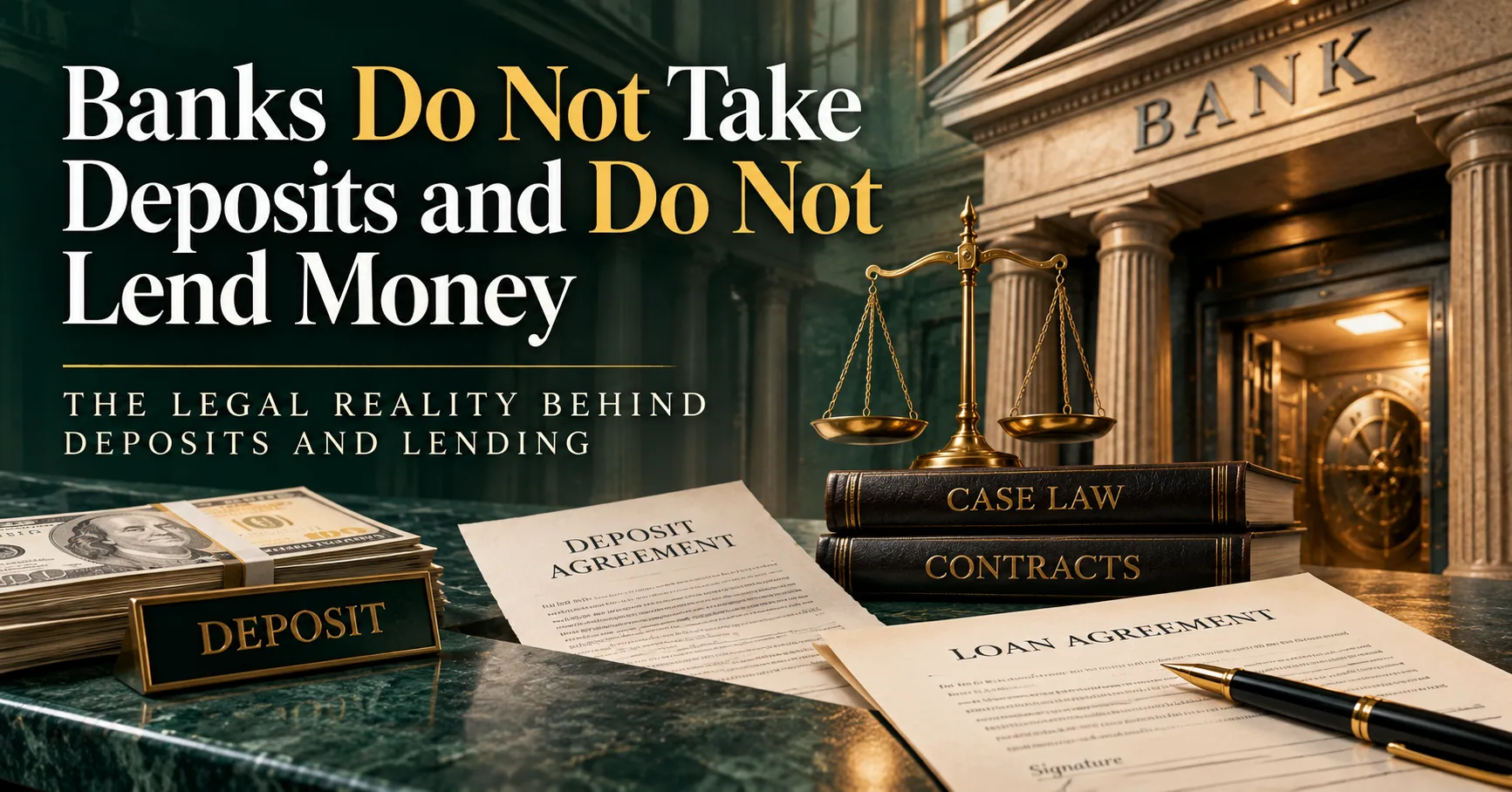
Banks are commonly thought of as deposit-taking institutions that lend money. The legal reality is different: banks do not take deposits, and banks do not lend money.What is a “deposit”? It is not actually a deposit. It is not a bailment, and it is not held in custody. At law, the word “deposit” is...

Read the full article →

MoneyMan ·Banking Fundamentals ·5 months ago
Whose Money is the Bank Lending?
MONETARY LITERACY & MASTERY FOUNDATION
LESSON 02 · BANKING FUNDAMENTALS

Whose Money Is the Bank Lending?

Having established that bank deposits are loans to the bank rather than money held in storage, we now examine how those deposits are created. Most people believe banks simply lend out money deposited by other customers. In reality, modern commercial banks create new deposit money when they extend credit. Understanding this process reveals one of the most fundamental mechanisms of the modern monetary system.

ACADEMY INTERMEDIATE 8 MINUTE READ
LESSON 02 BANKING
ACADEMY LESSON BANKING FUNDAMENTALS
LESSON SNAPSHOT

Whose Money Is the Bank Lending?

⏱
Reading Time

8 Minutes

02
Difficulty

Intermediate

✓
Prerequisite

✓ Lesson 1

2/3
Progress

Lesson 2 of 3

◆
LESSON OVERVIEW

Lesson Concepts Covered

01
Commercial Bank Lending

Commercial bank lending

02
Money Creation

Money creation

03
Deposit Creation

Deposit creation

04
Bank Reserves

Bank reserves

05
Banking Risk

Banking risk

?
BEFORE YOU BEGIN

If banks don't simply lend someone else's deposits, whose money are they lending when they approve your loan?

Try our Bank Credit Simulator

01
COMMON BELIEF

Part 1 • The Common Misconception

When you go out to take a loan from the bank, whose money are they lending? Are you getting money that they have sitting inside the vault?

Most people answer yes.

COMMON BELIEF
Banks lend the money deposited by other customers.
BIG IDEA Commercial banks generally do not lend existing deposits.

When a bank approves a loan, it simultaneously creates a brand-new bank deposit that did not previously exist.

02
CREDIT CREATION

Whose Money Is Being Lent?

QUESTION & ANSWER Q: I am a bank and I make loans. Whose money am I lending?
ANSWER Nobody's.

You are creating new money. Lending creates money out of nothing, and that money is deposited somewhere, creating deposits.

COMMERCIAL BANK CREDIT CREATION
What Happens When a Loan Is Approved?
LOAN APPROVED → LOAN CONTRACT → NEW DEPOSIT CREATED
EXPERT PERSPECTIVE · IRVING FISHER
"If two parties, instead of being a bank and an individual, were an individual and an individual, they could not inflate the circulating medium by a loan transaction, for the simple reason that the lender could not lend what he didn't have, as banks can do. Only commercial banks and trust companies can lend money that they manufacture by lending it."

— Irving Fisher

Fisher emphasized that commercial banks possess a unique legal ability unavailable to ordinary individuals: the ability to create new deposit money through lending.

▶
INTERACTIVE SIMULATOR

See Bank Credit Creation Yourself

If banks don't simply lend someone else's deposits, whose money are they lending when they approve your loan?

Launch the Bank Credit Simulator →
2.1
DEEPER INSIGHT

Deposits, Counterparty Risk & Banking Stability

Understanding that bank deposits are loans to the bank changes how we should think about the safety of our money.

Every financial contract depends upon the ability of the other party to fulfill its promise. Economists refer to this as counterparty risk.

When you hold a bank deposit, the bank is your counterparty. Your account balance represents the bank's promise to repay you on demand. As long as the bank remains financially sound, that promise is generally honored without question.

BIG IDEA Every bank deposit ultimately depends upon the financial strength of the institution that issued it.
EXPERT PERSPECTIVE
"Every financial contract depends on the strength of the counterparty. If the party guaranteeing payment weakens, the value of that guarantee weakens as well."

— Interview Guest

03
BANKING STABILITY

Why Counterparty Risk Matters

Under normal economic conditions, depositors rarely think about the financial health of their bank because withdrawals occur smoothly and confidence remains high.

Problems arise when confidence begins to disappear. If enough depositors question whether a bank can honor its obligations, many may attempt to withdraw their funds simultaneously.

This phenomenon is known as a bank run.

KEY INSIGHT Banking stability depends not only upon assets and reserves, but also upon public confidence.
WHEN CONFIDENCE BREAKS
The Mechanics of a Bank Run
DOUBT → WITHDRAWALS → LIQUIDITY PRESSURE → BANK RUN
04
DEPOSIT INSURANCE

Why Deposit Insurance Exists

Deposit insurance was created to reduce the likelihood of bank runs by reassuring depositors that their money would be protected even if an individual bank experienced financial difficulty.

Whether deposit insurance completely eliminates counterparty risk is a separate question. What it demonstrates is that governments recognize the importance of maintaining confidence in the banking system.

THE CHAIN OF CONFIDENCE
Confidence Helps Support Banking Stability
DEPOSITOR → BANK'S PROMISE → CONFIDENCE → STABLE BANKING SYSTEM
05
REVIEW

Key Takeaways

01
Bank Deposit

A bank deposit is a promise made by a financial institution.

02
Counterparty Risk

Every promise carries counterparty risk.

03
Confidence

Confidence plays a critical role in maintaining banking stability.

04
Deposit Insurance

Deposit insurance was introduced to reduce panic and help prevent bank runs.

05
Modern Banking

Understanding counterparty risk is essential to understanding modern banking.

❦
LESSON TAKEAWAY

Banks Create Deposits Through Lending

Commercial banks generally do not lend existing deposits. When a bank approves a loan, it simultaneously creates a brand-new bank deposit that did not previously exist.

LOOKING AHEAD

What Happens When Depositors Stop Bearing the Risk?

Deposit insurance was created to reduce panic and help prevent bank runs. But protecting depositors from losses introduces another important question: can protection against risk change the behavior of the institutions taking that risk?

NEXT
BANKING FUNDAMENTALS · LESSON 03 FDIC Increases Moral Hazard
→
END OF LESSON · COMMUNITY DISCUSSION

Continue the Conversation

Have a question or another perspective? Explore the contributions below and share what you have learned.

14 replies 1K Read more →
MoneyMan ·Financial News & Discussion ·2 weeks ago
The King Dollar Myth: The Numbers Tell a Very Different Story.

The King Dollar Myth: The Numbers Tell a Very Different Story

Maneco64 — October 27, 2026

Tuesday, October 27th, 2026. Maneco64, home of alternative economics and contrarian views.

Well, today we're going to look at King Dollar. Is it a reality or a myth?

And I'm going to recommend a really good video, which I'll put here right now, that Francis Hunt made recently, three days ago, where he dissects an interview that Jim Rickards did with a Bitcoin channel.

I think you'll love it. I love this video that Francis Hunt made, and he really rips apart Jim Rickards' view that the dollar is king, that the Treasury market is the place to be, that there's no bond market in China, that they're backward.

And my purpose today, though, is not to rip apart Jim Rickards, even though I'd like to, but it's to look at the numbers, look at the charts, and let you decide whether King Dollar is a reality or a myth.

And of course, by King Dollar, I don't mean the $20 dollars in gold in a $20 gold piece, or the $1 in silver.

I mean these trashy bank notes that are issued on behalf of the Federal Reserve by the Bureau of Engraving, these Federal Reserve notes. That's what I mean.

And it's what actually the late and former Fed Governor John Exter called "I owe you nothings."

And he actually pointed out that it's not just the dollar, the King Dollar since 1971, that are "I owe you nothings," but all fiat currencies.

Anyway, I actually like to thank one of you guys, one of the viewers that sent me these ten $2 Federal Reserve notes. They're crispy and new. Unfortunately, they're not worth as much as this $20.


Before we look at some charts about the dollar versus other currencies, before we actually look at China as well and whether they have a government bond market, I want to look at the dollar index because it's an indicator that people like Jim Rickards, people like Brent Johnson—yes, I said his name—even people like George Gammon, I think the dollar milkshake guys, they always point to the dollar index.

And I've spoken about this many times in the past years.

And I think what we need to do, though, is go back to 1973, and that's when the dollar index was invented or created.

And the reason for that was that the era of fixed exchange rates that we had up until August 15th, 1971—and actually they tried to keep the fixed exchange rates after Nixon closed the gold window, but it didn't work because there's no discipline anymore.

It was everyone for himself.

Each country started printing, and it was the race to the bottom.

And that's why a lot of these fiat currencies, the dollar included, and we're going to look at that, haven't done really well versus gold since 1971.

But what I want to do here is compare the King Dollar, this "I owe you nothing" dollar, to the other "I owe you nothing" currencies.

So, the dollar index basically is a basket of the major European currencies, the Canadian dollar, and the Japanese yen.

And I've added up the euro, which is basically a recent creation. And the euro, of course, as per the dollar index, was made up of the major legacy currencies in Europe, like the Deutsche Mark, French Franc, Dutch Guilder, Italian Lira, and so on.

But yeah, the euro, the Japanese yen, the pound sterling, and the Canadian dollars—and that's by order of how important their weightings are—make up 92.2% of the dollar index.

And back in 1971, of course, the Chinese economy and other economies in the Global South were nowhere to be seen in terms of GDP or trade.

But yet the dollar index doesn't include them.

The GDP of China now is greater than the GDP of the Eurozone, and it's not even in the dollar index.

And if you look at the Chinese yuan versus the dollar, the dollar has dropped quite a bit in the last two years versus the Chinese yuan.

But yeah, so is the dollar really king? Is the dollar index really king?

Because the dollar index was started at 100 back in March of '73. And right now, I think we're just above 101.

So that's 1% in 53 and a half years.

Gold at the time, of course, one ounce of gold used to buy around $85 to $90. Now, as I speak here, we can buy about $4,004.

But what I wanted to show you, even within the dollar index, if we look, for example—and you can do this by going to fxtop.com, and I'm going to put a link to that in the description. This is where you can get these charts.

If you look at, let's say, the dollar versus the Deutschmark, and you can still calculate the Deutschmark because its exchange rate versus the euro was fixed back in, I think, 1999.

So, since August 15th, 1971—and I picked that date because it was a really important date. It was the date where the United States and the world's monetary system crossed the Rubicon, and there's been no way back from August 15th, 1971.

Well, the dollar's down 48% versus the Deutschmark.

So much for King Dollar.

Versus the Swiss franc, it's even worse. The dollar's down 80%.

Versus gold, the dollar is down 99%.

And I would add, and you can do this yourself, I'm not going to do it here. If you do this for all the other currencies versus gold, you'll get more than 90% loss as well.

So, this shows you, in my opinion, that the real king is gold, but let's continue.

Versus the yen, even versus the yen, which is supposed to be collapsing right now, the dollar's down 56% since convertibility was stopped of the dollar into gold.

And the reason I'm doing this is not to bash King Dollar or bash Americans.

This is to warn you in the United States and around the world, because a lot of people still use King Dollar, that it's very dangerous to keep a lot of fiat dollars because they're going to continue to lose value versus real money, i.e. gold.

And it wasn't me who said that gold was money. It was J.P. Morgan when asked what gold was.

He said, "Well, gold is money, everything else is credit."

Why do these people keep pushing this agenda?

And I mean, I've had Jim Rickards on this channel six years ago. I interviewed him. I've read some of his books. He's even got a case for gold.

So, I asked Jim Rickards, "How can you be for gold and at the same time believe that the dollar is king?"

It's impossible because the higher the gold price goes versus the dollar, the less of a king the dollar is.

There's also Currency Wars. So, yeah, I actually recommend these books.

But I think the only thing I can say—people like Jim Rickards and the dollar milkshake people and people who push this agenda that the dollar is king, that Treasuries are the best safe haven, and at the same time they pay lip service to gold.

I think these people have an agenda.

They're trying to protect Wall Street and the fiat dollar. They're trying to protect the deep state.

We know that Jim Rickards admits that he works with the CIA. I don't know about Brent Johnson and other guys.

So, that's why I'm warning you, not because I want to bash Jim Rickards or Brent Johnson. It's because I don't want you to buy into this narrative.


And the other thing I wanted to talk to you about—and I had Luke Gromen on, who's really objective about the dollar, and he's an American. He hasn't bought into the milkshake theory.

I'm going to put a link to an interview I did with him recently. I highly recommend it.

And one thing he mentioned to me that I hadn't really looked closely at is the United States' net international investment position, or NIIP.

And what he told me is that the U.S.'s net international investment position was around negative $23 trillion.

And I've looked through here on ChatGPT, and this is what it says here.

If you don't understand what this means, the United States has by far the world's largest negative net international investment position, meaning that foreign investors own substantially more American assets than Americans own foreign assets.

The NIIP measures the difference between U.S. assets abroad—foreign stocks, bonds, businesses, real estate, and other investments owned by American residents—versus foreign-owned assets in the U.S.: American stocks, Treasury bonds, corporate debt, businesses, and other assets owned by foreign residents.

So yes, United States citizens, or Americans, own just under $47 trillion of foreign assets, $46.97 trillion, but foreigners own $69.39 trillion of U.S. assets.

The net international investment position of the U.S. is minus $22.42 trillion.

And the reason I'm talking about this is that a lot of people like Jim Rickards, Brent Johnson, and others in the dollar milkshake world say that foreigners will rush to buy dollars because they owe a lot in dollars and they don't have any dollars.

But according to this, foreigners are net long $22.42 trillion.

So keep that in mind.

Hopefully this will help you decide whether you think King Dollar is a reality or a myth.

I'm leaving it up to you. I'm giving you the numbers.


The other thing I wanted to talk about is China.

And again, not trying to bash the U.S. or King Dollar, even though I don't think it's king.

I'm not trying to cheerlead for China. I'm just trying to paint the reality for you so you can make sure that you protect your savings and your wealth.

Well, Jim Rickards comes out and says, "Well, there's no government bond in China. The yuan or renminbi will never be a reserve currency. It's going to take decades. There's no government bond market in China. There's no repo market. There's no rule of law."

Even though in '08 none of the bankers on Wall Street went to jail.

I see that in China, when people in the financial sector or any other sector commit massive frauds, they don't only get jail; sometimes they get capital punishment.

So I'm not too sure what Jim Rickards meant by the rule of law.

And I checked on ChatGPT, and you can check it yourself. And ChatGPT has the sources. You can click on the sources.

I asked ChatGPT, is there a functioning government bond market in China with a repo market?

And this is the answer I got.

Yes, China has a fully functioning government bond market and a large, sophisticated repo, or repurchase agreement, market.

In fact, China's repo market is central to how the People's Bank of China, or PBOC, manages liquidity in its banking system.

It says here, as well, China has one of the world's largest bond markets, second only to the United States.

Its principal government-related debt instruments include:

Number one, Chinese government bonds, CGB, sovereign debt issued by China's Ministry of Finance, comparable to U.S. Treasuries.

And I checked that also. I think they have about $6.5 trillion equivalent outstanding.

And they've got local government bonds issued by provincial and municipal governments.

So, they even have a muni market, how the Americans call their municipal bond markets.

And they've got policy bank bonds issued by institutions such as the China Development Bank, Agricultural Development Bank of China, and Export-Import Bank of China.

These are not sovereign bonds, but are important high-quality collateral in China's financial system.

China has an established sovereign yield curve, including 2-, 5-, 10-, 30-year government bonds and even longer maturities.

And Jim Rickards said that the rising yields and dropping prices of Treasuries is a sign that people need dollars and that Treasuries are still a safe haven.

Even though, as Francis noted, the 30-year bond price has gone down like 50% in the last four or five years.

And actually, Chinese 10-year government bond yields and 30-year government bond yields are going down, which means their prices are going up.


There's a lot going on politically, geopolitically.

We've got the midterms in about a week. Well, in exactly a week.

We've got elections in Israel today. I don't think that really is going to change much in terms of the war against Iran.

And yeah, we've seen oil up and down. Brent is still—spot Brent is still around $111.

Gold is right around $4,000. It's just above $4,000 right now.

Silver, yes, it's getting bashed around, unfortunately.

It's still above $50. It's at $52.82 right now, down over 100 cents, down 2%.

I don't know why. I guess there's a lot of paper out there.

And with that, I'm going to wish you all a very good day.

Take care. Bye.

MoneyMan ·Financial News & Discussion ·2 weeks ago
Gold & Silver: Angry, Mad, and Scared! You Sell As Wall Street & Central Banks Buy

Host — Bald Guy Money

Hello everyone, welcome to Bald Guy Money and we start this one off talking about fear as higher oil prices and a potential restart of the war with Iran dominates the minds of investors across all sectors pushing sentiment as you can see here into the extreme fear zone according to the fear and greed index. Now, due to these latest developments that basically dictated what the market did this past week, we have completely obliterated all of the positive signals we were seeing develop in the price of gold with a new weekly closing low for 2026 below $4,000 an ounce this past week.

And although we still haven't taken out the July low on an intraday basis, I want you all to pay close attention to these weekly candles on the screen right now. And notice that we didn't see the same end of week buying that we saw during the summer around these price levels as indicated by the tails or the wicks at the bottom of the candles. And that is bad news that supports the possibility of some more selling earlier in the week for gold that I want you all to be aware of.

With silver, as I said in last week's video when I showed you all the gold to silver ratio data, possibly headed back to $50 an ounce, maybe even as low as $48. I don't want to sugarcoat it as we broke the July lows this past week, closing just above $53 an ounce. Now, some of you watching may be wondering what happened to the worst case scenario of a double bottom for metals, specifically for gold, since I warned you all about silver moving lower last week. That I've been talking about in recent videos. And it's a valid question because I think we're still going to see it play out.

And although it seems, at least for now, that we're not going to make a higher low like we did between 1999 and 2001, which is the scenario I favored, we may be in the process of making a lower low type of double bottom, also known as a liquidity hunt, as Wall Street players inflict maximum pain and maximum fear on retail investors while quietly loading up in the background with ETF inflows, espec especially in North America, which is the dark blue color you see on the chart here, remaining relatively positive going all the way back to mid July.

So, don't get fooled or scared out here because the big secret behind a liquidity hunt is this.

Although they only happen about 40 to 45% of the time, they are the most explosive double bottoms, usually undercutting the previous low by about 3%, which means gold may still come back as far as $3,824 per ounce before making a more explosive move to the upside, similar to what the S&P 500 did, admittedly on a longer time frame, but one that led to a 17-year bull market for stocks with this week's Federal Reserve decision and speech by Kevin Walsh, which he gives right after the decision is made, potentially being the catalyst for a final flush out in gold and silver,

even though the market gives a 90% chance of the Fed holding rates in this meeting, which I will of course cover in a midweek video. with the real expectations of a recovery from my side. And I've shared this on X as well as in my recent roadmap updates starting no sooner than after the US midterm elections with the war topic also weighing heavily on the market as we saw this past week. So since the market is so completely shaken and uncertain in this video, I want to speak directly to two groups of people.

Number one, people who are afraid, maybe even mad, and want to give up on metals right now, I want to show you why you would essentially be selling the bottom here. And number two, I want to speak to people who are patiently holding metals but may not fully understand why the setup is so bullish for both gold and silver right now, despite the weakness in price.

And to do that, I sat down with my friend, author, investor, and speculator Don Durant to discuss why this time is no different to any other time in the past, what the setup you should be watching is, and why smart money is literally lining up to buy gold right now. I have kept in only the most important parts of our conversation because I understand time is valuable, time is money, but I encourage you all to watch to the end because this is an important video. Now, before we get started, please remember that you don't have to be allin on metals, but there is such thing as not enough.

And if you're a buyer, Summit Metals has great prices and great service with gold and silver selling at very affordable prices right now. And please also check them out on whatnot. They do auctions there. They're meant to be fun and yes, as I've said in the past, sometimes prices get bid up, especially on collector coins. But there are deals to be had, sometimes even below spot. And when you sign up with the Summit Metals link, new accounts get $15 to put towards their first purchase, meaning your chances of getting a deal are even higher.

So, use the QR code on the screen or link in the video description to take advantage of that. It is worth checking out. So, I want to thank Don Durret for joining me in this video. And instead of doing a long drawn out intro, I just want to jump right into it with you, Don. Now, we just made new lows for gold and silver in 2026. Oil seems unstoppable right now. Consumer sentiment is hovering around 10-year lows, and sentiment for the precious metals is lower than really I ever remember it.

Now, I shared my point of view on this in the video intro, but I want to ask you right off the bat, are you at all concerned about what's happening with gold and silver right now? And what do you think of some of the lower price targets for gold and silver that are circulating online right now?

Don Durrett

Um, I guess I'll start with the targets. So, there's basically a gap. Um, if you look at the charts, there's kind of a gap between 3500 and 3950 there because basically we went kind of went straight up on the breakout. So, there's basically very little support below 3950. Um, and so everybody seems to think we're going to go down to 3500 and which is a possibility, but that would be a little bit over a 10% drop from here, which would be pretty brutal considering how how far we've fallen. And you know, gold's down 29%. You go down another 10% or more. So 10% takes you to 3600.

So they're talking about like a 12% drop from here. Now there's a ton of support at 3,400 to 3500. So that's kind of a worst case scenario, I think. But I don't think we're going there. Um, and here and let me and let I I think I'm going to pull up a chart. Before I do that, I want to talk about I think it's more likely that we only fall 5%. So 5% is about 3,800 and if you drop 5% basically the the worst of it is over. We're at 675 on the HUI. The low is 580 in June. So we're not even close to the low there.

Although gold and silver are at their lows, which is really interesting. The miners have not. So, a lot of people the minor are usually a tell that we're close to we're close to bouncing here. People don't want to give up their miners. Um, so if you lose 5% that takes it from 675 down to 643, which is really kind of a nothing burger drop from here. So, I'm not really worried too much as long as that 30 3,800 holds. I think that's important. Let me share my screen.

I'm going to show you one of the reasons why I'm very confident that we are we're we're basically um at the bottom um or very very close. So this is the gold chart monthly and this big red uh candle here. This is this is the the the March uh candle, but we fell down. We closed June at $4,000, which is exactly where we're at right here. And if you look at those five candles, we've been basing at $4,000 for five months. This is actually quite healthy correction, if you will, as long as it doesn't break down.

And you can see uh this is the monthly I but there's basically this is this kind of this big candle which c which created that gap. Um and so this breakout in September was so massive, such a big candle, there's basically nothing no support here. Um, and so I don't I think my hunch is that we're only going to go down this area here, 3,800, which will be fine. Now, this month uh that we're in right now in October, we're at 4,000. We have one week to go. I'm hoping that next week we can stay here at this 4,000 level. That'd be very healthy.

Um, and then the next month if we get a green candle, um, I think we're we're off to the races situation here. Uh, I think leg two could begin. That's what I'm I'm hoping for. So, I since I have this this chart up here, I I want to I'll go I'm going to go ahead and tell you my expectations of what's going to unfold.

I I think that and we talked a little bit about the macro and the stock market, but I think that this basing that's been occurring here um and this whole correction, if you will, in the in the in the in gold has been occurring during a period when the stock market has been very strong. And so I think that the stock market, we're starting to see weakness there. And so I think that the stock market which is currently at 7,600 the 200 day moving average is 7300 and as you know and as you're the people that are watching this know 200 day moving averages are very important levels.

You don't want to go below those levels. That's a technical wash out. You go you can get a significant bare market. You go below 20%. Uh we haven't had a 5% correction in in the stock market since March. 5%. And we're we're only a little bit above the 200 moving average, which is 7,300 on the S&P. So, I think we're going to go down there and test that 7,300 level. Um, and if we do, and the reasons why, we'll talk about it about all all the factors of why I think that's going to happen.

And if that happens, I think gold I think the fear trade in gold is going to finally trigger. I've been waiting for this fear trade in gold. The fear trade in gold is when people buy gold because they don't want to buy anything else. They don't want to buy bonds, they don't want to buy stocks, and they're not especially happy to put their money in cash with interest with inflation up. Um, and so gold is the go-to asset. That's never happened before, ever in history. Gold has been the go-to asset. And so this is a this is a unique situation.

Um, and so I think that that fear trade is coming. And the fear trade in my opinion will push if we do get this, you know, 4,000 close here in October. I think November is going to be a positive month for gold. So I think we're going to close November above 4200. This is the key thing. This is the key to it all. I'm calling it leg two. So leg one is kind of on the screen here. When you look at August, these these big green candles, you know, this August breakout, these this was leg one. This is the big leg one up.

Um leg two is going to be similar to this. Um and I and I think that that if you we close November above 4,200, I think December is going to be the leg two breakout. And I think we could close December close to 4500. And if that happens, we go into the new year. I think January this we could get another big green candle and I think we could close January close to 5,000. If that happens, you're in a upward momentum situation um leg two and then you're going I think you're going all the way to 6,000 by June. That's my take that's my call. But the key is November.

You got to close November strong. If if we're still under 4,000 at the end of November, we're gonna have a prolonged correction and we're we're we're it's going to be very nasty. Somebody was calling this correction we're in right now the big nasty. But trust me, the big nasty is it hasn't happened yet. The big nasty is if you stay below 4,000 for like three or four months because if that happens, that's your wash out. That's when you're going down to 3500 and you know you're stuck down there and everybody's selling their minor. Nasty, nasty, nasty.

But if you close this month at 4,000 next week and then you close November 4,200, everything's fine. So that's where we're at.

Host — Bald Guy Money

So you're striking a pretty optimistic tone, but there are a lot of bears out there saying that January of this year was the 2011 style top. Now, I don't personally see how a top in metals is made with the stock market at all-time highs. And we can go back to 1980. Metals made their top in 1980 with the S&P 500 still below the 1973 highs. In 2011, Metals topped with the S&P 500 below its 2000 and 2007 highs. Don, I'd like to ask you with respect to your optimism, what specifically are you looking at that tell you the really big bears out there on the metals are wrong?

Don Durrett

Yeah. Uh, a lot of times people get caught up in the narratives um, and they basically miss the forest for the trees. And and what I mean by the narratives is basically Wall Street ba basically if you watch television kind of mainstream media you get this feeling that everything is fine. We got high we got strong earnings. We got the best economy in the world. America's the leader. There's nothing to worry about here. We've been in a 17 years. We haven't had a we haven't had a recession for 17 years. So everybody has this kind of this mindset this normal uh mindset that everything's fine.

nothing to worry about and and nobody and it's hard for people to basically jump out of that box and see and look at reality of what's really happening, right? And can and kind of connect the dots. And it's kind of that 8020 rule where only about 20% of the people can really have vision and can really connect the dots. Well, not everybody can do it. and and so when you can't do it, you you just you you you basically start following kind of the narratives. You get stuck in that box. Now, you mentioned a couple of really important factors, but we we'll dig into this a little bit.

Everything I just said, I I'll I'll basically put some meat on the bone here. So, if you go back to 1980, right? Um when when gold when gold basically hit its top when gold was rallying from 1972 to 1980 the stock the the economy was was stinking. We had two recessions. The stock market was doing nothing. Stock market was actually you know bottoming in 1980 and then we went on a 20-year tear. It's the complete opposite of what's happening today. This one we had the stock market's been on a 17-year run and now gold's going up. Complete opposite. Same thing happened in 2011.

From 2000 from 2000 to 2011, the stock market was was stunk. We basically had two recessions in that period. 2001 2007 and the stock market was taking off in 2011. The opposite the exact opposite of what's happening today. in in 2007 and the last recession in 2007 nobody wanted in 2008 excuse me 2008 when we when it hit when basically that was really the last recession it ended and let's call it Q2 2009 um nobody wanted to own gold then nobody the central banks were sellers of gold sellers they nobody nobody was buying gold in 2008 nobody um today.

Um they basically did a poll recently about family, you know, family offices and 70% had no gold and the other 30% that did have gold had averaging under 1%. That's today. Back then it was worse, right? So here we have a a stock market going, you know, ready to go down, which is basically what happened in 2000. That's when gold went up, right? And so, and you 1972 again, gold is down. Gold is getting ready to go up. It's gold is set up here to go higher, not to go lower. The only thing gold's nemesis, gold's kryptonite is a strong economy. You only buy gold when you need gold.

So, right now, the argument against gold is that the economy is going to get stronger, right? [laughter] If we are seven, we're in a 17-year run, the economy going to get stronger and people are go, I don't need no stinking gold. That's not the trend at all. I mean, open your eyes. It's not the trend at all. The trend is kind of what the hell's going on. Look at fiscal dominance in the US. The reason why gold's at $4,000, the reason why gold went to $5,000 is because the US has a debt problem. And central banks are going, "Okay, I'm sitting on all these treasuries.

I'm sitting on all these US dollars." And US the US is getting ready. The US is they have a debt problem. I need to defend. I need to little have a little hedge against that. So the hedge is to sell some of that debt and buy some gold. Everybody knows we have a debt problem. Everybody. But everybody but Wall Street, their job is to sell stocks and bonds. So the narrative out of Wall Street is everything's fine. They don't when you if you turn on the TV they they basically pick the data points that make everything look rosy. They ignore the consumer confidence numbers, right?

Which are basically we're almost the worst of all times. They ignore the housing numbers which are, you know, basically the housing market is kind of stuck. If you're a real estate agent, you're not happy right now. High interest rates, the cost of living problem, all these serious serious problems. But the one problem they ignore the most and ironically the Fed ignores it. We're going to talk a little bit about the Fed. Iron the irony of ironies is that the bond market is the heart of the economy. Literally, it's the it's the beating not the stock market, the bond market. The bond market is much more important.

When when the Treasury needs money, they don't go to the stock market. The Treasury ignores the stock market. The Treasury goes to the bond market. The bond market is the heart and soul of the whole thing. If the US government couldn't borrow $2 trillion a year, our whole our economy comes to a standstill. So the the bond market has to be healthy. Well, we've we've reached a point now. We we've ignored it. People that like me who've seen it coming for years and years and years, we basically see this fiscal dominant situation. It's an inevitability. I call it a doom loop.

And basically what happens is is that the debt gets so big that you can't do anything about it. The right fiscal dominance is when the US government is forced literally forced to borrow money to stimulate the economy because if they don't if they if they basically cut spending the economy goes down. So they're they're in a dominant situation where they have no choice but to spend money. This is the reason why we had the big beautiful bill and nobody pushed back because you if you start cutting you're just gonna basically destroy the economy and you you that's the situation we're in right now and that's the doom loop.

The doom loop is you don't have a choice. What whatever whatever you decide is not going to work. If you fight inflation by by basically cutting stimulus you destroy everything. And if you stimulate and print to keep everything going, which what we've been doing for 30 years, you just get the you just make it a worse problem. So that's the kick in the can that we've been doing. But guess what? We're in an end run now. Now it's over. This is the reason why I'm so bullish because it's over. I raised my my targets in July when basically interest rates started heading higher.

So we had in July we had rates at 4.8. The 30-year was at 4.8 in July. It ripped from 5.7 and then the 10-year went from 44 to 53. So rates just took off. And simultaneous to that, Japan had a had a problem and the U and the Treasury started manipulating the bond market. And I basically said that's it. Game over. We it started. There's no there's there's no way out out from this. And now we've seen it. France their 30-year was at zero in 21. In 21 it was at zero. Today it's at five. Um, so the bond markets are burnt on fire. They're not going away.

Um, our US economy, if if you pay attention, if you will, you need to look at look at look at everything from a holistic standpoint and from a historical standpoint. And from a holistic standpoint, you don't want to use aggregate gate data. This is what Wall Street confuses you. Wall Street says, "Let's just look at GDP, you know, and unemployment numbers in the aggregate, and we'll we'll pretend that if the aggregate is good, we're good." But if you look underneath the covers, 60% we're at all almost near all-time highs at at um on the stock market and 60% of the stocks are in correction right now.

How in the hell does that happen?

Host — Bald Guy Money

No, I I [clears throat] think you're absolutely right. I mean, even look at staples of the stock market like McDonald's, right? This is clearly telling a a completely different story than what we're hearing when, for example, Kevin Walsh takes the podium when he gives his monthly Fed speeches. Now, you mentioned your path forward for gold and kind of this TINA idea, there is no alternative, and I think we got a really great taste of that in 2025. I talked about it in my last video where when the tariffs were announced, we saw the S&P 500 dump significantly from top to bottom. It was actually 21%.

Gold languished a little bit for the first week, week and a half, two weeks and then really bucked the trend and started moving up. But on the other hand, silver, it took it a little bit longer to start reacting to that. So knowing kind of what your path forward with respect to gold is uh 4,200 in November, 4500 if I remember what you said correctly in December and then moving up in 2027 potentially as high as 6,000 by the summer of next year. I'd like to ask you what does that path look like for silver for all of those watching this video who are very interested in that topic.

Now, just before we get to the path for silver, and Don will also talk a bit more about gold. Before he gets to that, I want to remind you all that channel partner Land of Land is offering a $300 discount on any purchase of land to all of my viewers when they use the discount code bald guy. I've said it many times now, but I recently purchased some land myself for prepping purposes. And I've been collecting walnuts on that property, as I've been showing you for the last month or so. And I want to use this fact to remind you all that land is a valuable asset to own.

Not only for preppers like me in times of supply chain uncertainty, but also in times of inflation, both of which we are experiencing right now. So check them out at landofland.com. They have properties all across America with some starting right around $1,000. You can now buy directly at their marketplace or search for deals at their auctions page. And remember to use code bald guy for $300 off of your purchase.

Don Durrett

Yeah, I'm I'm going to share my screen. I want I just want to show you one more. I want to go back to this chart one more time. I I want you to know that when this when this took off at $2,000 24, this green candle, this was kind of the breakout. The stock market was going up here and the dollar was strong here. So, gold was a was correlated to the stock market.

this when the when the when it broke when the correlation stopped that's when I'm going to stop here stop my share here when the correlation stopped when this when basically gold stopped following the stock market up what caused that was the war and if we wouldn't had that war in Iran I think that gold would be above $5,000 right now and that war started right when the correction so we had the correction in basically end of January early February the war started in February [snorts] this this This war was a complete nemesis of gold and the reason why it was the nemesis for for for several reasons that war is

still occurring today and I really believe that was one of the reasons gold is having trouble. Um and the war creates the big the biggest problem there's like about several issues that impact gold because of this war and the biggest one is the flow of money. Oil is kind of the lifeblood of the economy. But if you look at dollars, how much money dollars gold the flow of money for gold for dollars, it's huge because when you when you look at how how much how many millions of barrels are used globally on a daily basis, most of that cash flow goes to the Middle East. Well, guess what?

The Middle East is trapped right now. So, the flow of money has basically been totally trapped, if you will. So those countries are like, you know, those are like investors who who accumulate gold, buy gold. Instead, they've been selling gold, net sellers, and and they haven't really gotten back on their feet yet, right? Um and so that then that there's that. So it's basically the supply demand dynamics of gold got impacted severely by this war and it's still going on. When you slow down the demand of gold, just slow it down a little bit, Wall Street, they start to control the narrative.

And the narrative is that negative real rates are bad for or positive real rates are bad for gold. Negative real rates are great. And so if you have high inflation, you have high rates, that's bad for gold. Sell your gold. Sell your gold. So that narrative works when the supply demi demand dynamic is weak. But when demand is strong, which I showed you that chart, you know, you know, that correlation, the dollar was high, you know, and people were buying gold. They didn't care if the dollar was high.

But when but when you when the dynamic is weak, a strong dollar, we're at 101, which we're this is a strong dollar. Strong dollar and high interest rates will actually will slow gold down. That's what's happening today. But that narrative, that's not the the number one driver of gold. That narrative only works when the dynamic is is somewhat weak. If the demand is higher, that those those don't work. And when the what pushes gold higher, and I'm going to show you now another chart. What pushes gold higher is fear. That's your number one driver is fear. And so this is my favorite chart for gold and silver investors.

This is gold versus the S&P 500. This is from Northstar bad charts. And this goes back to 1957. Again, this is gold divided by the S&P. So if we took if we basically say use let's use round numbers right now. If the S&P was at 8,000 and gold was at 4,000 that would be 0.5. So you take the 4,000, you divide it into 8,000. It's 0.5. We're currently at 0.52, but you lose 0.5, right? Well, we came out of this base at three. We based all the way here at the bottom at three, and now we're now we're this we're done. That 3 is over.

Gold now is basically starting to rally. So now we we haven't entered this this channel right here. We got into this channel in January of this year. we got to 7 and the top of the channel is 77 and kind of the middle of it is about 7 and you can see this line that line went all the way up to the top and touched it and bounced off. That's where we got in January. Um, and now we backed off. We're now below the channel and we're at 0.52. You probably can't see it, but the first number below these block uh black boxes is 050.

So about 65 is the bottom of that channel. Um and we're going to go all the way up to 20. Now we're going to we're this is this is going to be leg two is going to be stage one and leg three is going to be stage two. This this is when we win. This is when the fear trade starts. What pushes gold higher. Now these these movements up. This is the 1970s. This is the 2000. What pushes gold up is fear. We just we're just starting the fear. You only buy gold when you're in fear.

So this is the 1970s and the fear was, you know, this, you know, the economy is just going to get worse. I need I need some hedging and let's buy some gold, right? And then this is the the 2000s when you had the two recessions. So these are recessions. Recessions. Get ready for a recession. So gold runs when you have recessions. Get ready for a recession. That's what's coming. That's the fear trade. That's what I've been waiting for.

And so once the recession is going to happen right at the right right about now, right when we get ready when gold starts out performing the S&P 500 again three was the was our base and now we're at 0.5. So we're starting to climb out. We're not going back to three. We're going to go higher. Once we get to 7, it's kind of a game-on situation. So, we're getting really close here. So, now I'm going to tell you about silver. Silver's an easy answer. Silver right now, I like the Michael Oliver method of using the the silver gold ratio. We use percentages.

So, if you you right now, if you divide silver into gold, it's 1.3. I think I think the base not the base the floor of silver the reason why it's low 1% that's when silver is is not a monetary metal it's basically considered a base metal um basically considered a commodity but once silver is recognized as a monetary metal once people are buying silver for the same reasons they buy gold I believe the floor is 2%. So right now if you use a $4,000 gold 2% it should be 80 bucks but it's not. It's 53 and I think that's because it's basically trading as a base.

But I believe that once this next leg two comes um I think we'll get above 2% and I think we'll stay there. So, if you use 2% of $8,000, it's $160, which is I which I think will be the floor at $8,000. And then at 3%, it's $240. So, at $8,000 gold, I think a good range is 160 to 240. Now, you can go a little below it, which would be 150. A little above it, 250 somewhere in there. Now it's $7,000 gold. It's $140 at the bottom and 210 at the top. And so I think a good range is like 125 to 250 is it somewhere in there.

Now that's a big big range, right? But I think you know 120 125 you know when gold rips you know gets to $7,000 gold basically gold takes off right and I which I think is going to happen. I think the floor of gold will absolutely be $100. But I think that floor silver, yeah, it'll be $100, but it will slowly inch its way up that floor, you know, 120, 130, 150 somewhere. We we kind of won't know, but the floor is going to I think it's going to inch up.

Um, and so I think you can use 150 as a conservative number for analyzing silver miners and 200 for moderate and 250 for aggressive. I I those those are the three numbers I would use as a range of valuing silver miners. For gold, I use 7,000 to 8,000. 7,000 conservative, 7,500 moderate, 8,000 aggressive. you can and basically you can throw a range out there and that's kind of what you expect. And so

Host — Bald Guy Money

and that's why I was really looking forward to this call because I I like the way you think in the sense that even my targets which I was I've been sharing since last year put silver between $150 and $200 an ounce and gold between $7,000 and $7,500 an ounce. But I guess what I want to ask you is do you think considering what you said about gold in the month of November and then how we finished the year.

Is silver just going to follow gold up or is it going to take gold really stabilizing in that base and proving to the market that the correction is over before silver takes off? So basically do you think silver can kind of chop sideways or languish a bit longer while gold starts this recovery process?

Don Durrett

First of all, keep it really simple. Your targets are dead on. They're they're right with me and they're they're right with a lot right with a lot of people. I think these are very common sense targets. And the reason why we've come to this conclusion is everything I said earlier about the trend of gold. The reason why gold's going higher, there's there's really strong reasons why gold's going higher and not going lower, if you will. Gold goes up when you have economic problems. We haven't had any economic problems in 17 years. So connect the dots there. We're going to have problems. And when we have them, gold's going higher.

So it's it's kind of a really simple simple story, if you will. You don't The other thing is you don't focus on silver, you focus on gold, the big dog. The reason why is because gold's market is just so much bigger than silver. And gold gold is what the central banks buy. They don't buy silver, they buy gold. and silver. All you have to do is remember, okay, we now we have three examples. Three, you know, example number one, it was 1980, right? Silver outperformed gold in a big way.

It went it went to six, I forget, it's 850 divided by 50, but basically silver outperformed gold in a big way in 1980. Same thing happened in 2011. Silver went um you know it ripped when silver rips it rips fast right that we had that example it was basically um 50 divide by 19 1900 but silver outperformed gold in a big way now we have the third example was last year silver went from $35 to 120 right it went up 4x almost 4x in six months gold did gold went up didn't even go up 1x right

Host — Bald Guy Money

I think a lot of people lose sight of that don to be perfectly honest.

Don Durrett

So we have three examples of silver absolutely outperforming gold in a massive way. The same exact thing is going to happen. Silver is going to go from right now it's at 53. [laughter] So we'll call it 60 and it it's basically going to basically go up, you know, double to 120 and then double, you know, six time it'll go 3x to 180. Gold will not even double. So s that's what's going to happen. Silver is going to outperform gold. And I explained this earlier. The reason why it's very obvious is that when silver is valued as a commodity, it languishes. Right now $53.

When it's treated as a commodity, it languishes. When it's treated as a monetary metal, it rips. And the psychology turns. and and people all this it's like people are ignoring silver ignoring silver ignoring silver you know I don't need that I don't need it and then silver prices go up and they go oh that's that's an asset that's money give me some of that they it's a completely different psychology and that's that's it always happens you know now we have three examples so it's not going to be a shocker when silver outperforms gold by 2x that's what it's going to do maybe two and a halfx

Host — Bald Guy Money

I completely agree but That's also the moment I'm telling a lot of my viewers to say, "Hey, that's a moment when you should be trading into gold because of that relative long-term stability in gold versus silver." So, I just want to add that bit of spice to to the conversation for for those viewing and and really, you know, just to add also a little bit of my perspective there.

I think gold needs to kind of reprove itself in the market like you said, start regaining that momentum before that switch kind of triggers in people's minds and they start looking at silver as a monetary metal again as they did at the end of last year and early this year as the DXY was was coming down significantly. And I think that's um that's the moment again where it's going to happen but potentially again with a little bit of lag versus gold. So, it's obvious for any of the viewers, Don, we're both big bulls on on the precious metals.

And I think it's to uh important to point out that we're long-term bulls. Uh we're not trading in and out of a broader bull market. And I say that because, you know, I've received a lot of mixed comments uh lately uh especially from people who clearly interpreted my message of owning physical gold and silver for long-term financial stability in a bit of a different way. So, I just want to be clear before I ask the next question with uh respect to where I stand on that and and and why I remain bullish.

Now, uh what I'd like to ask you, Don, is what would make you change your bullish thesis on gold and silver? With all the bears out there watching potentially even this video, there are going to be some bears watching this video. What is it that would make you change your thesis to join their camp?

Don Durrett

very simply a solution to the debt problem which I don't see that happening if so if the Treasury the US government could could basically solve their debt problem get the bond market healthy again I would basically turn bearish gold and that's it that's the only thing the only only thing that would change my mind I want to go back to the two things you just mentioned talked about trading gold for excuse me trading silver for gold I absolutely agree and the reason why is because Gold is a monetary metal at all times and silver isn't and it and so this is very cyclical.

So you kind of want to get out of silver and into gold. Um but the problem is if you don't have a tax burden I absolutely so so I don't I don't stack gold. I hope hopefully I'll I'll begin. But I stack silver because until you until it's 2x I'm getting 2x of my money. Why am I stacking gold? But I would trade in a heartbeat if there was no tax implications. So, I don't know when I would do it. 250 silver, 300 silver, but if there was no tax implications, I'd swap. I I just want to mention that the the tax

Host — Bald Guy Money

a lot of people who have an IRA, for example, can make that swap within their IRA. You know, a lot of dealers offer these IAS. I'm obviously affiliated with Summit Metals. They offer IAS. There are plenty of good IAS out there. And just to everybody watching this, look out for those scammy IAS that try to sell you numismatic stuff or have, you know, uh, famous personalities, former NFL players, television personalities promoting them. That's usually a red flag if you're looking to have uh have an IRA.

Um, now, you know, we've been talking about medals publicly, the both of us, for years now, and you've been doing it much longer than I have. uh at the end of last year and obviously January of this year too, I think we saw one of the largest influxes of new metals and mining stock buyers in the retail space that at least I remember, you know, maybe rivaling what happened in the fallout of C19 when a lot of people started stacking precious metals.

And to the people out there watching this video who entered metals and mining stocks late and maybe in some cases bit off a little more than they could chew and and by the way that happens to a lot of us especially early on in our investing uh voyages, let's say. So, you know, don't feel ashamed about that. It happens to everybody. Uh a lot of these people are sitting potentially in losses right now and they're looking Don at what their alternatives are. And we touched on it a little bit earlier, but what I'd like to know is what you would tell those people.

What do you think their real options are? And you know, why their future, considering also some of the things you've already built on is if there's anything you've missed, why their future should include metals as well as some of these mining stocks.

Don Durrett

Well, that's two questions. Um, now before I answer this question, I I I when you when you were giving the question, I just want to give you props at how eloquent you are at asking questions. You you're a real pro at this. Um, much better than the average podcast host, if you will.

Host — Bald Guy Money

Thanks,

Don Durrett

you you you do a hell of a job. Your qu the way you ask your questions, how f how fast, the way you an, you know, spread them out and explain, very eloquent. You do a fantastic job. I just want to bring that up. Okay. So, now we're going to talk about people. There's basically three things I want to talk about here. The first one is your question about people that got in late and they're underwater. What the hell do they do? Right. The second one is, do I stay in this? You know, what wheel forward.

Before I do that, I wanted to talk a little bit about you said earlier about that gold needs to basically get its mojo back, right? This weak sentiment right now. I don't think that's the case at all. Um, I I I think that gold it, as we speak right now, I think it is the go-to kind of hedge, if you will. It's I think the whole dynamic around gold has shifted. I think the number of eyeballs on gold right now, I think, are absolutely huge. Huge. And and it's only going to get better. I do not think there's weak sentiment in gold. I think it's an illusion.

I think I think it's kind of that Eddie Murphy thing where, you know, trading places when he goes, I I hear that, you know, in his intuition, it's coming. You watch. Here it comes. Here it comes. I feel like here it comes. I feel like sentiment in gold is much much better than people think. Now sentiment in miners absolutely in the toilet. It's been in the toilet since 2011. It hasn't the sentiment never came back. But I think I think sentiment for the for physical gold I think is is is roaring right now. I I think I really do.

Host — Bald Guy Money

If I could add, if I could just interrupt you there because something also came to my mind and it's funny you mentioned that because I see your point completely because on one side you have the retail crowd that's looking at the price action and completely let's say demotivated by what's happened since January. On the flip side and I'm in a contact with a lot of professional investors, people who are running, you know, those family offices, etc. And they're all they they all have a different price target in mind. Some of them them they have 3,800.

Some of them it's as low as 3500 but very few of them are you most of them are talking about buying gold and getting into it. They're just waiting for that key moment. Now are some of those price targets going to hit? Who knows? But to me, I get the sense that they're coming in at at one point or another. And that one point or another is within the next 12 months.

Don Durrett

Yes, it is the go-to asset. Like I I mentioned earlier about that poll that family offices, 70% had zero. That's going to change in a big big way. Okay. Now, let's talk a little bit about the people that are underwater. These are the people that came in late to the party and they basically started like August of last year. they've been got in the last 12 months, but if you got in in August, September of last year, you're probably okay. Um, and but November forward, somewhere in there, um, actually all the way to October. November forward, especially December forward, um, you're probably underwater.

Um, and so, and the later you got in, the more underwater you are. Um, and so it's a difficult situation, but the key here is do you have more powder? Do you have more capital to spend? If you do, man, this is a beautiful time to buy. A beautiful time to buy the dip if you have capital. The reason why is the key. Now, again, I'm a speculator in gold and silver minor stocks. I'm not an investor. I do not care about the next 12 months. I don't really care about the next 24 months. I I I've been doing this for 20 years and I've been accumulating mining stocks.

Accumulating them. I have 165 I think mining stocks and then another 10 ETF mutual funds and plus physical. I'm basically all in on gold and silver but trying to make money on gold and silver miners collecting stocks, collecting them for a specific trade. It's not an investment. I don't do this you you know to make money on a 12-month basis. I don't care. Like I said, I ignore the next 12 months. It's all for me, it's all noise. I'm trying to hit a thesis. It's very similar to the Michael Bur trade when he basically he was a value investor.

He sold all his value investing stocks and put all of it into market back securities. You know, it was a trade for him. He's basically but he was he basically he basically one day he basically said this is this is going to work. He he basically and I came to the same conclusion with with gold and silver miners. this is gonna work. I don't know. Now, he basically had a time range around 2000, like three, two to three years was his expectations for this whole thing to crash. I don't have a timeline.

My my timeline is I mentioned this earlier that the bond market is the heart of the US economy and the bond market is is basically flawed because you can't live on debt. Eventually, your bond market's going to break. And so I that's my thesis. My thesis is the bond market's going to break. I firmly believe that and I'll just keep collecting miners. And so so since since that's my thesis, I have something I call buy smart, sell smart. And buying smart is basically getting as low entry as you can get, as good an entry as you can get. You don't want to get a bad entry.

And the best entries are when you have deep corrections. I remember when the hui was under 200. I was like, you know, I was a pig in mud. Whenever the hi got under 200. So the hy is at 600 now. So I buying stocks when it was under 200. Whenever it got under 200, I'm like bye bye bye, you know, and I'd run out of cash and have to, you know, reload kind of thing. But I I usually buy monthly and I'm lucky because I've always had income. And so every month you have income, you know, you basically I buy a stock. I try to buy a new stock.

And so I I and I accumulate.

Host — Bald Guy Money

I'm going to share a little bit of an anecdote that some of my viewers probably aren't going to like, but some of the people who have been watching me since I started on YouTube, you you might appreciate this one. So, back in 2019, I found out actually in back in 2017, I found out about Bitcoin and I started buying it in 2019 and I wrote it basically all the way up to the top in 2021 and I didn't sell and wrote it all the way back down.

Now, back then I had this thesis and I did a video about it on YouTube and the thesis was and it was a thesis that I believed in was that Bitcoin was going to be kind of adopted and made official within the the financial system and we'd see ETFs launched for Bitcoin and and I'll pull up the the image on the screen just to show you all that I'm not full of it.

What I said was that my my price target for when this happened and I believed it was going to happen, which is why I'd never exited the trade, was that that would bring the price to between 85,000 and I believe it was 125 or $130,000 per Bitcoin. And I said, that's my sell place. So, I wrote it all the way back down and I started accumulating again heavily in the 20s in around 20,000. My Patreon members will remember me beating the drum on on that one.

And last year in November, basically, I believe [clears throat] it was November at 111,000, I came on to YouTube and I said, "Okay, we've we've we've achieved what what I believed in." Now, do I think that, you know, for those of you who are are metals metal heads as well as Bitcoiners? Yeah, sure. I I think on a speculative basis that Bitcoin can even go higher than that and that's why when I when I sold out I kept one bitcoin on the side that I basically have no at no cost to myself.

So that that's also a bit of an anecdote to those of you out there watching this who are so concerned about this and and building on what Don said really either you believe in those higher gold and silver targets and that a major correction in the stock market is happening that the bond market is weak and that debt is unsustainable or you don't believe those things and I think that's an important question everybody watching this video needs to ask themselves in order to remain uh in the trade, if you look at it as a trade, I don't look at the precious metals as a trade.

I look at it as kind of a long-term thing. Um, and I look at the at the miners as a speculative trade. Uh, but since I mentioned Bitcoin, I noticed before we started the call, Bitcoin was briefly fell below $80,000. I don't know where it is right now, but anyways, it's been experiencing a bit of a correction this weekend. I wanted to ask you, Don, if you think the correction that we're seeing this weekend in Bitcoin is potentially a canary in the coal mine that we're going to see the markets coming down still heading into the Federal Reserve meeting, which is happening, of course, on Wednesday.

And I will be doing a a bonus video midweek to talk about the fallout of the Federal Reserve decision. Uh for those of you who want to see that and are expecting that, I will do such a video.

But I want to ask you, Don, do you think what we're seeing this weekend in Bitcoin is kind of telling us that at least in the first few days of of next week, we're probably going to see markets, including potentially metals, come down a bit more, which would kind of be a sign for people who are really eager to hit the buy button this weekend to say, "Hey, let the trading start this week before you do your DCA this month." for example,

Don Durrett

as far as physical gold um and and and and Bitcoin right now, I I think we can I I think there's a really good chance because a lot of times when you buy those, you basically make pretty big purchases. I I I would be a little I think silver right now at 53 is a really good entry. Even if we go to 48, you're not going to miss it by much. But um with it's tough Bitcoin, I would I would be a little patient. I would wait for sub 75, maybe sub 70. Um, gold, you know, I think we're going to see 3,800.

I would probably, if I was going to buy some physical gold, I would probably be patient here and and try to get it at 38. 30. I would be a little patient on Bitcoin and gold, and I'd basically be aggressive on silver right now.

Host — Bald Guy Money

I appreciate it. It was great. And thanks for taking this on such short notice. I really enjoyed the the call. I was telling my wife earlier today like I'm really looking forward to talk uh to talking to Don because our last call I just enjoyed it so much. So thanks again for coming on and I hope we can do it again soon. Maybe in the new year. Let's see, you know, obviously what happens after these midterm elections, November into the end of the year and early next year and let's get together again and and take stock of the situation.

Don Durrett

Yeah. Yeah. January would be great. Middle of January.

Host — Bald Guy Money

Excellent. Take care, Don.
ConnorF ·Financial News & Discussion ·3 weeks ago
The Hidden Wealth Transfer Happening Inside Your Retirement Accounts

You own nothing. Those are all intangibles. They are all inside the system. If those overvalued intangible assets fall, you take the loss.

Because the real question isn't how many investments you own. It's how much of your wealth you actually control.

Take a look at this Bloomberg headline. High earners are actually choosing not to max out their 401(k)s because they want more control over their money.

Now look at the Schwab chart. Savings accounts, IRAs, brokerage accounts, health savings accounts. Look at all those choices.

But you want to know something that I really want you to recognize?

You own nothing. Those are all intangibles. They are all inside the system.

And this is what I really want you to recognize: Most of these are different forms of money or wealth. They're different ways of holding financial claims inside that same system.

And every one of those accounts comes with rules, restrictions, and somebody standing between you and your wealth—and taking lots of pieces of it, by the way.

So think about that. You worked for that fiat money. You gave up hours of your life that you can never get back. And now, to access the value of that labor, you have to go through somebody else's system, and they're also dictating the value.

Here's the reality: If you don't hold it, you don't own it, and you need permission to access it. Period.

And governments understand exactly how to encourage people to keep their wealth inside that system.

Look at what Ireland just announced: a brand-new savings scheme. Doesn't that sound wonderful?

Well, wait a minute. This isn't about putting fiat money aside and keeping it safe. Heck no. It's designed to encourage people to move their savings into stocks, bonds, and investment funds.

They call it democratization. Pay attention to that word. I hear it all the time.

I call it expanding the pool of people whose savings can be pulled into the system.

Because a debt-based financial system needs fresh capital to keep asset prices elevated, debts financed, and promises intact.

In other words, there always must be new money coming into every Ponzi scheme, and the public must have confidence in the system so they keep using it.

But listen to this scheme.

The first 50,000 euros gets favorable tax treatment. Above that, there's a proposed annual 1% tax on the excess account value.

And that tax isn't based on whether you made money or lost money. It's simply based on the excess account value.

Now, let's look at the full cycle. And I want you to expand your thought process on this.

The central bank expands the fiat currency and credit supply, pushing up the fiat-denominated prices of financial assets.

But at that same time, inflation is reducing the purchasing power of your labor and your savings.

And then you're encouraged to move those savings into financial assets whose prices have already been inflated by that same system.

Do you see what I'm saying here?

They encourage you to go into a system, reduce the value of your labor by inflicting inflation on you, and then, on top of that, tax the inflated value.

If those overvalued intangible assets fall, you take the loss. If their fiat value rises because the government did this, the government can tax that higher valuation.

And I know it's complicated. That's why I've tried to explain it a few different ways, so you can see what's happening.

I mean, it's evil genius. There's no doubt about it.

But through all of it, you still do not hold the real asset. You need permission from the bank, brokerage, custodian, or platform to access it.

Think about that.

Your labor is devalued. Your savings are pushed into potentially overvalued financial claims. The government taxes the inflated fiat value, and you still need permission to access what you supposedly own.

Well, I'm sorry. To me, that's not a savings incentive.

That's a wealth transfer mechanism disguised as an opportunity to save.

And who determines the rules? Who would that be? Oh, yeah. The government.

Who holds the assets? Financial intermediaries.

And whose markets benefit when more fiat money flows in? Not yours.

Now, let's go to Mexico, because this is where you can really see what's happening to retirement wealth.

Oh my goodness, look at this chart.

Mexican pension funds hold approximately 4.3 trillion pesos in government debt.

Where did all that fiat money come from?

The workers. People spending their lives working, putting fiat money aside, and believing they're building financial security for retirement.

Look what happens. The retirement funds become buyers of government IOUs.

And in case you think that doesn't happen everywhere, what do you think is in Social Security?

When there were excess funds, the U.S. government borrowed them. There are just IOUs in there now.

So here it's simple.

The government gets a market for its debt, and the workers get a promise that they'll be paid in the future with fiat money that has less and less purchasing power.

And down the road, what are they going to be paid in?

More fiat money. More fiat currency that governments and central banks can expand, reducing what each unit buys over time. And as we're seeing with sticky inflation, it doesn't take very long.

So the worker takes all the risk while the system benefits from access to that accumulated capital.

And here's the part that I really want you to think about.

Your retirement savings can be supporting government borrowing and corporate borrowing while you're counting on those same financial promises to support you.

And that brings us to the most important question of all.

Whose financial stability are you really working for?

Who decides what you can buy?

Who actually holds your assets?

Who benefits from your labor?

And what happens when you need access during a crisis?

Because here's the truth.

Having five different accounts inside the same financial system is not true diversification.

You're still dependent on financial institutions, government rules, and a currency that, by design, loses purchasing power.

And remember what purchasing power represents: the value of your labor, those hours of your life you've already spent.

That's why I'm such a strong advocate for physical gold and silver.

When you personally hold physical gold and silver, you're holding monetary assets that are not somebody else's promise to pay. You don't need anybody's permission to possess them.

And that's what true diversification is about.

Holding wealth outside the financial system and, if you're so inclined—or because you may not have any choice—inside the financial system as well, rather than depending entirely on financial claims.

Here at Zang International, we help you create and build protection before the system forces that decision on you.

Physical gold and physical silver that you own, control, and hold outside the financial system.

So give us a call today, because once urgency becomes an emergency, frankly, your choices get smaller, not bigger.

Because the real question isn't how many investments you own. It's how much of your wealth you actually control.

So thank you for being part of this extremely important conversation. And wherever you are in the world, please be safe out there.

And remember, sovereignty begins with what you choose to own.

2 replies 175 Read more →
MoneyMan ·Economic Roundtable ·3 weeks ago
Many blame capitalism for their affordability problems, when the true cause is statism.

Statism is the gradual replacement of civil society, markets, savings, and individual choice by political control, public spending, regulation, taxation, and monetary intervention.

In most developed economies, and increasingly in the United States since 2008, the dominant force is not free-market capitalism but a model of big government, chronic deficit spending, high debt, rising taxes, monetary debasement, regulatory obstruction, and political interventionism that protects insiders while penalizing new entrants. That is why so many millionaires and wealthy people support socialism. It is the perfect way to eliminate a merit-based system, obliterate competition, and keep privileges provided by political affiliation while demanding even more government control. Few people are richer and more powerful than socialist tyrants and their enablers. Meanwhile, socialism needs poor people that stay poor and remain submissive to the state.

Artificial money creation is never neutral. It disproportionately benefits governments and owners of assets that can protect themselves from monetary inflation. At the same time, it always hurts real wages, deposit savings, and those with no assets. Socialism is often sold as a rebellion against privilege, but in practice it is one of the most effective tools ever designed to entrench it. The bigger the state, the more valuable political access becomes. The more interventionist the system, the easier it is for large incumbents, bureaucracies, and connected interests to dictate regulation, capture subsidies, suppress competition, and decide who receives favors.

Brij Khurana, a fixed-income portfolio manager at Wellington Management writes in the Financial Times: “Perhaps there is no better example of the K-shaped nature of the US economy than the fact that employee compensation has fallen to 50 per cent of GDP, its lowest level since 1947, while household net worth is close to an all-time high of 546 per cent relative to GDP. This dichotomy helps explain the resurgence of socialism among younger Americans. Gen Z depends disproportionately on wages, whose purchasing power has been eroded by inflation, while baby boomers hold much of the country’s accumulated wealth. It is this wealth effect that is increasingly responsible for the inflation that remains in the US economy. Excluding shelter, core inflation has been relatively stable at about 2 per cent for the past three years. The stickiest components of inflation are related to housing, restaurants, travel and other services where demand is tied to wealth.

Socialism replaces success-driven inequality with a politically directed one. However, in statism inequality is a matter of price, not availability. Socialism leads to hyperinflation and scarcity because it ignores economic calculation and uses the debasement of currency to expropriate the wealth created by the remains of the private sector and keep citizens dependent and submissive, while the political leaders enjoy the perks of privilege. When the state spends too much and the central bank disguises the consequences, citizens are told they are being protected. However, they are being impoverished through currency dilution and asset inflation.

S Shawn ·Introductions ·4 weeks ago
Howdy!

Howdy everyone,

My name is Shawn.

I’m 42 years old, a married guy, living in Illinois (USA).

I joined because I’m interested in this topic and would love to learn more about it as a skill.

I’m a big forum guy and am even on the support team that powers this forum. I run a few myself and blogs, too. I love blogging.

Other than that, I’m really into the outdoors and you can usually find me somewhere on a trail.

Thanks for having me! 🙂

3 replies 152 Read more →
MoneyMan ·Financial News & Discussion ·3 months ago
80 times bigger than Enron! 5.1 Trillion Fraud

Host:

Hi, welcome back to the Della Cambona show with a blockbuster interview. Today we have Mitch Vexler back on. He’s been exposing what he calls a clear pattern of fraud in property tax appraisals and the trillions in school district bonds built on top of them. Today we’re digging into his latest report, Who Watches The Watcher? — the illusion of oversight, the compromised review boards, and how political fixes keep changing the subject while the real allegations stay uninvestigated. This also connects to the bigger market risk. In my recent conversation with Michael Pento, he warned about his models and the U.S. dollar. Mitch is going to challenge those models head-on. What happens when you force in the fraud data? The school bonds lose all credibility and the panic hits Treasuries. He argues a controlled demolition of those bonds is better than a greater depression. We’re going to dig in right now. Mitch Vexler, welcome back. It’s a big one.

Mitch Vexler:

Yes, it’s been very busy. We’re about to get filed more than likely within the next 10 days. The Supreme Court of the United States claim is fairly simple: Does any state Supreme Court have the authority to deny, via deprivation of rights under color of law, any citizen’s access to both state constitutional law and federal constitutional law? The obvious answer is no.

What we’re asking the Supreme Court of the United States to do is reverse and remand. There’s also a follow-up petition going to the Sherman Federal Court under U.S. Code 42 sections 1983, 1985, and 1986. It’s a civil claim going after the chief appraiser and the entire bench of the Supreme Court of Texas individually for deprivation of rights under color of law. We’re doing that civilly, but deprivation of rights under color of law, sections 241 and 242, is also a federal crime.

Host:

A big part of the puzzle that happened since the last time we spoke is that President Trump is aware of this. Walk us through what he knows.

Mitch Vexler:

When I did the Fraud Fighters presentation, I had no idea what to expect. I was simply told there were people there who had access. It turns out they had more than access — they had President Trump on speed dial, including Peter Thiel himself. I spent several hours with Peter Thiel in the back room, off the floor where it was quieter, speaking with him every 20 minutes or so. It was a crazy event, but he understood what was happening.

At that same meeting with Peter Thiel was David Kenny, a bar-licensed Supreme Court of the United States appellate attorney. He has a sister case in California about the bond fraud. His dollar amounts are much smaller than what I’ve discovered, but the pattern and practice to defraud is identical.

When you mentioned Michael Pento and he used the word “model,” that was right up my alley. Around 2:00 in the morning I got an idea: “Okay, you want a model? I’ll give you a model across the United States.” This pattern and practice is occurring everywhere, and it’s not by accident — it’s by intent.

Over the last year to year and a half I’ve been collecting audits from attorneys general across the United States who are auditing school districts and/or central appraisal districts. We’ve quantified the problems. We haven’t quantified them for every jurisdiction, but the pattern of practice is excruciatingly real and identical. We proved it in Volume One and Volume Two of the Pattern in Practice. Danielle is the only one who has the copies right now, but within about four or five hours those two documents will be posted to my website. There’s no way out. I didn’t invent this.

Attorneys general for different states had their own audits. I simply mapped it out. It took a couple of days, then I used AI to identify the common thread. One document is about 35 pages, the other about 39 pages — down from over 3,000 pages of audits. I went after the common thread: the laws that were broken. Even the attorneys general themselves don’t have this compiled this way. This documentation is going to be used in court.

Host:

These are bombshell documents. Have you heard back from the president’s office? Has there been feedback?

Mitch Vexler:

Not directly. There are meetings happening today. There was a meeting yesterday with various people. The goal is simple: I need Solicitor General Sauer’s signature on one piece of paper I’ve already prepared — the Motion for Expedited Hearing. With that one piece of paper, this case should be heard within 60 to 90 days at the Supreme Court of the United States.

This is a national security risk. This is not a property tax case. Imagine if another state did what the Texas Supreme Court did: deny a citizen access to the courts — deprivation of rights — not just one citizen, but 32 million Texans. That is what the Supreme Court of Texas did. They violated their oath of office. They violated the Constitution of the United States and the Constitution of the State of Texas. They prohibited adjudication of a known, proven, deemed-admitted fraud.

Host:

It is happening in other states.

Mitch Vexler:

Think of it this way. What happens if Oklahoma, or any state, does the same thing the Texas Supreme Court did? The Constitution of the United States vanishes. It’s deemed meaningless by rogue courts. Who would have thought the biggest rogue court at the moment is here in Texas?

Multiple people are now reaching out. I’ve reached out three times, left messages. They have the emails. I’m even sending it through their Supreme Court channel. They could look at it and say they’re busy. They’re not that busy. This may very well be the largest case Solicitor General Sauer has on his plate right now. It comes down to two paragraphs:

Does the Supreme Court of Texas have the right to deny any citizen or citizens their constitutional rights?

The answer is no. Reverse and remand. That’s what we need the Supreme Court of the United States to do. Very simple.

The balance of the case under 42 U.S.C. §§ 1983, 1985, and 1986 will be heard in the Sherman Federal Court. This isn’t going away. It’s getting bigger and compounding.

Back to Michael Pento’s point: Model this, everybody on Wall Street who thinks you’re so smart. How does your model look when you take into account $5.1 trillion? That number is light — admittedly extremely light — but it’s quantifiable. Take $5.1 trillion into your bond model numbers and figure out how it’s going to get paid for. It isn’t.

Models on bonds are based on credibility. Mathematically, the $5.1 trillion could in theory work at 13 cents on the dollar and be paid off over time if all expenses and interest were frozen today — which isn’t going to happen. But when this blows, what goes with it simultaneously within hours? U.S. government bonds — the 2s, 5s, 7s, 10s, 30s. They will drop in value within hours.

Markets are about price discovery. When an algorithm gets nervous and sees the words “credibility” and “bond” in the same sentence, you’re talking hours for virtual complete destruction. The algorithm builds speed based on volatility. Volatility will spike because the credibility is gone.

This problem could be resolved by repealing all property taxes in favor of a uniform state sales tax and immediately wiping out the bonds. You kill the $5.1 trillion. It’s like giving up the queen to save the king. The king is U.S. government bonds. You cannot let them get infected by the school district bonds.

Model that into everybody’s current bond portfolios and you start seeing the panic. When the algorithms pick up the panic, everything goes bad real fast and nobody can stop it.

Host:

That’s an excellent analogy. The obvious question is: of course they’d want to save the king, right? But do they see it as too much of a risk right now to sacrifice the queen?

Mitch Vexler:

At that presentation I knew there were federal officials in the room. I laid the case down simply and spent an hour in front of about 780 people. I said: if you can disprove anything I’ve said in this presentation or anything in the Second Amendment to the criminal complaint delivered to the FBI, DOJ, SEC, and IRS, I’m begging you — please. If anything is wrong, we’ll fix it. But I know you can’t. You also can’t disprove the 403 pages of the Second Amendment, the First Amendment, or the original criminal complaint. If you can’t disprove it, then it happened.

All of this is a matter of getting the case heard. Had the first court said, “Vexler, we’re going to hear this case,” we wouldn’t be having this discussion. What this case has done is lay bare the criminality of the courts themselves protecting known, proven, deemed-admitted fraud.

Hence the piece Who Watches the Watcher? Volume One covers how many audits occurred and the common thread. Volume Two maps the local level — not just state, but local taxation and local school district bond levels. No matter how you slice this, they knew these bonds were toxic. That word “toxic” appeared in the California Policy Center document in 2015. The State of Texas knew it was bad in 2015. They kicked the can down the road to the point where this is more than likely going to blow up in fairly short order.

Host:

If it does blow up, is that the “reset” so many other experts speak of?

Mitch Vexler:

When they say “reset,” let’s bifurcate it. On one hand you have currency — make no mistake, we are in a currency war. If we weren’t, we wouldn’t be doing these tariffs. That’s one column.

On the other column, the word “reset” pales in comparison to the reality. The reality is that $5.1 trillion is 80 times bigger than Enron. Enron shook the globe.

These school district bonds — or any bonds for that matter — are paid for within the Federal Reserve system itself. The Federal Reserve has a reverse repo that can take bonds at face value. I’ve already stated the school district bonds are worth in theory 13 cents on the dollar. In truth they’re a liability, because when this blows the lawsuits will run rampant. They are not an asset. Yet the Federal Reserve will accept them at face value. I believe the Federal Reserve is completely clueless about how the impact of these bonds will actually work.

Let’s use a simple school bus example. A bus bought 20 years ago had a five-year shelf life. They built bonds upon it. Over 20 years the debt load on that bus is up 4x the original cost. Every time they issued a new bond — say a seven-year bond — they never paid off the first one. They rolled it into a new bond, then another, then another. I don’t believe this can be undone. There’s no system that can go backwards because they don’t hold the CUSIPs that long.

The median household income doesn’t exist to pay this off under any circumstance. This is the abject definition of bankruptcy. When I say the bonds are worth somewhere between 13 and 30 cents on the dollar in theory, I’ll take the opposite side and tell you these things are a liability. There’s no asset here.

It’s worse because the Federal Reserve can use the reverse repo window to cover the banks at face value. Remember 2008 and the big to-do about rating agencies? These are the same rating agencies today claiming these bonds are worth AA or BB. These bonds are sub-junk. The simple reason: mom and pop don’t have the money to pay this off. This is compound cumulative interest on top of compound fraud. It’s a Ponzi scheme.

Host:

For the middle class, for the mom and pops — does everyone just go broke? What does life look like?

Mitch Vexler:

It’s not necessary. This can be fixed more than likely within 10 days. At the federal level, via executive order for example, repeal all property tax. Wipe it out. You have to replace it with something, so replace it with a uniform state sales tax. In Texas it might be 15% total; in Montana 9%. It’s only going up 3 or 4% from where you are today. But mom and pop get their properties back. Every institution gets their property back. When you pay that property off, it’s yours. You own it. That’s your retirement.

Right now what you have is equity stripping. The amortization that should go back into your pocket is being transferred into the pockets of the central appraisal districts and the school districts. They’re equity-stripping your mortgage. Not only do you not fully own the property because of the property taxes, but more money is coming out of your pocket.

We broke it down recently: if you had a $220,000 home five years ago, based on Federal Reserve rates it might reasonably be worth around $270,000. That isn’t what happened. Through the fraud they said your $220,000 home is now worth $440,000 — up 100% in five years. Property owners think they’re happy. Happy on what? They’re broke. The person who owned that $220,000 home just wrote a check over five years for the fraud component, not the real estate. The $400,000 or $600,000 number isn’t real. It’s a fraud. The rating agencies are dead wrong.

Host:

Speaking from a Canadian perspective — I know you’re Canadian and now live in Texas — if you take a city like Toronto, it’s amplified. You cannot buy a home today without $160,000 income and live comfortably. Canada has the same Uniform Standards of Professional Appraisal Practice. They just put a “C” in front of USPAP. Same document.

Mitch Vexler:

USPAP isn’t the problem. The problem is nobody ever read it. They’re not using it. They claim they do — go to any central appraisal district website and it says they adhere to USPAP. Mass appraisal standards require adherence to USPAP. It isn’t happening. This is fraud by intent. This is no accident. That’s what Volume One and Volume Two of the Pattern of Practice prove through the attorneys general audits themselves. I didn’t make this up.

Within 60 to 120 days there are going to be major political shifts. The Canadian people have had enough. The American citizens I’m speaking to — and I’m getting emails by the hour — have had enough. The money simply isn’t there.

If the Supreme Court of the United States allowed the Supreme Court of Texas to get away with deprivation of rights — and it’s not even up for debate that is what happened — what would be the net result if the American people no longer had the privileges under the Constitution? The answer is civil war. That was the founding of the United States. The War of Independence was fought over this exact issue: taxation without representation. Representation means the law.

Canada has the same problem. They don’t have the same constitutional structure, but they have an awful lot of very angry people and a lot of very poor politicians. Something bad is going to happen. The reason I’m doing this is because I saw it coming in 2016–2017. We started calculating the math in 2017. The goal then was to stop that something bad from happening.

You’re now seeing these problems play out live in London, Ireland, Germany. They have the exact same problem: the calculation of taxes stripping citizens’ money. It’s the property taxes that are the problem. And USPAP is global.

The truth is a very simple fix: get rid of the property tax in favor of a uniform state sales tax and wipe out the fraudsters. Look at what’s happening in Minnesota. The national press hasn’t figured out that the nexus of where that money comes from to create the fraud is mom and pop. Mom and pop are paying for the fraud to be committed against them. It’s the property taxes.

The only answer is repeal the property tax in favor of the uniform state sales tax. Get rid of the central appraisal districts. Get rid of the tax assessor-collectors. Get rid of all these boards that claim to know what they’re doing.

Host:

Those people want to hold on to their positions.

Mitch Vexler:

You can’t hold on to something that wasn’t yours to begin with. Or you end up in something 80 times worse than 2007 — or worse — because now it will infect U.S. government bonds due to one word: credibility.

If the U.S. government doesn’t stand up and say “enough — $5.1 trillion, bankrupt the school districts that participated in the fraud,” that is the credibility. Letting this fester and blow up means U.S. government bonds go with them. I don’t know what the trigger could be — it could be Japan; Japan is in a world of hurt on their bonds right now. No one knows the exact trigger or the exact damage. But what we do know is quantifiable: these school district bonds and the property taxes.

People sell these bonds under two words: “unlimited tax.” There’s no such thing. It’s a bald-faced lie. I defy anybody on this planet to show me an unlimited tax. The entire structure is 100% fraudulent.

At that presentation four weeks ago in Vegas I showed a chart called the Infection Rate Spreadsheet — the same infection-rate math used in COVID to determine how fast a disease rolls through a community. If you have three bad property comparisons, within 60 days you’re at about 12% corrupted data at the central appraisal district. On tape, Don Spencer, the chief appraiser of Denton Central Appraisal District, stated they took 60,000 properties outside of the database, manipulated them in Excel, and put them back. Take 60,000 plus the three and you’re at roughly 50% corrupt within 60 days. Take that out three years and you have a 100% corrupted database.

That one document proved there is not a single central appraisal district in the United States that can adhere to USPAP. It’s a mathematical impossibility. The fraud is up and down the chain, all the way into the Supreme Court of Texas itself.

The goal is to stop a disaster from happening. Recognize the disaster. This is fixable very quickly — probably within 10 days the switch can be flipped so the damage is minimized. Those who invested in these bonds are going to lose. Sue the people who sold you this garbage if you want. But even though it’s $5.1 trillion, we haven’t seen a portfolio that holds more than 2% of these school district bonds. The real mom-and-pop economic damage is minimal. But you cannot keep paying on something that’s bankrupt for the next 30 years while they keep ordering more bonds “for the children.” None of this money — the operations and maintenance or the interest and sinking fund — is going to any children. We’ve even found hidden investment pools. The teachers themselves are getting ripped off and have no clue those pools are there.

It’s up and down the chain. The two largest purveyors of fraud on the planet are the Federal Reserve and the school districts.

Host:

You started working on this in 2017. I’ve been with you on this journey for a little over a year now, and it’s pretty terrifying to see the trajectory. We have the bond risk and the fraud risk, but now you’re talking about the risk to the U.S. Constitution and the risk of civil war. This is a whole other ball game.

Mitch Vexler:

That’s why when Michael Pento mentioned the word “model,” I said fine — we’ll prove it, and we’ll prove that the people using these models don’t have access to this information. They don’t know I exist. They don’t know the website exists. Everybody should go look at the amount of evidence on the website.

You mentioned the word “reset.” Reset of what? The only thing that is truly secure is something in your hands. You’re right back to the metals. Even if the government said we’re going to back currency in motion (M1 and M2) at 40%, gold goes somewhere around $40,000 an ounce.

Could they do a basket — gold, silver, corn, oil? Absolutely. Would I like to see that? Sure, because it lends credibility. This whole thing really comes down to credibility. We have a U.S. Constitution that does not just guide the United States — we’re the backbone for the globe. If that Constitution is rendered meaningless, we have an extraordinarily serious problem.

This itty-bitty thing people perceived as a tax case has turned into something Solicitor General Sauer has nothing more important to do. This is the biggest case right here, right now. This is a national security risk.

We’re way past a tax case. They should have left this alone and said “we’ll let this go.” The first judge didn’t, and the other judges allowed it to happen all the way up the chain. There’s no defense because the law exists. Deprivation of rights under color of law is real — both civil and criminal. The math clearly exists. We’ve provided every stitch of it. The facts exist.

What we haven’t hit yet is a judge willing to take this on. We’re now at the point where we have to go to the Supreme Court of the United States to reverse and remand the Supreme Court of Texas before the bonds blow up and we end up in civil war.

Host:

Mitch Vexler — you can learn more at Mockingbird Properties. He’s fighting the good fight. God bless Mitch and all the work you’re doing.

To the people on Wall Street: you have power, you have reach. Study the website. Go look at Volume One and Volume Two of the Pattern in Practice. Tell me your models take this into account — I tell you they don’t. Reach the politicians you know, all the way to the top. Now is the time. This case needs to be heard at the Supreme Court of the United States.

Thank you, Mitch. We’ll bring you back soon and hopefully have some good news the next time we speak. Thank you all for watching.

Mitch mentioned metals, and of course we both believe you should be owning physical metals in times like this. Mitch, do you get bogged down by the price? Are you chasing the price of gold and silver every day?

Mitch Vexler:

No. There’s somebody you and I both know, and there’s a standing order a little bit below where we are now, but it’s big enough to fill a pickup.

Host:

That person is now heading the global division of ITM Trading. We’ve gone international, so we’re able to service Canadian clients, clients in Europe, wherever you are in the world. We’re trying to help people outside the U.S. take back some control by holding physical gold and silver. Reach out to my colleagues at ITM Trading. Mitch, we’ll see you soon.

Mitch Vexler:

Perfect. I appreciate it. Thank you very much.

Host:

Thank you all for watching. We’ll have more great content coming your way.

4 replies 428 Read more →
R Ravenfreak ·Off-Topic ·5 months ago
Do you use a VPN to browse the internet?

VPNs are extremely popular these days, lots of people use them while browsing the internet. I've only used Proton's free VPN in the past but I honestly don't use a VPN that often. I probably should start using one though. Anyways do you currently use a VPN and if so which one do you use?

5 replies 478 Read more →
W WatchMakingWebsite ·Questions & Feedback ·1 month ago
Can We Still Trust the Economic Data We Use? — Economic Research in the Age of AI

Economic students today have access to more information than any generation before them. Inflation figures, interest rates, employment data, government debt, GDP, bond yields and central-bank announcements can be accessed almost instantly.

But having more data does not necessarily mean having better information.

With AI-generated articles, social-media commentary, revised government statistics and economic charts being shared without context, knowing where a figure came from is becoming just as important as understanding the figure itself.

This raises an important question for monetary-policy education:

Should students be taught how to verify economic data before they are taught how to interpret it?

For example, students researching inflation or interest rates might compare information from sources such as:

  • Bank of England

  • Office for National Statistics (ONS)

  • Federal Reserve Economic Data (FRED)

  • International Monetary Fund (IMF)

  • World Bank

  • OECD

  • Bank for International Settlements (BIS)

  • Government and central-bank historical archives

Historical data is particularly important. Looking only at today's economy can make a policy decision appear unusual, while comparing it with the inflation shocks, recessions, banking crises and interest-rate cycles of previous decades can completely change the discussion.

There is also another problem: economic data gets revised.

The GDP figure reported today may not be the same figure recorded several months later. Employment statistics, productivity estimates and other major indicators can also change as better information becomes available.

That means students should arguably learn to ask:

Who produced this data? When was it published? Has it been revised? What methodology was used? Is the chart showing nominal or real values? Is the source reporting facts, estimates or forecasts?

These questions are becoming even more important as AI tools make economic research faster. AI can help compare decades of information, explain economic concepts and identify patterns, but it can also repeat outdated figures or unreliable claims if the underlying sources are poor.

Discussion

What economic data sources do you consider essential for students studying monetary policy?

And more importantly:

Should modern economics education place much greater emphasis on source verification, historical datasets and data literacy before students begin drawing conclusions about inflation, interest rates and monetary policy?

Share the databases, archives, central-bank resources or research tools you believe every economics student should know about.

5 replies 245 Read more →
Load more
ForumSpark © 2023 - 2026 · ForumSpark.net · Terms