Join the Monetary Literacy & Mastery Foundation to understand how money, banking, inflation, and central banking really work. Free educational resources, community discussions, and structured learning for sound money principles.
Mark Moss delivers one of the clearest explanations yet of the four stages of Financialisation and why the global system may finally be reaching its limits.
The First Floor was the DotCom Bubble. Excess liquidity and speculation drove valuations to unsustainable levels before the collapse of 2000–2001.
The Second Floor became Residential Property. Supported by aggressive lending, derivatives and central bank policies, property evolved into the dominant asset class until the Global Financial Crisis exposed the risks.
The Third Floor was Sovereign Debt. Massive QE programmes, ultra-low interest rates and unprecedented money creation allowed governments to postpone the consequences of previous excesses. Covid accelerated this process dramatically.
Today that Sovereign Debt Bubble is showing signs of strain as bond yields rise, refinancing costs increase and global demand for government debt weakens.
The question becomes:
What is the Fourth Floor?
If confidence in fiat currencies, bonds and debt-based assets continues to erode, capital may increasingly seek scarce, tangible and trusted stores of value.
This is where Exter's Inverted Pyramid becomes highly relevant.
Gold, silver and selected real assets sit at the foundation of that pyramid. In a world carrying record debt levels and unprecedented money supply growth, even a modest reallocation of capital could have profound consequences for precious metals markets.
The road of Financialisation may be approaching its end.
Full Readable Transcript: Keith Knight's Top Ten Problems with Democratic Socialism
Human Action Podcast with Dr. Bob Murphy
[Music Intro]
Bob Murphy: This is the Human Action Podcast where we debunk the economic, political, and even cultural myths of the day. Here's your host, Dr. Bob Murphy.
Hey folks, before we dive into the episode, I wanted to mention that this year would have been Murray Rothbard’s 100th birthday. So we at the Mises Institute are calling it the Year of Rothbard, and we’re giving away one of his books free every month throughout the rest of 2026. July’s pick is The Origins of the Federal Reserve, which is a short, sharp look at how the Fed really came to be and who was behind it. Grab your free copy at mises.org/hapodfree. We’ll also put a link to that URL in the show notes page for this episode. Go ahead and get your free copy of Murray Rothbard’s The Origins of the Federal Reserve if you act now in July.
Okay, let’s now go to the episode. Keith, welcome to the Human Action Podcast.
Keith Knight: Bob, thank you so much for having me on. I appreciate it, man.
Bob Murphy: Well, you’ve released a heroic video detailing 64 problems with democratic socialism. So why don’t we do a little teaser? We’re going to go through 10 of them—we’ll see how it goes. But before we start, can you just explain how you got this idea? What made you want to create such a thing?
Keith Knight: Probably because so many people in my generation see that the Republicans and Democrats do not offer desirable resolutions to any of the issues we face. So they’re looking for an alternative. Now, once you hate something so much like the Democrats or the Republicans, you start to have really low standards for what counts as an alternative. So people are generally looking to democratic socialism.
The mayor of New York, Bill de Blasio, was also a democratic socialist. He had publicly said that ideally every square inch of New York City would have collective decision-making through the democratic process. But now you have someone who explicitly brags about calling himself a democratic socialist, in the case of Zoran Mamdani, and he was celebrating victories in recent elections—I think they were congressional seats. So a number of people are upset with the status quo and want basically anything that they could be offered.
An interesting thing that happened was although there’s been this point of unification between libertarians and democratic socialists where they oppose the warfare state—libertarians oppose it because it violates the non-aggression principle. Democratic socialists, I don’t know if they really oppose the crimes of the Soviet Union or any of the other crimes throughout history, but at least they’re against the mass murder operation in Gaza or the bombing of Iran. So there was a great deal of overlap between us recently in the realm of foreign policy.
And then after the Strait of Hormuz closed, it was so clear when there was a drastic increase in the price of gas. It was so obvious that what happened was the government intervened and forcibly limited the supply of a product or service and the price for that product drastically increased as a causal result of the government limiting the supply. Usually whenever we see high prices the democratic socialists will say obviously things are privatized, people are greedy, and under capitalism you can charge whatever you want. But in this case, it was so clear that the restricted supply led to much higher prices, making it so everyone was paying more dollars at the pump, that the democratic socialist was more or less saying, well, in this case, yes, the government limiting the supply caused a nearly 100% increase in the price.
So I thought, hey, this might be a good opportunity for me to explain a multitude of reasons as to why I think democratic socialism is not the correct alternative for those who care about increasing living standards and behaving morally.
Bob Murphy: Okay, great. And then just one last little caveat before we dive into this. It seems that there’s been a lot of emphasis lately on the “democratic” part. And I assume the point of that is to say, oh, we’re not like Stalinists. Like, yeah, we admit that in some cases there have been some mistakes made under previous regimes, but that’s because they were authoritarian. There wasn’t any problem with socialism. That’s still a great idea. And so as long as it’s like a majority rule, it’s power to the people, people going to the ballot box and elected officials having socialism, then it will be nice, American, fair for everybody and not concentration camps. Is that kind of what that term is doing?
Keith Knight: Yes, that has been my understanding. So the way Bernie Sanders explained it is bringing the voting box into people’s everyday lives. I think he used the term “ballot box into people’s everyday lives.” When he was on The View, he said that democratic socialism means that everyone deserves to be treated with dignity and respect. So those are the kinds of things that they’re gearing towards as opposed to Pol Pot, Chairman Mao, or Joseph Stalin.
That’s why right at the beginning of this video I lay out the definitions. The democracy aspect is so difficult to pin down. When I refer to democracy, I simply mean large-scale decision making within a general population as opposed to there being a monarch who’s in charge of decision-making. But when it comes to the terms, I summarize communism, according to Marx’s 1848 Manifesto, as the abolition of private property, implying the abolition of contracts between consenting adults. Socialism being the institutionalized aggression against private property and contracting agents within a society. And capitalism—I’m using that term interchangeably with the free market—meaning a social system based on the explicit recognition of private property and non-aggressive contractual exchanges between private property owners.
So by getting those definitions down, I think that at least lets us know we’re either going in the same direction because we at least agree on the definitions, or if we don’t, well, then we have a little more digging to do. But so often I hear a lot of disagreements just come down to a different way of defining terms.
Bob Murphy: Okay. So I think we’ve made the people wait long enough. Let’s start diving in here. What are the problems, Keith, with this democratic socialism? If it’s just dignity for everybody, that seems like a good idea.
Keith Knight: One thing that I wanted to mention to you specifically is the problem of diversification. That’s what I call it. This is the 61st problem that I mention. Now the assumption is under democratic socialism instead of having a boss or capitalists or private stock owners who should own the company, Noam Chomsky asks himself, he says obviously the people who work there. So of course you get into the issue of well if I’ve worked there 10 years and I’m very productive do I get as much pay as someone who is on day one on the job or still in training? That’s interesting but it’s not the hard part I’m getting at.
If I work at Amazon, I don’t think it necessarily makes sense that I would want to own stock in Amazon. I would want to diversify my portfolio. I might want to own a little Walmart, a little Discount Tire, a little Apple because in case the company I’m working for goes down, well then all my eggs are in one single basket. So democratic socialism literally means there is no private ownership of production. There is no stock market. This being Mises’ rule of thumb in determining whether a society is capitalist or socialist: Is there a stock market? Is there private ownership in the means of production? If there is not a stock market, then I as the worker am forcibly being deprived of diversifying my portfolio and I am forced to put all my eggs in the basket of where I’m currently working. Only private enterprise and a stock market allow me to actually diversify my portfolio so I can make responsible financial decisions. Democratic socialism by definition in every case means I’m deprived of this. What do you think about that?
Bob Murphy: It’s intriguing. I’ve never heard anyone bring that up. And you’re right. Like I might go at it a different way and just say to the person who’s advocating that the workers of the car factory should own the car plants and the people working at the power plant should own the power plant and blah blah blah and say okay we have that on day one and then like you say down the road what if some of the workers are playing cards or something and reading poetry whatnot and then what if they agree among themselves let’s do a 50-50 swap and just now we each own 50% of the other person’s thing. Just for purposes of diversification, would they be allowed to do that? I don’t know. In other words, if the democratic socialist is conceding that the worker should own the place where they work, can they then voluntarily trade among themselves? I don’t know what the person would say. So that’s interesting. But yeah, I think it’s a great point. I’ve never heard someone bring that up.
Keith Knight: The next one, point 36, is apartheid entitlement. That is how I summarize the issue. So if you imagine a society where only some people can vote once every four years between two politicians and other people can’t and the way the state decides this is partially based on your age, partially based on your income, partially based on your race and your background. They don’t give you the specifics, but you know these things are taken into account and because of things like your age, race, gender, your income level, they will determine whether or not you have a vote once every four years between two politicians. We would obviously say, well, this is an apartheid state where different people have different sets of rights.
However, whether or not you get that vote counted once every four years between two politicians who are probably going to end up lying anyways, what’s more important is how you’re able to acquire resources in your everyday life. So now consider the different rights: you can vote, I can’t. All right, that’s not ideal, but it’s going to be okay. Now consider you—in order for you to put food on the table for your family, you have to go to a job, work; in exchange for doing the work, you get money. With that money, you go to the store and allocate your scarce dollars to the store in exchange for food to feed your family. I have a different set of rights where I have SNAP EBT or food stamps. This means I have a right to acquire, using the mechanism of the state, resources absent the consent of any other party. I don’t have to be productive. I don’t have to be a kind, virtuous person and make sure I’m engaging in mutually beneficial contractual exchanges. I literally have a right that you don’t have and it affects every aspect of your life.
If I can acquire resources this way, you need to find someone voluntarily to interact with. I don’t have to do such a thing. There’s the apartheid aspect. The entitlement aspect is asking why is it that with all the welfare—and democratic socialists are right, the biggest welfare queens are the military-industrial complex, politicians like Lindsey Graham, a lot of banks using the benefit of the Federal Reserve’s discount window. You can say that even the rich are big welfare queens to a very large extent. There seems to be a level of entitlement. I don’t feel the appreciation from police officers, teachers, soldiers. I’m always asked to thank them for their service. And I’ve never once been thanked for being a net taxpayer, even though I’ve been one since I was 14 years old. That would be 16 years as of now.
So it’s not only immoral in creating a sense of apartheid, it creates this level of entitlement where people on the involuntary aspect of the spectrum—the food stamp recipients, the members of the state apparatus—they do not seem like they’re on their heels to please consumers at all. They feel completely entitled. And if you ever talk about cuts, the only motivation you could have for wanting cuts is because you hate the poor, you don’t care about the climate, or you just want the rich to rule over the rest of us. So this sense of entitlement that’s created as a causal result of this apartheid state that’s being ushered in is another reason to oppose democratic socialism.
Bob Murphy: Okay. Let me say what the objection is. Again folks, what I’ll do here is either elaborate on or play devil’s advocate just to get both sides put out here. So I imagine what someone would say and I’ll say this objection Keith or this pushback and then if you have a subsequent one that you were going to cover you can just say we’ll get to that on number two or something. But I could imagine someone saying whoa whoa whoa Keith the way you’re framing this it is all wrong here. What you’re calling coercion and involuntary—that’s the function. That’s why it’s democratic. So yeah maybe if Stalin ran the system down your throat but no we vote on it and so we as a society voluntarily choose this system and it is fair that there’s criteria for if you don’t earn enough then you get food stamps. It’s just that you’re privileged enough that you don’t qualify. But again, it’s not that it’s taken from you against your will and given to this other person. No, we all agreed. If you didn’t like it, then make a pitch for voting for a politician. We’ll change the rules and we’ll all decide next ballot, next election if we want to do that or not. So, it’s voluntary.
Keith Knight: I appreciate the feedback. I will address that in the social contract aspect of our discussion.
Bob Murphy: Great.
Keith Knight: The next number 39 is I call this Böhm-Bawerk’s apartment complex. Imagine you’re a democratic socialist and you say, you know, I don’t really think coming up with the idea of what to sell really adds any value to a company. I don’t think getting the property beforehand and engaging in investment and on-the-job training—that just adds no value. All the value is created by the workers. Okay, if you believe something that ridiculous, there is still the Böhm-Bawerk’s apartment complex issue that you must face.
Here’s how I summarize this from his book Capital and Interest, trying to bring it into the 21st century. We have 30 construction workers who are just walking about and they see a plot of land with a bunch of property and materials and it says “Former capitalist, move to Jamaica. Please homestead these scarce resources and they’re up for grabs.” So the 30 construction workers say, “Perfect. We’re going to homestead this, claim it to be our own, and we the workers will own this, all of this property. We don’t need to come up with the idea. We see the blueprints. We know that it’s going to be a complex. We don’t need to come up with the property. We don’t have to get it financed because all of the property is right here. So now this is democratic socialism and there’s no need for a capitalist.”
To which Böhm-Bawerk says, “Not so fast.” How long is it going to take to put the pipes together? How long is it going to take to decide which construction worker is doing what? How long is it going to take to get from the ground up to just start building the foundations, then putting the roofs on, then waiting for the concrete to dry, and then you have to start marketing the complex to people. Hey, move-in special. Here’s how much you can spend. Once people even move in, we’re talking it’s maybe 6 months, maybe even a year at best. You got to get through all the regulations. And then once people move in, maybe they’re delinquent. Maybe the people who move in break a bunch of stuff and you have to repair it. Now you have to take even more money out. It could very well be multiple years before you ever make money, let alone make a profit off of this apartment complex.
Here lies the third essential aspect of the capitalist. The capitalist can finance a project and give those workers money in a closer time frame than if they would have had to wait for it to be profitable. Also, if the enterprise may or may not be profitable, there is no guarantee that you will get customers. So the capitalist is not only accounting for some risk, he’s also allocating scarce resources toward you in a closer time frame than if you would have had to wait in order for something to be profitable. And I believe that the research I’ve done shows that most businesses, small businesses, are not profitable in a few years and end up going under. So in that case, it makes a hell of a lot more sense. If you like the proletariat, don’t make them take on any unnecessary risk because you might not find the customers. So that is the value of the capitalist—usually seen as they come up with the idea, they provide the property. Those are absolutely essential. But Böhm-Bawerk’s apartment complex, I think, is a decent enough analogy to explain another benefit of having the capitalist as a potential option for the proletariats to contract with.
Bob Murphy: Okay. And just to make sure people get it—the point being the capitalist is advancing, like paying the workers ahead of time. So the worker gets the food and gets the enjoyments up front even though the thing that he worked on technically might not come to fruition for years until years later.
Keith Knight: That’s the insight.
Bob Murphy: Okay, great. Okay, hit us with your next one, Keith.
Keith Knight: The next one is the social contract myth. Imagine you go to Red Robin. You go down. You say, “I want these items off the menu.” They bring you the food. And then they bring you the bill. This could sort of be seen as a social contract. You never explicitly said, “I will pay this price for this item.” But there’s a general understanding between both parties that this is how you operate.
Now, imagine you go into Red Robin. You say, “I’ll have item numbers 1, 2, and 3.” And Red Robin says, “Oh, we went to the kitchen. We actually don’t have the food, but here’s your bill, and you have to pay it.” No one in their right mind would think that you should have to pay that bill if they didn’t bring you the food. And this is the nature of a contract where there’s a sense of consideration. I will give something in exchange for the value of something else.
Now, compare this to what the state laughably calls a social contract. If you don’t pay your taxes or you’re caught disobeying the law, well then you could potentially go to jail for not upholding your end of the social contract. However, what happens if the state does not hold up their end of the social contract and keep the population safe? What if there’s a crime problem, which there is in many American cities? What if the state starts a war based on faulty information which leads to blowback which makes your country less safe? What if they don’t protect you on December 7th of 1941? What if they don’t protect you on September 11th of 2001? This is not a contract because when the state fails to uphold their end, the obligation is still on the population to uphold their end of the contract and there’s no opting out.
So getting back to your earlier point, well we can vote once every two, four and six years between two politicians. I think the best evidence that this is not a justifiable solution is because the assumption is the state has a right to our income and then we get to vote. The best proof that this is a facetious justification would be if it were justifiable, then any institution in society could just allow us to vote for their CEO once every four years and then that company would have the right to tax our income. If anyone should be able to tax our income, it’s probably the grocery stores who provide us food and make sure that we’re alive. Without the food, we’re absolutely dead. Police force probably be privatized afterwards. So the inability to apply their ethics universally with regard to voting is why voting is not a sufficient response to the failure of the social contract myth. What do you think about that one?
Bob Murphy: I like it. One thing that occurred to me too when you’re talking about like December 7th and 9/11 and whatever—one that I like to cite is like the FAA. Every time a plane—I mean fortunately it’s very rare now—but when I was growing up there was some plane that crashed in the Everglades and I think the airline was called ValueJet and they changed their name to something else but in any event it was, you know, as they investigated it there was all these clear violations that the existing regulations were not adequately enforced. The plane had no business taking off that day. And so, of course, what happened is the FAA got more funding and someone wrote an op-ed in my local paper saying how some crazy libertarians want to abolish the FAA, but the rest of us want them to get more funding because they’re understaffed. And so I wrote a thing and it got in the paper saying, you know, what else would have to happen to conclude the FAA did a bad job. In other words, it’s not like we had a laissez-faire unregulated airline market and then a plane crash happened and people say the government should probably get involved here. No, we had the FAA. The day before the crash, why do we have the FAA? Because otherwise planes will be falling out of the sky, the crazy free market. They won’t be doing adequate safety checks. And so then a plane does fall out of the sky, then what does everyone say? Oh, the FAA obviously needs more money. And so that’s kind of a screwy system where when they screw up, they get more money. What would have to happen for us to say let’s try getting rid of that and having competing voluntary associations that sign off on flights and insurance companies vouching for it and if they screw up then it’s their money on the line. So anyway, yeah I like that there’s no way under this system for them to ever be held liable and like okay you had your shot let’s try something else now. Like that’s never an option.
Keith Knight: Exactly. We see it with the case of education all the time. What’s the problem with education? Never enough funding is what they tell us. It’s never a problem of management. And even with increased access to the internet and millions of books now available for free, the problem is still not enough funding. The teachers have the information and they want to give it to the children, but they’re being stopped and they just need money. And then they’re going to give all this wisdom to the students. It’s completely fake. And then the cases of what happened after December 7th of ’41. FDR had more money and more access to power than most previous presidents probably since Lincoln or Woodrow Wilson. After George Bush didn’t keep us safe on 9/11, his approval rating went to 91% and the federal budget continuously increased. Even when we won the Cold War, we now have people coming out and saying we need a $1.5 trillion Pentagon budget and conscription, selective service needs automatic registration. So I think your point is very well taken.
Keith Knight: Next we have the argument from praxeology. This is number 25. There is a book titled Economic Science and the Austrian Method by Hans-Hermann Hoppe and he talks about the fact that you would think looking at the case of East and West Germany where there was so clearly a choice on behalf of East Germans to want to immigrate that Khrushchev in ’61 had to build a wall, erect barbed wire, have soldiers with machine guns using them to stop people from leaving East Germany and going into West Germany. There’s also the obvious case of North and South Korea where there’s a big disparity in the standards of living.
So Hans Hoppe says, looking at this, shouldn’t we easily say, well, obviously the difference between East and West Germany, North and South Korea—there’s a heck of a lot of private property in West Germany and South Korea, and there’s very little private property and freedom to contract and exchange in East Germany and North Korea. He gave the speech in 1989, I believe. How is it that anyone still says there’s an argument for collectivizing the means of production under the rulership of a caretaker class?
His thesis is that it is so difficult to engage in controlled experiments with human beings in societies because there are so many variables. What’s the problem with communism in Cuba? Well, it’s actually the fault of the U.S. government sanctioning them. The problem with North Korea? Well, unfortunately, they took much more of a toll during the Korean War than anyone else. The problem with East Germany? Well, they didn’t get enough Marshall aid. That’s the only reason East Germany was not as successful as West Germany. They can always, always, always come up with an excuse. What’s the problem in Venezuela? Well, the U.S. has the Monroe Doctrine and would never allow democratic socialism to flourish.
So again and again and again whenever we run these extremely costly experiments with giving governments tons of power over the lives of individual human beings and all the decisions they make, there’s never a lesson to be extracted. So Hans Hoppe says instead of using the empiricist approach of saying there’s nothing we can know unless we engage in an experiment and then constantly disregarding the experiments, he says we need to use a process of logical deduction.
So under socialism, the institutionalized aggression against private property means the homesteader and the non-homesteader are treated equally. This raises the cost of homesteading. This means that the more hurdles you have between people homesteading property, acquiring property, producing goods, offering employee contracts, the more hurdles you put in between producers and consumers, the fewer people you will have in those latter roles. This means you will have higher prices than you otherwise would because you have fewer employers. You have lower wages than you otherwise would because there’s fewer employers competing for employees. You would have lower quality of products and services available to the population because there’s not competition amongst producers of those services.
So we attempt to engage in a logical deduction of saying that the more hurdles you put in between producers, consumers and giving people the right to contract, the lower standard of living you’re going to have. And that explains the disparity between East and West Germany, North and South Korea.
But then he says there’s another side to this coin, the sociological effect of socialism. What ends up happening is instead of having a population that focuses on how do I meet consumer demand, how do I be a good employee, how do I provide value in exchange for the money of consumers, you then have people focused on developing political talents. And this creates a more or less low-intensity civil war where instead of people competing to produce, people are competing to consume. That is the actual dog-eat-dog society that the democratic socialists are always warning us about.
Here’s the analogy I use. Imagine you take two groups of 100 people. You tell one group of 100 people, “All of you are being conscripted to run for Congress. You must run for Congress. You have no choice.” Think of the types of personalities those people would develop. Because in order to get money and survive, they’re going to have to get a job in Congress. And then the other group of 100 people, you tell them, you have to go on the show Shark Tank. You have to get money from the investors. You have to come up with a product or service that the investors are going to want to invest in. And the only way you could do that is by making something that they know they could sell to a significant number of consumers. Think of the different types of personalities that would be developed between these two groups of people.
Anyone who is being forced to run for Congress is inevitably going to have to start working on campaign slogans. And it’s not going to be very in-depth because they have to get a majority of votes under democratic socialism. So instead of being complex, they’re going to use bumper sticker lines in order to rally the masses. And compare that to the people in Shark Tank who know they can’t get any money from the investors unless they persuade them. The investors know they can’t get their money back unless they find a consumer base who are willing to part with their scarce dollars in exchange for a new product or service. So the Shark Tank / Congress analogy I think really gets to the heart of the sociological effect that Hans Hoppe brought to light in his book A Theory of Socialism and Capitalism. The first part is from Economic Science and the Austrian Method. So what are your thoughts on that one?
Bob Murphy: Yeah, I think it follows like you say it’s hitting both angles that we can sit there and do it logically in a deductive fashion then someone’s oh yeah but let’s be empirical and it’s you know what more could we offer here in terms of a controlled experiment in the social sciences but like you say those examples are pretty good. One of my favorite anecdotes the spirit of this is definitely right. I think I talked about it in my book Lessons for the Young Economist, but it was listening to some guy who had compiled a bunch of case studies of defectors from North Korea. There was one guy working for the propaganda division. The higher-ups gave them some photos that in South Korea there had been a labor strike. They said take these photos and tell our people you’re so lucky to be living up here in North Korea because look at down there how bad the workers have it. The guy looking at this photo ended up defecting. He said three things stood out: people were in cars, they were allowed to protest, and the guy holding the sign had a ballpoint pen. Up here regular people didn’t have cars or pens. So the higher-ups were so out of touch they had no idea that photo contained evidence of how much better life was across the border.
Keith Knight: I love that story. I have never heard that one.
Bob Murphy: Yeah. The thing that got me was the ballpoint pen one. They got pens down there. You guys have pens. So okay, we might be able to get through all 10 if we keep the pace up.
Keith Knight: Let’s do it. Number 12. This is a line that I had heard from Bryan Caplan. He just simply said the secret to mass consumption is mass production. Now, this is completely contrary to anything that democratic socialists advocate. They say if something is privatized, it doesn’t matter whether there’s one product. There’s no such thing as diminishing marginal utility, whether there’s only one microphone in the world or there’s 10 million. If they’re privatized, it doesn’t matter because the capitalist is just going to charge a super duper high rate that only the 1% are going to be able to afford. This is literally how they explain the current state of healthcare and housing. That there’s no incentive to increase the supply. There’s no incentive to appeal to mass consumers and because they’re privatized and this terrible unregulated market has yielded us our current circumstance.
Ryan McMaken recently came out and displays how roughly 60% of healthcare expenditures are covered by state and federal governments in America today. Not to mention occupational licensing, certificate of need laws, the FDA. So the current problems in healthcare have nothing to do with there being too much freedom to contract. But this is important because if you hear the way democratic socialists describe economics, it would make no sense to hear that companies like Walmart and Amazon are really rich. They’re the monopolies or oligopolies. They just throw out the word monopoly as if it doesn’t mean one seller. So even when there’s competitors, they call big companies monopolies. According to their worldview, these big companies should have the highest prices. But what do we see? We actually see the absolute opposite. The way they’ve gained large market share is as a result of meeting a large number of consumer demands throughout a wide variety of products and services that they offer. Nothing within the democratic socialist framework explains this.
Historically, we also see it with Cornelius Vanderbilt making large amounts of money by increasing the number of people who could travel by steamship. John D. Rockefeller drastically decreased the price of oil not because he was such a nice guy but because he wanted more customers. As Rothbard says in Making Economic Sense, the firms are constantly courting the customer whereas governments are at war with the customers. They literally make demands on the taxpayer and if the taxpayer doesn’t concede to the demands the state will use violence against them. That is a completely different way of analyzing a situation than when you’re in the voluntary sector and you have to meet consumer demand in order to get money out of people’s pockets.
But how does the democratic socialist even explain things within the healthcare realm that are more privatized and you don’t have to get a prescription and the state is not requiring you to have insurance? How are things like Tylenol so cheap? According to democratic socialist theory, Tylenol should be extremely expensive since it’s privatized. Dayquil and Nyquil should be extremely expensive. LASIK eye surgery should be drastically increasing in price. And we shouldn’t expect there to be any increase in quality after all this time. The most beneficial healthcare that I’ve gotten access to has been massage therapy, which is not covered by any insurance, and watching free online videos describing what the ketogenic diet is. That was never some big government plan. Those things were provided to me at an extremely low cost because fortunately there was a free market. Democratic socialists have no explanation in all of their theories as to why such things are widely available at a very low cost.
Bob Murphy: Just two quick ones on that. If people haven’t read it, Burt Folsom’s The Myth of the Robber Barons. It’s just awesome. He goes through market entrepreneurs versus political entrepreneurs to show that like you’re saying Keith that yeah, John D. Rockefeller drastically reduced the price of kerosene. Same thing with Carnegie and so forth. And then the other thing too just on the government agencies looking at their customers as a nuisance whereas private companies, like beer companies, do they say “Hey, don’t drink so much beer.” No, they’re like “Oh, you want more? Okay, here.” Right? So that just showing again it’s not because there’s something so intrinsically different about electricity and water versus beer. It’s that one is privately owned and marketed and has competing companies. The other one doesn’t.
Keith Knight: Precisely the point. Next point is competition protects workers better than the state. So when I had this debate with Ben Burgess who’s a professor at Rutgers, he was advocating democratic socialism. After I gave the examples all the way from Vanderbilt through Rockefeller all the way to Steve Jobs, Tim Cook, Jeff Bezos and all these other things, he basically conceded everything. He goes, “Yeah, yeah, yeah, I agree with all those.” He didn’t even refute the industrial revolution point. He goes, “Yeah, but you’re just talking about things that people buy. Most of people’s lives are spent at work and work is where we need to focus on.”
Okay. So now that they’ve conceded the markets produce better for consumers than a state apparatus would, we have to ask ourselves why is it that such a small percentage of workers get the minimum wage. According to democratic socialist theory, companies do the absolute bare minimum. So if there were any lower they could go, they would. But they’re legally being stopped from going past the floor of standards that the state was kind enough to provide for us. So with this theory, we would expect roughly 99% of people to be getting the minimum wage. And once people started getting the minimum wage, they would just get that wage forever.
The two ways that we can easily refute this is look at the percentage of people who currently earn the federal minimum wage. The numbers I came across are roughly 1.4%. It’s very difficult to account for state minimum wages. Let’s say it’s 5% of people who are earning the minimum wage. How is any of this explained with the concept of democratic socialism which says companies only do the bare minimum? Well, what ends up happening is companies try to incentivize customers to come to their store so they provide products and they try to incentivize employees to work for them. So they offer things like higher wages or more compensation or very entertaining break rooms or time off or fun events at work. In other words, companies competing for customers has given us lower prices and customers competing for employees will yield higher wages.
This is not just some theory. We see it every single day. Second, when Paul Krugman comes out and says wages are stagnating, the way he describes it is by looking at a demographic. He looks at wages within a bracket to see if they’ve increased or decreased. First of all, why would I care if my wage stays the same over time if there’s a competitive marketplace where prices are consistently coming down? He also doesn’t address the concept of time prices. But the ultimate fallacy comes in. If wages are not growing, we would see people at age 16 have similar wages to people at age 46. We see the opposite. We see people getting on-the-job experience and with this experience being able to demand a higher wage at later points in their life. The analogy I use is imagine a guy goes to a college in 1980 and surveys 500 freshmen who are 18 years old. Twenty years later he goes back and they’re still 18. He could conclude that no one at this college ages. Well, the flaw is these are different human beings.
Bob Murphy: Yeah, great stuff. When I was younger I really got into people arguing about the 80s and Reaganomics and trickle down and it was fun to look through the statistics about income mobility. There was a lot of chicanery involved there. Another thing too that this is a basic contradiction in the whole democratic socialist thing—the rich just pay the bare minimum. All these greedy capitalists. These same people will say with a straight face oh, and in the United States women get paid 83 cents on the dollar for the same work as a man. So why don’t the greedy capitalists lay off all the men and just hire all the women? Then if they get the same work, they’re 17% cheaper. And all of a sudden, oh no, their hatred for women is even stronger than their money-grubbing greed. So it’s interesting how that works.
Keith Knight: They must really hate them. Absolutely fascinating.
Keith Knight: Number nine is the monopoly contradiction. So my general thesis is if you want good products and services and employment opportunities, you would want voluntarily funded competing agencies generally tend to provide better service than a coercively funded monopoly. Here’s the contradiction. The democratic socialist tells us to be terrified of the potential of there being a monopoly in the private sector. They say if there is a monopoly, one seller of computers, then we would get higher costs and much lower quality. Well, first of all, they don’t consider the fact that people could use alternatives to that type of product. But let’s say computers are a human right. Everyone must access them. The contradiction comes in when the democratic socialist explicitly says we should have single-payer healthcare. This by definition is a monopoly. They also want the state to have a monopoly on certain firearms. They want the state to monopolize the currency with the central bank. They want the state to monopolize selective service. A number of democratic socialists do advocate military conscription under the justification that if everyone has to be forced into these wars, this will make the rich less likely to advocate provoking wars. As if Tsar Nicholas and Kaiser Wilhelm and Stalin and Hitler didn’t have military conscription. Absolutely absurd. So that is the monopoly contradiction.
Bob Murphy: I love the term that Hans Hoppe uses: the state is an expropriating property protector. That is the monopoly contradiction.
Keith Knight: The Donald Trump test. The claim is by democratic socialists, the public sector serves the public, the private sector serves the private, the capitalist, the bourgeoisie, the 1%. So one of the ways we could see whether or not people serve the public in the public sector or serve the private in the private sector is take someone and have him experience most of his life mostly imperfectly in the private sector and then take that same exact person and then switch him to being in the public sector and then ask not just the libertarians but then ask the democratic socialists was this person more of a danger in the private sector or in the public sector.
In the case of Donald Trump it should make it very clear that he has credibly threatened to end a whole civilization in one night. He starts wars based on lies, murdered 156 innocent civilians... He was not doing those things when he was in the evil greedy private sector. So it’s actually if we take the empirical cases it’s the complete opposite of what the democratic socialists tell us. What did George Bush Jr. own some stock in the Rangers? You should have been relieved when he was elected president because now he has to serve the public. No, the reality is in the private sector they can’t get a penny out of your pocket or a second of your time unless you voluntarily give it to them.
So if we agree that human beings are inherently self-interested, you would want human beings operating with the constraints of the free market where they can be freely disassociated from and where they have to compete in order to access your scarce time and resources. So, the Donald Trump test, I think, is critical to the democratic socialist narrative.
Bob Murphy: I like that. I hadn’t thought of it that way. I imagine what they would say... but the fact that Donald Trump got elected twice, they need to deal with that. And all the awful leaders in history who have been elected. In the private sector the damage is limited. If the wrong person becomes CEO then the people who have skin in the game have an incentive to move him pretty quickly. The worst case outcomes are much more limited in the private sector. Whereas under democratic socialism you better make sure the wrong guy doesn’t win that democratic election.
Keith Knight: There’s a reason why voters are so irrational. It is because they don’t care enough based on the effect they will have on the outcome. So, it is irrational to say that the average person is going to spend a ton of their scarce time in order to make sure they vote for a kind, virtuous, economically literate person when at the end of the day they get a one in maybe 5 million vote. It’s very unrealistic or utopian to think that people would spend so much of their scarce time doing something that yields them so little of an effect on the outcome.
Even if you’re focused on getting the right people in, this is still a very important analogy to take the same human beings, change their incentive structure. This is an empirical example of taking the same person, changing their incentive structure, and then that being the factor. He now has access to the public purse. That is the variable that we’re measuring to see if it’s beneficial or costly to the public. And even according to the democratic socialists, Trump, Bush, any of the politicians that they hate are more of a threat to civilization in this public sector than they are in the private sector. So, I believe that sufficiently addresses it. Even if it doesn’t convince them, hopefully it will increase the amount of insecurity they have when advocating this nonsense.
Bob Murphy: Okay, looking at the clock here. Is it all right if we wrap up or am I cutting you off right with your favorite one?
Keith Knight: Let’s do two more. I’ll keep it absolutely right.
Bob Murphy: Let’s blast it.
Keith Knight: Number four. The welfare state turns human beings from assets to liabilities. In the marketplace, any additional person who’s born or immigrates is someone I can trade with, someone I could be friends with, someone I can employ, someone I could make value-for-value exchanges with. The welfare state means every additional person is a potential liability on me. This means whether I have one kid or 10 kids, the more kids I have, that puts more of an obligation on you. This puts people against each other and creates more of a low-intensity civil war than would otherwise exist. The welfare state turns humans from assets to liabilities.
Bob Murphy: There was something I noticed when I was a student manager in college. This one kid that was obnoxious and people couldn’t stand him. People would get annoyed because a lot of times he would miss his shift. At a party or in class if he showed up people like oh geez. But at work if he didn’t show up that was the reason people got mad at him. Isn’t that interesting that in the productive private sector even the kid that’s real annoying and no one wants him to be around—unless it’s in a job and then they do want him to show up. The market makes everybody valued.
Keith Knight: Very important observation. The number one argument against democratic socialism is their adherence to hyperindividualism. This is something usually thrown at us. We are individualists. We only care about one person, the individual. That person being ourselves. However, the marketplace is a cooperative enterprise where I’m constantly competing to cooperate with other people. I can only get money if I exchange value in exchange for it. This is a harmonious cooperative enterprise. The socialist only thinking about themselves puts massive obligations on millions of strangers without having any idea of what the outcome would be. It’s actually the socialist who says to themselves, “I don’t care what the outcome is. Everyone has to chip in for this healthcare program, this education program, this housing program. Anyone who doesn’t chip in, I support sending the police to their house, putting them in jail, and shooting them if they resist.” That is hyperindividualism. Whereas the market is a collective, cooperative, voluntary enterprise. So if you’re against selfishness, oppose democratic socialism.
Bob Murphy: All right. Last big picture here for you, Keith. Have you gotten any feedback from either democratic socialists or like people on the left in general on this stuff? And like, is this working? Is this helping? Or is it more like we’re all just giving each other high fives?
Keith Knight: Yes. Especially my book, Domestic Imperialism: Nine Reasons I Left Progressivism. You can get a free PDF of that at libertarianinstitute.org or buy it on Amazon. I have had a number of people who came to me and said that they were curious about these ideas because the popularity of Bernie Sanders and AOC at the time was significantly increasing. So, I’ve had a great number of people tell me and I experience it in my everyday life. I see people with 100% confidence in democratic socialism stop bringing politics up altogether. So if I could at least get them to shut up about it, that’s a realistic step in the right direction. Changing people’s minds is hard. Making them so insecure they’re terrified to advocate this completely immoral, economically illiterate nonsense, that’s also a victory we shouldn’t shy away from.
[Laughter]
Bob Murphy: Keith with the shock and awe campaign with the arguments. Okay. So you mentioned your book. If people want to read more of your stuff, where do they go?
Keith Knight:libertarianinstitute.org. My name is right up on the top. You can see my articles. And podcasts—I have 1,100 podcast episodes as of recently. I will sometimes do five minute episodes and still put those out as a podcast just to reach a different audience. This presentation is 3 hours and 58 minutes. So I try to have a wide variety.
Bob Murphy: Sure. Great. Okay. And so folks, yeah, we’ll link to Keith’s archives, the Libertarian Institute, this the video he did that we’re giving you a teaser for the 64 issues or objections to democratic socialism, your book. And I’ll throw in other things too if I can find it. All right. Well, why don’t we wrap it up there? My guest folks has been Keith Knight. Keith, thanks so much for everything you’ve been doing.
Keith Knight: Thank you, Bob.
Bob Murphy: Thanks everybody for tuning in. See you next time.
The cost of living has become absolutely suffocating for millions of Americans. For years, the bureaucrats in Washington have been feeding us numbers that show that the rate of inflation is low, but it is obvious to everyone that what they are telling us is simply not true. Many of the items that I regularly purchase at the grocery store have more than doubled in price over the past decade. Some have more than tripled in price. When I get to the register to check out, I feel like asking the cashier which organ I should donate to pay for my groceries.
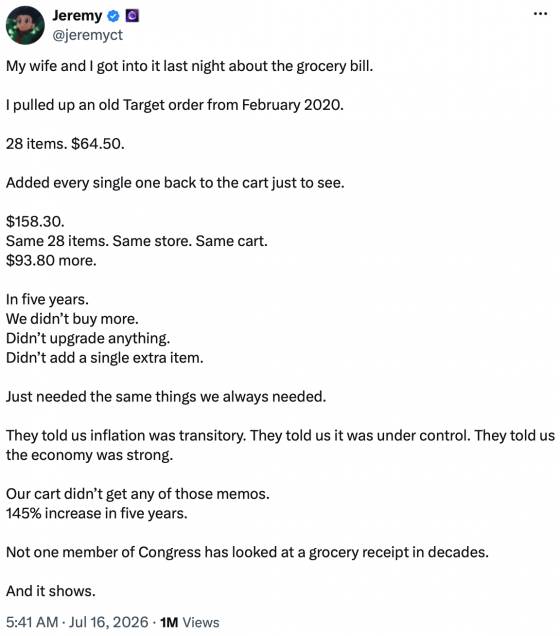
We have reached a stage where grocery prices are causing extreme financial stress for families all over America. One man recently caused quite a stir on social media when he revealed that a grocery order from Target that cost $64.50 in 2020 is now $158.30 in 2026…
This post has already been viewed a million times.
The reason why it is so popular is because it instantly resonates with people.
Everyone knows that grocery prices have risen to absurd levels, and yet the statisticians in Washington keep assuring us that everything is fine.
I don’t believe them.
Do you?
The Washington Post just conducted a poll that found that 66 percent of Americans consider the cost of groceries to be unaffordable.
That figure has risen by 21 percent just since February…
First they came for Muslim activists. Then they came for Nigel Farage. Now, they’re coming for independent media outlets.
UK-based readers may recall the moment almost exactly three years ago when the word “debanking” entered the mainstream British English lexicon. The prestigious London-based private bank Coutts had just decided to close Nigel Farage’s bank account due to his unsavoury political views and alleged Russian connections. That decision turned out to be very costly.
Almost immediately, Farage did what Farage does best: he whipped up a massive media frenzy. In next to no time two senior banking scalps had been claimed: those of Dame Alison Rose, the CEO of Coutts’ parent bank and “Big Four” lender, Natwest (formerly known as the Royal Bank of Scotland) and Coutts’ chief executive Peter Flavel.
Within a month, Natwest’s share price had slumped 8%, wiping £1 billion off its market cap, much of which was being propped up with public funds, and generating juicy returns for short-selling hedge funds. As we reported at the time, the resulting scandal drew much-needed public attention to a long-standing but accelerating trend — the “de-banking” of people and organisations with politically inconvenient views:
[T]his is hardly a one-off event: as I reported a couple of weeks ago, banks on both sides of the Atlantic are increasingly debanking their customers, often without explanation. I gave the example of California-based writer, activist, and social and political commentator Elad Nehorai, whose political views and ideals could not diverge more from those of Nigel Farage. Yet he, too, had his account at Bank of America, his bank of many years, summarily closed with no apparent warning or explanation…
Without a bank account, it is almost impossible to participate in the economy. And it is getting more difficult as cash becomes harder and harder to access and use. As Alex Lo writes for South China Morning Post, “Banking is a fundamental utility like water and electricity, and that’s precisely why democratic societies are increasingly turning to its use as a method of censorship and repression.”
However, the resulting government inquiry concluded that customers were not being “debanked” for political reasons. As a result, not only has debanking continued but debanked customers now face the prospect of being blocked from setting up new accounts at other banks, as the Telegraph reported on Monday:
Banks are planning to block “debanked” customers from setting up accounts with other lenders, potentially leading to innocent people being effectively locked out of the financial system, The Telegraph can reveal.
Lobby group UK Finance is developing a platform that will allow banks to share data on their customers where they detect “markers of economic crime”.
Lloyds, Barclays and Revolut have already started sharing data about customers, leading to accounts being frozen or closed, The Telegraph understands, following a pilot in 2024.
The data-sharing platform will build on that pilot to make a UK-wide system, which could automatically bar people from opening another account.
But concerns have been raised that thousands of innocent customers and businesses who have been debanked unfairly could be barred from opening up an account with another bank, effectively leaving them locked out of the financial system.
The latest victim of the debanking trend is the left-wing news website The Canary, which has accused the Lloyds Banking Group of “withholding a substantial amount of our money” after nearly a decade of use. The news outlet — which brands itself as “radical working-class media” — says “Lloyds has not explained why it has taken this action… despite multiple communications from us”.
In a statement on Tuesday, the Canary speculated about the possible reasons behind Lloyds’ decision, including its anti-Zionist and pro-Palestine stance:
Whilst we do not currently know the reasons behind our debanking, we cannot afford to be naive about this.
We do know that multiple other politically engaged people have suffered similar actions by other banks in recent times. It is not lost on us that powerful banks are able to restrict the financial activity of anti-Zionist and pro-Palestine organisations and individuals.
It is an outrage that the Canary has been unceremoniously dropped into financial instability with no notice or explanation from Lloyds.
Starmer’s Last Attack
It would hardly come as a surprise the attack was in response to The Canary’s pro-Palestine sympathies. The UK government has done everything within its not inconsiderable powers to criminalise pro-Palestine, anti-genocide activism, including by scrapping the ancient right to trial by jury. Through its new National Security Law, the outgoing Keir Starmer government seeks to bulldoze literal thought crime legislation into law — in Orwell’s native United Kingdom.
I need to explain something very important to you.
The law that the govt used to arrest me, Section 12(1A) — the first ever use against a journalist — is a very short line. It is vague on purpose. And that is the exact line they have copied into the new "National Security Bill"
You can say something that is 100% factual, but if it paints what they deem a "proscribed organization" — even one that has never harmed the UK — in a "good" light, you can get 14 years in prison. (That's also copied from the Terrorism Act).
An article in The Canary explains just how dire a threat the new National Security Law poses to journalism and political dissent, describing it as “one last power grab” by Keir Starmer’s outgoing government:
As I am sat here writing this, there’s a sense of terror kicking in. I’m a journalist. It’s my job to be in the know about foreign affairs. At the Canary we pride ourselves on bringing people the news that the mainstream doesn’t dare. But this terror is absolutely nothing compared to what other people must be feeling.
This radicalised weaponisation of new legislation will hit marginalised communities so first and hardest. Journalists and community workers with direct, lived and painful connections to global conflict zones are facing a massive legal trap. If a reporter so much as quotes an entity that the home secretary has designated as a threat, they face immediate prosecution.
Civil liberties groups warn that the law will grant the Home Office absolute power to decide who is allowed to speak. And by leaving the definition of ‘assisting a designated body’ vague, the state has created a total monopoly on the narrative. It’s very much going to be, follow their way and toe the line, or go to jail, it seems.
Indie media outlet Zeteo warned of the severe danger of this new power-grab. The outlet warned that journalists face immediate arrest simply for conducting public interest interviews with banned groups. People will only get one side of the story. There will only be one narrative fed to us… and it will be the government’s.
The timing of Lloyds Bank’s debanking of The Canary is also curious, coming just two months after it announced the launch of a daily left-wing print tabloid — and what’s more, one that defends Palestinian rights. Following an injection of cash last year from used car and property website founder Cecil Hetherington, Canary director Steve Topple hailed the new tabloid as an alternative to the corporate press.
After its debanking, the Canary says it is now in a “financially precarious situation” and does not know when “money that Lloyds is holding will be returned” or how it will affect “our ability to get another bank account in the future”.
“The immediate effect has been that we have been unable to pay any staff or contractors,” Topple told Novara Media. “We have a large team, and all of them are now extremely distressed and in limbo. Many of them are marginalised people and it has hit them very hard. We are trying our best to mitigate the situation and have so far received much-appreciated support from members of the public.”
Lloyds’ actions have already triggered a storm of protests from across the political spectrum.
Debanking is one of the most pernicious forms of cancellation that an individual or organisation can face — something the FSU is only too familiar with.
Lloyds has provided no explanation for its decision and has not told The Canary when… https://t.co/Y2YKbFC1wu
— The Free Speech Union (@SpeechUnion) June 30, 2026
A Growing Phenomenon
The first major target of debanking in the UK, well over a decade ago, were members of the British Muslim community, particularly those involved in Pro-Palestinian activism. But unlike with Farage, their plight was met with total radio silence in the mainstream media, as the veteran journalist Peter Oborne recounts in the video below.
By the time Farage had lost access to Coutts’ banking services, in the summer of 2023, banks in the UK were closing nearly one thousand accounts daily, with just over 343,000 closed in 2022, compared to about 45,000 in 2017.
Following the Farage affair, the Financial Conduct Authority conducted an investigation into banks’ debanking practices, the conclusion of which was that banks had not been closing customers’ accounts for political reasons. Farage described the outcome as “farcical”.
In the US, recent victims of debanking include Scott Ritter, the former United Nations Special Commission (UNSCOM) weapons inspector who is a prominent critic of US and Western imperialism. In January, his bank of 26 years, Citizens’ Bank, closed all of his accounts, including his and his wife’s joint accounts with their daughters, without offering an explanation, as he recounts in the first minutes of the following interview with Judge Napolitano:
In a letter to Ritter Citizens Bank apparently that not only was it under no obligation to divulge the reasons for closing his accounts but that Citizens’ policy actively prevents any disclosure of any information concerning the decision to close the account. As Cato Institute notes, this silent treatment often has to do with confidentiality laws:
However, these are not laws meant to protect the financial privacy of customers. Rather, this confidentiality is to prevent citizens from finding out they are under criminal investigation. For example, reports filed under the Bank Secrecy Act are restricted so heavily that banks cannot share the details of the reports or even admit that a report exists.
While Ritter does not know the exact reasons for his debanking, he suspects that someone in the FBI, fully armed with the “totality of [his] banking transactions”, had “tipped off” Citizens Bank about “suspicious activity” that resulted in Citizens Bank issuing an SAR [Suspicious Activity Report].”
Ritter believes that donations he had received and subsequent cash withdrawals before his three trips to Russia in 2025, which thanks to US and EU sanctions is disconnected from the Western economy, may have triggered the move. According to Ritter, the “purpose of “de-banking” is to harass a targeted individual,” even in the absence of evidence pointing to any criminal activity.”
The reasons for an account closure, while often a mystery to the customers affected, often include operational reasons. Put simply, a financial institution chooses to close the account of a customer because the reputational risks of being associated with that client are simply too high. However, political or ideological motivations appear to play a part in some prominent cases.
The most clear-cut example of this was the Canadian government’s decision, in February 2022, to invoke the emergencies act to compel banks to seize the accounts of the freedom convoy protesters who had blocked several key border crossings. According to the minutes of a meeting between Canada’s Economy Minister, Vice President and WEF board member Chrystia Freeland and senior bank executives the day before the act was invoked, one CEO flagged concerns that if banks were forced to close accounts, it could be seen as the sector “being used as an arm of the government” or even “a political weapon.”
In 2022, Paypal banned the accounts of the UK-based Free Speech Union, its founder Toby Young and his online publication, the Daily Sceptic, for purportedly breaching its policies against hate speech. Worse still, the fintech giant surreptitiously slipped a line into its terms of service granting itself the right to fine customers $2,500 for spreading misinformation. When the news got out, provoking a huge public backlash, PayPal claimed it had all been a big mistake.
Of course, as NC readers EssCetera and Rev Kev pointed out in comments to a previous post, Paypal has a long, storied history of doing this sort of thing, going all the way back to its freezing of Wikileaks’ account in 2010. And banks in the US have been closing down the accounts of workers in the porn industry since at least 2014 as part of “Operation Chokepoint”, which targeted certain undesirable but legal business sectors (h/t Michaelmas).
From “Debanking” to “Civil Death”
If there’s one fate worse than being debanked, it is suffering through the ordeal of “civil death”. Francesca Albanese, the UN Special Rapporteur for the Palestinian occupied territories, became subject to US sanctions roughly a year ago that cut her and her family off not only from US banking but also travel and tech.
In Albanese’s case, it was clear to her why she was being put under constraints normally reserved for narco-barons and terrorists: she had just published a UN report denouncing the more than 60 (largely Western) multinational corporations that are allegedly complicit in, and profiting from, Israel’s military occupation of Gaza.
“This fury [came] because I poked the bear,” she said. “Not in one eye, in both eyes.”
👉 “The moment I pointed to the fact that there are businesses who are profiting from it, yes, I get sanctioned.”
The first UN expert in 80 years to be sanctioned by the U.S. explains why she now faces a U.S. travel ban, frozen accounts, no ability to bank anywhere, cancelled… https://t.co/ia3WLhmyV7
In the clip below, Albanese explains (in French), as she fights back tears, the extent to which she has been barred from participating in basic civil life since the imposition of US sanctions against her:
“I can’t make payments with my working credit card nor can I do transfers; my health insurance has been cancelled, I can’t make hotel reservations… I’m being treated as if I were Pablo Escobar. “
UN official Albanese described financial and insurance restrictions imposed on her following her public statement characterizing Israeli actions as genocide.
"I can't make payments with my working credit card nor can I do transfers; my health insurance has been canceled, I can't… pic.twitter.com/zAH7paGjxm
Other victims of civil death, this time at the hands of EU authorities, include the German journalist Hüseyin Doğru and Jacques Baud, a retired Swiss colonel and former senior strategic analyst for NATO. In both cases, the justifications were openly ideological. Baud was accused of of acting as a “mouthpiece” for pro-Russian propaganda and disseminating “conspiracy theories” about the war in Ukraine while Doğru was targeted due to his reporting on Gaza.
In the case of Doğru, both his wife and mother were also targeted with sanctions (h/t vao). In neither case were criminal charges imposed, and because the sanctions are defined as an administrative measure within the EU’s bureaucracy, neither Baud nor Doğru can appeal to a court of law in their respective countries of residence (Belgium and Germany). This is the very definition of Kafkaesque.
Worse still, these sorts of processes could soon be automated almost across the board, as I warned in my 2022 book Scanned:
Combining [central bank] digital currencies with digital IDs while phasing out, or even banning, the use of cash would grant governments and central banks the ability not only to track every purchase we make (and made in the past) but also to determine what we can and cannot spend our money on. They could also prevent certain “undesirable” people from buying anything. Anyone with a blocking notice attached to their digital identity would “thus be unable to do many of the most basic things independently,” says [German financial journalist Norbert] Häring.
Incidentally, the digital euro has already become a de facto legal reality, after the European Parliament (EP)’s economic and monetary affairs committee gave a green light to the eurozone central bank digital currency (CBDC) last week. Presumably, even many members of our highly informed readership will have been unaware of this fact since it all occurred against a backdrop of near-total media silence.
From 1926 through 2025, just 27.6% of stocks beat the broader market. Nearly 60% actually destroyed shareholder wealth, and the median stock delivered a lifetime return of -6.9%. Yet despite those sobering odds, U.S. stocks collectively created roughly $91 trillion in wealth over the last century, with just 46 companies responsible for half of it.
Those are some of the headline findings from a new study by Hendrik Bessembinder of Arizona State University's W.P. Carey School of Business, who examined the performance of nearly 30,000 U.S. stocks over the last century. The research paints a striking picture of how wealth is actually created in the stock market: while broad market indexes have generated exceptional long-term returns, the vast majority of individual stocks have failed to keep pace.
Bessembinder analyzed 29,754 publicly traded U.S. stocks between 1926 and 2025. Over that period, the overall stock market produced an annualized return of about 10.1%, turning every dollar invested into more than $15,000, according to the study, detailed in this white paper.
But those impressive aggregate returns mask an uncomfortable reality. The typical stock fared far worse. In fact, the median stock lost 6.9% over its lifetime, fewer than half of all stocks generated a positive lifetime return, only about 41% outperformed Treasury bills during the time they were publicly traded, and just 27.6% managed to outperform the market itself.
The reason is simple: stock market returns are incredibly uneven. While any stock can fall to zero, there is effectively no limit to how much a winner can rise. Over long periods, a tiny number of extraordinary companies generate gains so large that they more than offset the thousands of stocks that stagnate, disappoint, or disappear altogether. Those rare winners account for an outsized share of the market's overall success.
Perhaps the most surprising finding is that this concentration has become even more extreme. In Bessembinder's original research covering 1926 through 2016, 89 companies accounted for half of all shareholder wealth created by the U.S. stock market. After adding the last nine years of data, total wealth creation more than doubled to roughly $91 trillion, yet the number of companies responsible for half of it fell to just 46.
And yet stocks are heralded as a safe way to invest.
Good morning everyone, and welcome to the weekend Join the Dots.
Last weekend I found that magnificent interview with Toby Costa. It was pure information, which is exactly what this channel is about. This channel is not about giving financial advice. It is about providing information so that you can make better-informed decisions for yourself.
This week I found another two excellent interviews featuring Dr. Nomi Prins at the Rick Rule Symposium held in Florida. Today we're going to begin with one of the key themes from those discussions by looking at silver.
Silver Shortages in India Push Premiums Higher
Let's begin with the first article.
India's restrictions on silver imports have created shortages. Naturally, when the government limits imports while demand remains strong, shortages develop and premiums rise because people still want silver regardless of government policy.
During 2025, India imported approximately 138 million ounces of silver, representing roughly 15% of the world's annual silver supply.
When restrictions are placed on imports, the result is predictable. Demand remains while supply becomes more limited, causing prices to increase.
Currently, silver is selling at roughly an 11% premium in Mumbai, equivalent to about $6.50 above the paper spot price.
This closely mirrors what is happening in Shanghai, where silver is trading at approximately an 11.5% premium, around $6.70 above the current spot price.
This means the world's two largest silver-consuming nations—countries whose populations have a deep cultural appreciation for both silver and gold—are both paying premiums of roughly 11% over the quoted paper market price.
To many observers, this serves as further evidence that the paper market is not accurately reflecting physical demand.
Evidence is what matters.
Evidence.
Truth.
From that evidence we can draw logical conclusions, separating reality from suppressed truths to better understand what is actually happening.
Australia's Housing Slowdown and the Second Derivative Effect
The second article is particularly relevant for viewers in Australia.
It examines what could be called the second derivative of a housing market slowdown.
Rather than focusing directly on falling home prices, it looks at what happens to businesses that depend on an active property market.
The article, published by the Financial Review rather than a personal blog, is titled:
"How a Frozen Property Market Is Putting a Chill on Freezer Sales."
The concept is straightforward.
When housing activity slows, sales of household appliances decline.
People typically purchase new refrigerators, freezers, washing machines, and other large appliances when they move into a new home.
Likewise, homeowners often upgrade household goods when rising property values make them feel wealthier. Increased home equity encourages additional spending because people believe they have more financial flexibility.
As the housing market freezes, those purchases disappear.
This is why retailers that sell household appliances begin experiencing declining sales.
The impact doesn't stop there.
Furniture retailers suffer.
Automobile sales weaken.
Curtain and furnishing companies see reduced demand.
Many sectors tied to home purchases begin to struggle simultaneously.
Eventually these effects spread throughout the retail economy, creating recessionary pressures that originate from a slowing housing market rather than from consumer demand alone.
A Major Buyer Continues Accumulating Gold
The third item comes from Andy Schectman, speaking with Kai Hoffmann during the Rick Rule Symposium.
The central message is simple.
There appears to be a very large buyer—a true "whale"—steadily purchasing enormous quantities of physical gold and taking delivery.
Many speculate that this buyer is China, although the identity cannot be confirmed with certainty.
Regardless of who it is, the important observation is that large amounts of physical gold continue leaving the market and moving into long-term ownership.
Andy Schectman presents extensive supporting data for this conclusion.
Although much of this information has been discussed before, it reinforces the growing evidence that significant physical accumulation continues behind the scenes.
The Real Asset Lockout Has Begun
The primary discussion of the day centers on Dr. Nomi Prins.
What makes Dr. Prins particularly interesting is her background.
She previously worked at a senior level on Wall Street.
That experience allows her to understand not only how financial markets function but also how major financial institutions think and why they position themselves the way they do.
Understanding Wall Street's perspective helps explain many of the changes now taking place throughout the global financial system.
According to Dr. Prins, real assets will increasingly be required to support real money.
While technology companies continue attracting headlines and excitement, Wall Street banks are quietly expanding something else:
Their precious metals divisions.
Banks are hiring additional personnel and expanding their metals desks because they are preparing for future developments rather than reacting after the fact.
Banks don't wait until changes appear on newspaper front pages.
They anticipate them.
They study demand.
They observe where capital is moving.
Earlier we looked at India's growing silver premiums.
We also examined the strong premiums developing in China.
Another important statistic reinforces this trend.
In March alone, after silver prices declined, China imported approximately 836 metric tons of silver, nearly 30 million ounces.
That single month's imports represented roughly 3% of total annual global silver production.
China continues acquiring significant quantities of both silver and gold.
Dr. Prins summarizes the situation well:
"Tech is still buzzing, but at the same time the metal desks are hiring."
That contrast is significant.
It suggests that while public attention remains focused on technology, major financial institutions are quietly preparing for an environment where precious metals play a much larger role.
One notable example illustrates this shift.
JPMorgan reportedly relocated its entire precious metals desk from New York to Singapore, giving employees only one week's notice.
Such an abrupt relocation demonstrates how strategically important the metals business has become.
It was not an ordinary corporate move.
It reflected the importance of positioning the bank correctly for what it believes lies ahead.
Gold as a Monetary Anchor
Dr. Nomi Prins argues that gold is likely to continue moving higher over the long term because the forces driving demand are structural rather than temporary.
She notes that while short-term price fluctuations attract attention, the more important trend is the growing demand for gold as a strategic reserve asset.
According to Dr. Prins:
"Gold is going to get higher than these levels. We were looking at 5,500 in January. Our prediction at Prinsights was for 6,000 by the end of the year, and we still stand by that."
She explains that the reason extends far beyond simple investment demand.
The structural demand for gold is increasing because countries are looking for ways to diversify away from dependence on the U.S. dollar—not only as a currency, but also as a source of strategic power.
Gold increasingly serves as collateral that can support international trade agreements.
Those agreements may involve energy shipments, industrial equipment, transportation, or countless other forms of commerce.
Even when gold itself is not the item being traded, possessing substantial gold reserves strengthens a nation's financial position.
Dr. Prins believes central banks, particularly China, are unlikely to reverse the changes they have already made.
China reduced its holdings of U.S. Treasury securities from approximately $1.3 trillion to roughly $620 billion.
She argues that it is unrealistic to believe China will suddenly purchase hundreds of billions of dollars' worth of Treasuries again.
The global balance of economic power has changed.
Rather than focusing on daily price volatility, Dr. Prins believes investors should recognize that the world is entering a much larger hard-asset, commodity-based supercycle.
In her view:
"Gold is a monetary anchor for trade, for payment systems, and for central banks to diversify their own power."
The Growing Importance of Real Asset Collateral
Dr. Prins touches on several major themes that we've discussed for months.
One of the most important is the future role of collateral.
As Miles Harris frequently points out, the key question becomes:
What will serve as collateral in the future?
For decades, U.S. Treasury securities occupied that position.
They were widely viewed as the premier Tier One asset.
According to this discussion, that perception has weakened significantly in recent years.
Following the freezing of approximately $300 billion of Russian reserves, many countries began reassessing the security of holding large amounts of U.S. government debt.
Meanwhile, China has reduced its Treasury holdings by more than half while increasing its holdings of precious metals.
Exactly how much gold China owns remains uncertain because official reporting is limited.
Nevertheless, the broader trend appears clear.
Real assets are becoming increasingly important as collateral.
Dr. Prins also highlights the geopolitical dimension.
In today's changing international environment, gold and silver are no longer viewed solely as investment assets.
They are increasingly regarded as strategic financial resources within the broader competition between major global powers.
The Burden of Government Debt
Dr. Prins then turns to another issue: the enormous cost of servicing government debt.
She explains that whether people recognize it or not, everyone ultimately pays for government debt.
The United States now carries approximately $40 trillion in national debt.
The figure is so large that it becomes difficult to fully comprehend.
Yet the practical consequences are easier to understand.
Every year, before funding roads, hospitals, schools, energy infrastructure, or countless other public services, the federal government must first pay interest on that debt.
Dr. Prins compares this situation to an individual carrying large personal debts.
People often experience periods in life where they accumulate mortgages, student loans, or credit card balances.
Eventually they attempt to reduce those debts while continuing to save and invest for the future.
Governments, however, have followed a different path.
According to Dr. Prins, since the financial crisis the United States has continued moving in only one direction:
Higher debt.
As debt grows, interest payments consume an increasingly larger portion of government resources.
That leaves less money available for investments that directly benefit society.
Ultimately those costs work their way through the economy in the form of taxes, public spending decisions, and reduced financial flexibility.
Every taxpayer bears part of that burden.
Is There a Plan?
The sheer scale of debt servicing has reached extraordinary levels.
Approximately $1 trillion per year is now spent simply paying interest on U.S. government debt.
That occurs before spending on healthcare, education, defense, infrastructure, or other government priorities.
Dr. Prins questions how such a trajectory can continue indefinitely.
She also argues that there appears to be no comprehensive plan for reducing the debt burden.
The same concern extends beyond the United States.
Many developed countries—including Europe, the United Kingdom, Canada, and Australia—face similar challenges.
The fundamental question becomes:
Where is the long-term plan to reduce these growing debt obligations?
According to Dr. Prins, there isn't one.
There is no clear escape route.
If that assessment proves correct, it becomes easier to understand why many nations are seeking alternatives that include greater reliance on tangible assets.
What Has All That Debt Produced?
The discussion then shifts to a broader question.
If trillions of dollars have been borrowed, what has that borrowing actually created?
Looking across many American cities, educational institutions, and healthcare systems, the speaker argues that the visible results do not appear proportional to the scale of the debt accumulated.
By comparison, Japan is presented as an example of a country that used large amounts of debt differently.
Its borrowing helped finance industrial development, research, technological advancement, and manufacturing.
Many of the products that established Japan's global reputation—particularly its automobiles—were supported by decades of investment in research and development.
According to the speaker, China is following a similar strategy today by directing substantial resources toward industrial expansion and technological development.
The broader point is not simply the amount of debt a country holds.
Rather, it is how effectively that borrowed money is used.
The discussion concludes by previewing a future examination of China's property market and financial system.
The speaker notes that there are both strengths and weaknesses that deserve careful analysis.
Rather than approaching the subject from an ideological perspective, the goal is to examine the available evidence wherever it leads.
As he concludes:
"I'm not anti-China. I'm not anti-US. I'm anti-waste, I'm anti-lies, and I'm anti-censorship.
David Rogers Webb is a former investment banker and hedge fund manager who studied the mechanisms by which the Federal Reserve manipulated financial markets through the Dot-com bubble and bust. Then, early in the Great Financial Crisis of 2008/2009, he became alarmed when client accounts were encumbered in the bankruptcy of a small broker dealer. He then discovered that legal changes had been made quietly which sever property rights to securities.
G. Edward Griffin is a thoughtful writer, documentary filmmaker and tireless advocate of American values, individual responsibility and human freedom. Griffin wrote the landmark book on the Federal reserve titled The Creature from Jekyll Island.
This is a great miniseries and may be worth featuring along side hidden secrets of money.
THE UNITED STATES OF ADDICTION
Serialized Article — Part 1
How did George Washington get paid the first time? It wasn't with coins. The mint did not open until 1792. Washington's presidency began in 1789. The answer is that George Washington got paid the same way all US presidents have been paid: with bankers' fingers in his pockets, skimming money from the entire country through one huge banking scam.
That huge banking scam did not start in 1913 with the Federal Reserve. It did not start in 1863 with the National Banking Act. It did not even start in 1791 with the first Bank of the United States, the country's first central bank. It started on Alexander Hamilton's third day in office in 1789 when he had the country borrow funny money from a fake bank in which Hamilton owned shares. He then paid George Washington and other US creditors and employees of the government with that funny money.
Hamilton did not invent the scam himself. He copied it from the Bank of England system set up in 1694. But Hamilton fixed its one big flaw, the flaw that caused the Bank of England to default in 1696 when its funny money was exposed as a sham. Hamilton found a way to prevent a default from happening. Otherwise, the two scams are identical.
If George Washington had known the truth about his early paychecks, there would be a sequel to the hatchet story where what gets chopped to bits is a Treasury Secretary rather than a cherry tree. Thanks to Alexander Hamilton, George Washington got paid with paper IOUs, banknotes issued by the so-called Bank of New York in which Hamilton owned shares.
What prevented exposure of those banknotes as paper Chuck-E-Cheese tokens worth 35 cents on the dollar was the first bailout in United States history. In that bailout, Hamilton converted the Chuck-E-Cheese tokens into full US dollars and then had the United States pay his fake bank interest on the full US dollars rather than the fake bank paying the United States for every dollar-denominated paper Chuck-E-Cheese token that Alexander Hamilton upgraded into a full legal US dollar.
The United States paid the Bank of New York 6 cents. We transformed dumpsters full of its junk paper IOUs into full money and we paid the bank. This is crystal clear from the official record, as you are about to see.
If you understand this scam and, in particular, how Hamilton fixed the flaw with the Bank of England system, you will understand the scam that is modern central banking throughout the West, which is hands down the biggest scam in the history of the world.
By way of that background, welcome to Best Evidence. My name is John Titus. This video marks this channel's return to the War for Bankracy series after a very long break corresponding to a sea change in my thinking about how and when the cabal of globalist criminals that is currently running the US came into power.
How and when did they take sovereignty and divest the people of agency, taking the power from we the people? Like a lot of other people, I believed it was by a coup d'état at some point in American history. Originally in this episode I was going to argue that the coup took place during the global financial crisis. Other people of course have pointed to other events in US history as marking a coup. The JFK assassination is a big one. The creation of the Fed in 1913 is one. 9/11 is a biggie. And originally episode 4 was going to pile on to that list and say, “No, no, it was the global financial crisis.”
But the more I researched and really the more I analyzed, the more I understood that the coup theory does not really work. Not because there has not been a sovereign power transfer. For sure there has been a sovereign power transfer. We the people have not been the real sovereign in the US for a very long time. I do not think very many thinking people would argue that point.
The coup theory fails because a coup d'état is a criminal act. It is pretty much the worst crime on the books. Whereas the sovereign power transfer that took place in the US did so through legal channels. There was nothing criminal or illegal about it. And it was not at some point in US history. It was within two days of Alexander Hamilton taking office on September 11th, 1789.
THE UNITED STATES OF ADDICTION
Serialized Article — Part 2
That's when, two days later, he handed the keys to the nation's sovereignty, which is the power over national credit, over to private bankers. He did that, like I said, by copying and improving the Bank of England system set up in 1694.
Now, in episode two, we saw that the establishment of the Bank of England was a pivotal event in world history because that is what propelled the private power over national credit past the military to become the number one sovereign power in sovereign nations. Remember Machiavelli said in the early 1520s that the military was the greatest power, but by the early 1800s, Thomas Jefferson said, “No, banking institutions are more dangerous than standing armies.” That is really not so much a difference of opinion as it is a difference of era. Machiavelli simply did not live to see the Bank of England created in 1694. And that is when standing armies yielded to banking institutions as top dog.
And one very important reason for that was that in the Bank of England system and in the systems that follow it, power over national credit was not just private. It was anonymous. And that latter feature is what enables people, private individuals, to wield enormous power over a nation with no democratic safeguards, no restraints, and no transparency at all. You do not even know who they are. With the military, at least you know the names of the top brass.
In this episode, I am going to walk through that scam again, but this time I am going to use the US as an example and show you how Hamilton perfected the scam by eliminating the biggest risk faced by the bankers. I am also going to talk about another feature of the private credit system which ensures that the power wielded by bankers is permanent and that is the fact that the private power over national credit behaves exactly like an addiction. It replicates an addiction perfectly, where the country is the addict, the private bankers are the drug dealers, and the private credit, the money, what we think of as money, is the drug.
Actually, I am going to show you that the private power over national credit is worse than a drug addiction. I will get to that. But make no mistake about it, private credit addiction went into the veins of the US, into its money supply, at birth. And it is the apex ancestor of every addiction that came after it.
In so far as a coup d'état is concerned though there was not one. When Alexander Hamilton perfected the Bank of England system of addiction here in the US he did not do anything illegal and he was never challenged. He might have been near the limits of his discretion as US Treasury Secretary but no one ever challenged him. Not Congress, not the president, not the courts. So private credit addiction has raged in this country for 250 years. The public debt is now $40 trillion. The interest payment is absolutely out of control. And now the drug dealer's got to harvest the addict's organs because siphoning blood out of our veins is no longer enough. In financial terms, the debtor can't service the interest payment anymore, not the real interest payment at any rate. So the creditor has got to start pocketing collateral. And we are experiencing that in real time right now.
That is a short form of US history. Private credit addiction was created in 1789 in order to feed parasites. It got worse for 250 years and now the parasites are bleeding the nation dry before they move on to their next host or whoever that might be. But there was never a coup. If you want to take over a country, a coup is actually dangerous because it exposes you to prison, exposes you to death. It is a hanging offense. The much smarter play is to get the nation addicted to your credit and then control the credit. That is what is going on. Doing it that way gives you the upside of a coup d'état, gives you sovereign control without the downside, the risk of prosecution, jail or death. That is because the private power over national credit is a voluntary and legal transfer of power from the nation to private individuals.
The trick, of course, is getting the nation to hand over its power like that, which in the US was done by way of an inside job, as you are going to see in this video. It was not some outside enemy, in other words, who jabbed a needle of private credit addiction into the nation's arm. It was her first United States Treasury Secretary. And no one said peep. So even if it was of dubious constitutionality, what Hamilton did, and I think it was questionable at a minimum, it was not illegal and thus there was never a coup in the US.
That is a major reversal for me and for this channel because for over 10 years I have been saying there was a coup at some point, that at some point in US history a gang of criminals took over, took control of the US. And my number one piece of evidence on that score was and is to this day extremely solid, very solid, never challenged. And that is a decision made at the highest levels of government not to prosecute any executive at any global too-big-to-fail bank even when the banks admitted their crimes. That decision, as I have shown repeatedly on this channel, was ultimately made by the banks themselves by installing attorneys at the Department of Justice who refused to investigate crimes by banks. That outcome is absolutely shocking because it reveals that private bankers enjoy sovereign immunity far beyond what the United States president has under the Constitution.
Remember Nixon had to answer a subpoena. That is what got him out of office. He was subject to investigation but not the global too-big-to-fail banks. And what that reveals, the fact that they are not being investigated, is that the sovereign power under the Constitution, we the people, is not really the sovereign power in the US. I still stand by that. In fact, I did two long videos on that very point. One was The Veneer of Justice in the Kingdom of Crime in 2016 and then All the Plenary's Men in 2017. This video in a lot of ways is a prequel to those, but those said there was a coup and that is wrong. Otherwise, those videos stand as is. They are other good videos. However, it does not follow from the loss of sovereignty that a coup is what caused the loss of that sovereignty. That is where those videos go wrong.
In reality, our loss of sovereignty starts with a bank in which Alexander Hamilton owned shares and which is absolutely remarkable for its absence from so many accounts of early US monetary history. The vast majority of accounts of early US monetary history focus exclusively on the Bank of North America. But the US actually borrowed from two banks back then. One was the Bank of North America and the other is Hamilton's Bank, the Bank of New York. And of those two, the Bank of New York is obviously the real ancestor of today's too-big-to-fail banks, not the Bank of North America. And that is based on several abuses that were simply not true of the Bank of North America, the more popular rival than the Bank of New York.
THE UNITED STATES OF ADDICTION
Serialized Article — Part 3
I will just kind of run through what distinguishes Bank of New York over Bank of North America. One, the Bank of New York was born on the wrong side of the law. We are going to see that later. And it operated without a bank charter for seven years. It did not get its charter until 1791. And it did not have a charter because the people of New York did not trust it. The Bank of North America was in Philadelphia. It had its charter in 1781. Number two, the Bank of New York's encroachment on the sovereign money issuing prerogative under Article One of the Constitution was done with 100 per cent private ownership just like the New York Fed today. Bank of North America was 60 per cent publicly owned, at least early on, at least at first. Number three, Hamilton owned shares in the Bank of New York while he was US Treasury Secretary borrowing money from his own bank. So the financial graft of public servants that is so commonplace today started with the Bank of New York. Just those precedents make it a far better case for studying the private power over national credit scam.
Now, briefly, where am I getting my information about the Bank of New York and Alexander Hamilton? The answer is I am getting it from the Bank of New York's official history, 1784 to 1884. So, let's take a look at it. This is my corkboard for this episode where I can see all my source materials in one place and I can get to them. The leftmost item you see here is appendix 7 from the book I just mentioned, the history of the Bank of New York. And you can see the page over there, the list of stockholders of the Bank of New York at the time of its incorporation in 1791. So in 1789, the Bank of New York does not have a charter at all. But that does not stop it from issuing banknotes and lending them out to borrowers like the United States. Nor does it prevent it from issuing stock, including you see here, one and a half shares to Alexander Hamilton and three shares to his good buddy Aaron Burr. And even a share to their pal Oliver Cromwell, who died in the mid-1600s. Huh. Anyway, who knows? Whatever. If you flip to the end of appendix 7, you see that there are 723 total shares in the company, which made Hamilton the 0.2 per cent owner of the Bank of New York while he is sitting as Treasury Secretary. One and a half shares is kind of curious to me. The subscription price for a share was $500 per share. Hamilton was more than an investor though. He wrote the articles of incorporation for the bank in 1794 and was one of its 12 directors before he became Treasury Secretary. I will get to that in a bit, but he was knee-deep in this bank. One and a half shares is curious because it seems kind of small, but it is certainly enough to create the good old-fashioned aroma of self-dealing.
This is a good point to mention. By the way, the War for Bankracy series is 100 per cent backed up by Solari.com and Catherine Austin Fitts. Meaning, not only can you watch and download the War for Bankracy series at Solari.com in case YouTube and BitChute and Odysee take it down, you could always find an archival copy at Solari. But in addition, you can also at Catherine's site download the research materials and sources that you see here like the Bank of New York's official history. There is a PDF of that you can just download yourself. Catherine Austin Fitts, incidentally, gets huge props for this episode in particular and supporting it. She is a major Alexander Hamilton fan. So her support of this episode is being provided at great personal pain, rest assured. But support it she will because Catherine is first and foremost a woman of great personal integrity. She has also been magnificent as a mentor doing a weekly show with her together called Money and Markets on Solari for the last five years. Thank you Catherine Austin Fitts. I do not say that enough.
In any case, let's move on and let's now explore the scam called the private power over national credit by comparing the nation's early dealings with the Bank of New York with England's dealings with the Bank of England in 1694. So to set the stage in 1789, the US has just started to operate under the Constitution and it needs money for salaries and it could get that money either by borrowing money or by issuing money. Congress has both of those powers under the new Constitution specifically under Article 1 Section 8. Paragraph two of that section gives Congress the power to borrow money on the credit of the United States. And under paragraph five, Congress can coin money. Now, upfront, did coining money under the Constitution include the right to issue paper money like greenbacks almost 100 years later? A lot of people will tell you, "No, the term coining money only means gold and silver coins." But hold that thought. We will see if that position really boils down to no more than a ruse by private bankers to filter the right to issue paper money from we the people and keep it for themselves. For now, let's stipulate though that coining money is indeed limited to gold and silver coins. And we will see where that stipulation takes our analysis.
So it is 1789 and the US can coin money or borrow money on US credit to pay the salaries for new government employees like George Washington. But rather than coining money or borrowing money, the US borrows IOUs. It borrows paper notes from private banks in order to pay George Washington's lavish $25,000 a year salary and the more reasonable salary of Vice President Adams at $5,000 and on down to the Senate and the House. But what does that look like? What does a paper note from a private bank look like? Well, let me just show you. Let's just drill right down on this note from the Bank of New York. The US borrowed this privately issued funny money instead of borrowing real money, instead of borrowing gold and silver. But how do we know that this note is not actually money itself? Well, the note tells you that it is not money right there on its face. You can see that the president and directors of the Bank of New York promised to pay $1 on demand to whoever. If this were real money, there would be no need to demand anything. Unless a demand amounted to taking your $1 Bank of New York note to the bank, demanding your dollar, and being told by the teller that you are holding a dollar, and that your demand is thereby satisfied. That is ridiculous. That does not make any sense. So, you can see this note is not actually money. It is a promise to pay money, to pay $1. So, in 1789, money in the US was by custom silver and gold coins. A lot of them were Spanish doubloons, silver dollars, pieces of eight. And that is consistent with our stipulation. So, when the Bank of New York says it will pay $1 on demand, what that means is that the holder of this note could walk into the Bank of New York and demand in exchange for the note one ounce of silver, probably Spanish, or the equivalent amount of gold, probably a coin. But the point is, either way, when you ask the Bank of New York for your $1 in exchange for its $1 IOU here, you are probably going to get your silver dollar probably. If the bank has it on hand, then yeah, but that is not guaranteed. And that is why the $1 Bank of New York note, like all bank notes, is worth less than the face value of the note, worth less than a dollar. Think of it like a coat claim check at a restaurant. Yeah, you are probably going to get your coat back. But the ticket is worth less than the coat itself to be sure due to risk. We will talk about what percentage of their face value the Bank of New York notes were worth in a minute. For now, we know what the bank note is. It is an IOU and what it is not, which is money.
Now, the US borrowed $80,000 of notes from the Bank of New York in 1789. Alexander Hamilton chose that route. He went that way. That was his choice. And up until that point, that is exactly the same route that England took in 1694 with the Bank of England. It borrowed 1.2 million pounds of notes from the private Bank of England. The problem was the Bank of England stopped paying on its notes just two years later in 1696. It was a total disaster and it stopped paying because it lacked the gold to back its notes. And there was a run on the Bank of England. It was forced to say, yeah, we do not have the gold to back the IOUs. We saw this in episode two.
THE UNITED STATES OF ADDICTION
Serialized Article — Part 4
We saw this in episode two. The question is, was the Bank of New York any different? We know because we just saw it that the bank issued at least $80,000 in notes just to the US, plus it issued other notes, plus it had deposits. And depositors can demand gold and silver, too, just like note holders. And also this is very important. The Bank of New York lacked a charter. It did not have a charter in 1789. That is a big problem. The question is did the Bank of New York face the risk of a bank run like the Bank of England did in 1696? And the answer is yeah, it faced a run. It faced the risk big time. Not only did the Bank of New York lack sufficient gold to pay out all the demands out there, but its lack of a charter made it especially susceptible to a bank run. How do we know that? Because the Bank of New York's own official history tells us that in very clear language. Let's go back to our corkboard and see here. Look at the Bank of New York official history again. Let's just look at chapter 4 of the bank's history, page 36, second paragraph. The following is a statement of the assets and liabilities of the bank at the time it commenced business under the charter May 1st 1791. And then the actual balance sheet is shown on the next page. Here we go. We are interested in the Bank of New York species bank. It is Precious Metal Bank. That is in US dollars. The paper bank you see there is a hold over from when New York state as a colony issued notes denominated in British pounds which it actually did up until 1787. So we are going to bypass that and just look at the species bank the dollar bank. So on the right side there you see capital stock and that is gold and silver paid in by investors like Hamilton $318,000. Now, normally that money, that 318 grand would not be subject to a demand for return, but it is here because the Bank of New York did not have a charter. I will talk about that in a minute about why that is the case. But let's keep moving through liabilities. Next, you see notes at 181,000 and then deposits of $774,000. Both of those liabilities are without a doubt subject to demands for redemption on the spot. So, the Bank of New York, we will include the capital. I will get to why you have to include it in a minute. It has $1.27 million of liability subject to demands for conversion into gold and silver coins. If I am right about its capital stock being subject to demands for return, now let's pause for a minute. Let's look at assets. On the left side, you see gold there at $516,000. But you notice that it gets reduced down to $463,000 because there is $53,000 of notes that are already laying claim to that gold. So, it is only $463 grand. So the actual value of Bank of New York notes is not 100 cents on the dollar. It is 35 cents on the dollar because the bank has only got 463 grand to back up over $1.27 million of liabilities. And that figure, like I said, that is for 1791. It is not going to be that much different in 1789 unless it is worse. Now let's talk about why I say the capital stock is subject to demands for gold. Just like note holders and depositors can demand the gold. So could investors in the Bank of New York. Normally investors in companies like Hamilton investing in the Bank of New York. They can get their money back. They can get their gold back out of the company by selling shares to a second investor willing to buy those shares. In other words, if they want their gold back, they got to find a buyer. The company or the bank is not just going to hand the gold back to the investor in exchange for the investor's shares. But the Bank of New York's articles of incorporation, which were written by Hamilton in 1784, as we saw, told investors that their legal liability was limited to the amount that they invested. So, it was limited liability company. In other words, if you invested $10 in the Bank of New York, your total liability, your total exposure for the acts of the bank would be $10. But it turns out that is false. Without the bank charter, investors are on the hook for every act done in the Bank of New York's name. So if you invested $10 in that bank and the Bank of New York then loses, let's say, a wrongful death lawsuit for $10 million, a court issuing that judgment can reach your assets to the extent necessary to pay that $10 million judgment. You see why a charter is important now? So, if an investor asks the Bank of New York for their gold back the Bank of New York has got to cough up pronto. And Alexander Hamilton damn well knows that because he is a guy who got investors gold in the first place by telling them that the Bank of New York was a limited liability corporation. Now Hamilton was smart enough to recuse himself as a bank director when he became US Treasury Secretary, but there is no getting out of being the author of those articles of incorporation. And in 1787, Hamilton, as we saw from the Bank of New York's own official history, still had stock in his own bank, which George Washington is going to learn when he destroys the bank with a hatchet for refusing to honor his bank notes that he earned as US president. Now, given everything you have heard about Alexander Hamilton before, does he strike you as the kind of guy who is going to leave a loose end like a potential bank run just hanging out, whipping around in the wind, looking for something to hit. That is what William Paterson did with the Bank of England in 1694. But William Paterson was a pirate. He was a retired buccaneer. Hamilton was a lawyer. He was not a sloppy guy. He did what he had to do to conceal the bank's massive gold shortage. How did he do that? Well, let's take a look. Let's go to the official record. As you can see, this is the history of national loans of the US, July 4th, 1776 to June 30th, 1880. It is from the Treasury Department for the 10th Census of the United States. The part we are interested in is on page 29, which shows exactly how Hamilton solved the problem he created by paying people like George Washington and other US creditors with paper IOUs printed up willy-nilly by a private bank without enough gold in its vault to cover a potential run. Let's go top of the page. Look at the look there talking about arrangements with Bank of New York and Bank of North America for temporary loans in the earliest days of the US. Specifically, it says money received from these banks paid the first installment of salary due to President Washington, senators, representatives, and officers of Congress during the first session of the Constitution. So, temporary loans from these two banks pay George Washington. And we know that what the Bank of New York lent to the US government was paper notes. We also know that the Bank of New York cannot come even close to honoring all of its liabilities. So what does Hamilton do? He writes an official Treasury circular and sends it around to creditors of the United States who are both owed money by the US and who in addition sooner or later owe or will owe money to the US themselves. The circular quoted here was sent to customs collectors. Customs remember were the main source of US revenue back then more than a hundred years before income taxes got started. And this is how Hamilton headed off the Bank of England problem. How he prevented a bank run that caused the Bank of England to default. Here is what Hamilton says to the creditors. Sir, it is my desire that the notes of these banks payable either on demand or at no longer a period than 30 days should be received in payment of the duties as equivalent to gold and silver and that they will be received from you as such by the treasurer of the United States. This measure, he says, will facilitate remittances, facilitate payments from the states without drawing away their specie, meaning without drawing down their gold and silver. Signed, Alexander Hamilton, Secretary of the Treasury. So that is how Hamilton fixed the problem he caused when he had the US borrow bank notes worth 35 cents and pass them off as full dollars. A gamble that had burned the Bank of England and William Paterson, but was not about to burn the Bank of New York and Alexander Hamilton. Treasury Secretary Hamilton converted the Bank of New York IOU paper from notes into full US dollars by making them acceptable to the US government in payment of taxes. That is how you create money. And notice that he also expressly decreed those notes to be equivalent to gold and silver. England did not do that with the Bank of England in 1694 and it defaulted two years later. There was no bailout over there at least not in 1694. But let's return to the issue of paper money and let's think about what happened here with one piece of paper Hamilton circular the letter to the creditors. Hamilton converted other pieces of paper notes worth 35 cents into money into dollars. That is absolutely identical to a two-step money printing process. Step one, the Bank of New York prints some angels on a bunch of paper. Step two, Hamilton puts the US seal of approval on the angel paper, converting it into money. The Bank of New York angel paper started out as a 35 cent asset. The official US seal added 65 cents, turning it into $1 of legal money. So why is the US paying a percentage of the dollar when it added the vast majority 65 cents of that dollar's value? The better question though is why the US did not cut out the Bank of New York all together, pay it nothing, and simply print the paper itself. It could print eagles instead of angels. Obviously, the US had the ability to issue paper money from day one. Hamilton's letter that circular proves that even without the Supreme Court decision 80 years later holding as much that was Knox versus Lee of a series what is called the legal tender cases. And Knox versus Lee said yeah no greenbacks are constitutional. They are valid. The point here now though is that no one has ever complained about Hamilton's letter purporting to turn confetti from the Bank of New York into gold. So why do not the people who insist that the US can never ever be allowed to print money vilify Hamilton for doing exactly that, for violating their precious commandment? And the answer is their real problem is not with the US printing money. Their real problem is with the US printing money and not handing a percentage of it to private bank parasites like the Bank of New York. Remember, you got to remember the Bank of New York's demand for a percentage of the money came after the US upgraded the parasites trash IOUs into full dollars, which saved the bank from a bank run. And all these demands that the Bank of New York made, the upgrade, the bailout, the percentage cut, they are being made despite the painfully obvious fact that the US does absolutely not need the parasites at any stage of the money printing process. The Bank of New York drew angels on Post-it notes. That is it. That is all it did. Angels on Post-it notes. That is it. And if the bankers want a percentage of GDP for that, you got to be kidding me.
How much did the US pay the parasites anyway? Pay the Bank of New York for them to just suck interest payments out of the country whose labor is what enabled the conversion of their 35 cent junk paper into full silver dollars in the first place. Remember, the US borrowed $80,000 face of Bank of New York paper IOUs. But how much did that cost us? Well, let's take a look. Here you go. Center of the page for payment of interest on $80,000 borrowed from the Bank of New York, $1,934.82. And you can see just below that that the 80 grand loan from the Bank of New York was not made all at once. The US government borrowed 20 grand on Hamilton's third day in office, September 13, 30 grand the next day, 20 grand on October 1st, and a final 10 grand installment on December 1st, all in 1789. And you can see from above those entries that Hamilton is computing the interest payment on the loan as of March 1st next year, 1790. So it is less than a year. The bottom line math on these installments works out to a single blended rate on the aggregate $80,000 loan of 6 per cent annually. And I am here to tell you that is pure usury. That $1,935 interest statement, that is pure skim. You just saw it is Hamilton's blessing in his role as Treasury Secretary as a public servant that makes those notes worth 100 per cent of their face value. Makes them money rather than a paper asset worth 65 per cent less. So again, if it is the country's blessing of private bank notes that confer status as money on those notes, why are we paying private bankers a percentage of our own money when we could simply have the Treasury issue 80 grand ourselves and be completely free of any debt? Hands down, this is the biggest scam of all time anywhere. But let's ask this question. How does 6 per cent interest though for the Bank of New York parasites compare with the Bank of England parasites? Well, when England borrowed its gold back notes, it paid the Bank of England 8 per cent. So, the interest rate was different. The bottom line here is that American revolutionaries ended up getting a whole whopping 2 per cent discount for their troubles. Other than that, the scam of the US borrowing private banknotes in 1789 is identical to the scam of England borrowing private banknotes in 1694. This transatlantic scam, in other words, is what launched the public debt as an operating expense both in England in 1694 and in the US in 1789.
For just let all this sink in for a minute. We won the American Revolution. The American Revolution was won in 1781. But eight years later, the private bankers in London who had been fleecing the rebel colonies, indebting the rebel colonies at an 8 per cent interest rate, had been replaced by private banker parasites in New York who were indebting the United States at 6 per cent interest. Private anonymous bankers control each country by controlling its national currency. The country pays interest to private bankers to use their IOUs instead of simply issuing their own money, issuing the country's own money. The tragedy is that both countries destroy themselves with debt rather than just issuing money with no debt at all. And you can thank Alexander Hamilton for that. You can thank Hamilton for reducing the American Revolution to a shift change in bank managers who enslave nations in debt wherever they go. In other words, the United States might have beaten King George III's army, but it did not beat his bosses. Alexander Hamilton saw to it that the bankers stayed in command. When Thomas Jefferson, the author of the Declaration in 1776, 40 years later said that banking institutions are more dangerous than standing armies. This is exactly what he was talking about. And this is why Alexander Del Mar complained about the American Revolution. Actually, he did not complain about the American Revolution. He loved the American Revolution like I do. He complains about what happened just after the Revolution. And this is in his History of Money in America, which he wrote in 1899. Let's turn to page 109 where Del Mar goes on about how great the American Revolution is before revealing his massive disappointment with the immediate aftermath. Listen to his reason here. Never was a great historical event followed by a more feeble sequel. A nation arises to claim for itself liberty and sovereignty. It gains both of these by an immense sacrifice of blood and treasure. Then when victory is secured, it hands the national credit, that is to say, a national treasure over to private individuals to do as they please with it. So Del Mar says the US wins sovereignty when it wins the Revolutionary War, but then it immediately hands the win over by handing national credit over to bankers. The question though really is so what? If you hand over the national credit as Del Mar calls it to private individuals, are you also surrendering your sovereignty like I have been saying here? Del Mar answers that question yes. He comes down on my side of that issue which he makes clear when he completes his thought that he started there on page 109. He goes on so let's go back and I will finish that passage off. Here is Del Mar's impact assessment of handing over the national credit to private individuals. The colonists had practically an entire continent to themselves. They had only to take care that the seed they planted was genuine and uncontaminated. Nature was certain to do the rest. Well, they planted. And now, 1899, look at the fruit and see what it is that they planted. They planted financial corporations, a rotten seed that Rome had trampled underfoot nearly 2,000 years before. They planted private money in which successively both Greece and Rome had found the germs of social decay. And they planted financial exemptions from public burdens whose offspring has already become a tree so mighty that it cast a threatening shadow over the land. In a word, they planted another revolution. So there you have it. Now, why do you need a revolution? Why so extreme guy is what you are asking? The revolution is what you need in order to replace a king with some form of representative government run in accordance with the will of we the people. In theory, we the people gained our sovereignty from the revolution, at least here in the US. So the question really boils down to first, why is it that a handover of national credit amounts to a much broader handover of national sovereignty? And second, more specifically, why do not we the people simply use the sovereign powers that we did not hand over, like lawmaking, law enforcement, the right to raise standing armies? Why do not we use those sovereign powers to take the national credit issuance power back out of private hands? What is it about private and anonymous people issuing national credit that gives them sovereignty and dominion over an entire country despite the fact that their ability to issue that credit only exists because the country gave them that permission to do so in the first place? The answer is that debt-based monetary system as launched by Hamilton on his third day in office amounts to an addiction in which the drug dealer lender has total power over the drug user borrower. When bankers wrote IOUs for $80,000 and lent them to the US, which then had to pay back $82,000, private credit addiction was born in the US. The real cost to the country for that $80,000 hit was not $80,000. It was $82,000. And the hit after that is going to be $84,000 and so on. That is your basic addiction. You need more and more drugs to get the same high and you need more and more money to buy the same stuff. Debtor nations and debt-based monetary systems are addicted in two distinct senses. Number one, they pay ever larger prices to their dealer for yesterday's high. And second, if they do not get enough dope, they crash. The dealer's power over addicts comes from the control of the dope supply. And actually, private credit addiction is worse than a drug addiction due to what happens after a crash. When drug addicts and alcoholics crash, aftercare is managed by people outside of the cycle of addiction, doctors, family, friends, people who see that the real problem is alcohol and drugs and urge the addict to stop using dope and using drugs altogether in order to help the addict kick the addiction. When the debt-based monetary system crashes, by contrast, aftercare is managed by the drug dealers, by the bankers, because they are the experts, and their job is to keep the cycle of addiction going. And to do that, they have got to convince the addict that his problem has been fixed, that the cause of the crash is all gone. Now, the entire debt-based monetary system, in other words, rests on selling huge lies as truth to all of society. You actually believe that Dodd-Frank fixed the causes of the global financial crisis? Dodd-Frank is the brainchild of the leading drug dealer in the United States. I am going to show you that in the next episode using the drug dealer's own handwriting. You think the Banking Act of 1933 or Glass-Steagall eliminated the causes of the Great Depression? You got to be kidding me. They might have been good laws, but they played footsie with the real problem, which is private credit addiction on a national scale. But the high priest experts of finance and economics who are rich from the system that they work under are not going to tell you that. They will never identify any real solution. The entire industry, the entire finance and economics industry is a huge PR firm working for and owned by the people who get to create money out of thin air and lend it to the rest of us. That system, by the way, can sustain itself for only so long. Eventually what happens is the interest payment gets so big that the dealers got to start seizing the addict's collateral, seizing the nation's assets. That process is actually underway right now in the US. You see all these different schemes going about. Tokenization is one that all boil down to one thing. They are harvesting national assets before the parasites move on to their next host. And there is no voting your way out of this either. There is no buying your way out. Neither one is really an option, voting or buying your way out. And the reason for that is that no matter how much money you have got, Dope Man has got more. Dope Man prints money. You got to earn your money. To get out of this, you need assets that are not for sale. You need people who are not for sale. You need their spirit. You need their anger and the willingness to act. You need a revolution. In other words, exactly like Alexander Del Mar said. And you are never going to get there as long as you are looking for scapegoats like coup d'état perpetrators. And that is true for two reasons. Number one, it is a waste of time. Let us just say you are right. Let us say you are right and there was a coup at some point. Okay, well now what? What are you going to do? Round up all the perps? Most of them are dead. And if what you say is true, they are above the law anyway. So even if you are right about a coup, you are wasting your time because there is nothing you can do. The second reason to stop looking for perpetrators of some coup d'état is that blaming your problems, you are here meaning a country's problems, on some hobgoblin like a coup d'état perpetrator without ever asking if you yourself did something to cause your own misery is a go-to behavior of addicts in order to rationalize their own suffering. Addicts blame every person, place, and thing under the sun except for their own behavior, which never changes as a result because it is never identified as being a problem. As anyone in any drug and alcohol recovery program can tell you, Alcoholics Anonymous, Narcotics Anonymous, Rational Recovery, Women for Sobriety, Recovery Dharma, all of them, any program to stop addiction. It is not until the addict gets honest about the role he has played in his own misery that addiction can start coming to an end. Until the addict gets honest, he is going to hide behind fake villains and never take matters into his own hands. The problems in the US are rooted in its monetary system. That system is open to inspection. It is on the books. It is in Treasury circulars. It is in statutes. It is in case law. The problem is not hidden away in some dark cloak and dagger mystery. And look, I am not saying the people in charge have not committed crimes. They damn sure have. I have documented a lot of them at length on this channel. But the reason those crimes go unpunished is not that there was some coup. The reason those crimes go unpunished is that the criminals can use national credit to buy their way out of problems, to stay in power, and stay out of jail. Blaming your problems on a coup gains you nothing. Actually, the people who control the system by lending money into existence are all too happy to watch you vanish down rabbit holes searching for some coup rather than searching for things that we can do to end our own debt servitude. Now, in case you still doubt me that handing over national credit to private banks amounts to a handover of sovereignty, in the next episode, we are going to look at America's leading drug dealer, the New York Fed, at the height of the global financial crisis, and see how it controls the political process and election outcomes, and watch it break every law in its path to prop up its bank lieutenants just to keep the private credit addiction system alive and well in the West. There were eight people in the room that night in the New York Fed and one of them was a junior guy from the Treasury named Kevin Warsh. How about that? So, your new Fed chairman is a material witness to the Fed decision that night to break all the rules, including, by the way, the cardinal rule of central banking. Warsh's leash has been short ever since, and it is going to stay short when the next crash materializes into an absolute nightmare. So, stay tuned. Thanks so much for watching. I will see you next time.
Recent weakness in gold has caused some investors to question whether the bull market is over. According to Egon von Greyerz and his team, that conclusion misses the bigger picture.
The key is understanding the difference between short-term price movements and long-term trends.
Gold has nearly doubled over the past two years and has risen dramatically over the past several decades. Against that backdrop, the recent pullback is relatively modest. Corrections are a normal part of every major bull market, even when the long-term outlook remains positive.
Bull Markets Never Move in Straight Lines
Despite the recent decline, gold remains only modestly below its level at the end of last year. Markets often experience sharp corrections even during powerful long-term advances.
History provides an important example.
During the inflationary 1970s—a period many analysts compare to today's economic environment—gold experienced five separate corrections of more than 20 percent. The most dramatic occurred between 1974 and 1976, when gold fell roughly 50 percent, declining from around $200 per ounce to approximately $100.
Many investors assumed the bull market was over.
Instead, from late 1976 through 1980, gold rose approximately eightfold.
The lesson is simple: major advances are frequently interrupted by painful corrections that shake out impatient investors before the next leg higher begins.
Looking at the Bigger Picture
Many analysts believe the current environment shares several characteristics with the 1970s, including persistent inflation, slowing economic growth, and increasing financial uncertainty.
If those historical comparisons prove accurate, today's correction may represent another pause within a larger long-term trend rather than the end of it.
That said, history never repeats itself exactly. While inflation certainly supported gold during the 1970s, geopolitical events also played a significant role. The final surge toward gold's 1980 peak was accelerated by growing international tensions, including the Soviet invasion of Afghanistan.
Understanding those historical details provides a more complete picture than simply attributing every move in gold to inflation alone.
The Biggest Investing Mistake
One of the most common mistakes investors make is waiting until everyone agrees.
By the time headlines are celebrating an investment opportunity, much of the upside has often already occurred.
Markets reward anticipation, not confirmation.
Whether or not governments eventually make major changes involving gold is impossible to predict. However, investors who already own gold are positioned before those events occur, rather than trying to react after prices have already adjusted.
Today's environment is attracting renewed attention to gold for several reasons:
Central banks continue adding to their gold reserves.
Governments are openly discussing monetary reform.
Questions surrounding sovereign debt continue to grow.
Confidence in existing monetary systems is increasingly being debated.
None of these developments guarantee higher prices, but they explain why gold has returned to the center of economic discussions.
Looking Beyond Gold
The presentation also highlighted developments in India.
As the Indian rupee strengthens and capital returns to Indian financial markets, restrictions on precious metals could eventually be relaxed. Because gold and silver occupy an important cultural and financial role in India, easing those restrictions could significantly increase domestic demand.
Political incentives may also encourage governments to support stronger economic conditions ahead of elections, adding further liquidity to financial markets.
Will China Replace the U.S. Dollar?
Another topic explored was the future of the global reserve currency.
While many assume China will eventually replace the U.S. dollar, the argument presented suggests otherwise.
Three major obstacles were identified.
First, reserve currencies require unrestricted global movement. China's capital controls limit the free movement of money across its borders, making the yuan difficult to use as a true global reserve currency.
Second, countries that issue reserve currencies typically supply large amounts of their currency to the rest of the world, often by running persistent trade deficits. China has built its economic model around trade surpluses, making a transition to reserve-currency status structurally difficult.
Third, China's demographics present long-term challenges. Its aging population and shrinking workforce may limit its ability to assume the financial responsibilities historically associated with reserve-currency nations.
Why a BRICS Currency Faces Challenges
The discussion also questioned the likelihood of a common BRICS currency.
History shows that successful monetary unions generally require deep political integration and mutual trust.
Previous monetary unions—including the Latin Monetary Union and the Scandinavian Monetary Union—eventually dissolved despite involving neighboring countries with relatively similar cultures and institutions.
The BRICS nations face even greater obstacles.
India and China remain strategic competitors. The member nations operate under different legal systems, political structures, and economic priorities. Without a shared central bank, common fiscal policy, or long-term political union, creating a stable shared currency would be extraordinarily difficult.
Trade cooperation is one thing.
A shared reserve currency is something entirely different.
Gold as the Interim Reserve Asset
If neither the dollar nor another national currency immediately replaces the existing system, what fills the gap?
The presentation argues that central banks are already answering that question through their actions.
Across the world, central banks have been increasing their gold holdings.
The reasoning is straightforward.
Governments may question the long-term outlook for the current monetary system, but no universally accepted replacement exists today. Until one emerges, gold serves as a politically neutral reserve asset that carries no dependence on another nation's currency.
In that sense, gold functions as a bridge between today's monetary system and whatever eventually follows.
The Bottom Line
The recent decline in gold should be viewed within the context of its much larger long-term trend.
History demonstrates that powerful bull markets often include sharp and unsettling corrections.
At the same time, the broader discussion extends beyond the price of gold itself. It encompasses growing concerns about sovereign debt, reserve currencies, geopolitical uncertainty, and the future architecture of the global monetary system.
Whether one agrees with every conclusion or not, understanding these forces provides valuable context for evaluating gold's role in today's financial landscape.
Bridgewater Associates founder Ray Dalio appeared on Bloomberg TV today and delivered a measured yet cautionary assessment of the artificial intelligence investment frenzy. He highlighted classic bubble dynamics - sky-high valuations, rampant speculation, and "paper wealth" vastly outpacing actual cash flows - while drawing direct parallels to the 2000 dot-com era.
"All great technology changes produce bubbles," Dalio said in the Wednesday Bloomberg Television interview. "Nobody can get it exactly right. You have to either spend a ton of money to capture your market share and don't worry about whether it's too much or not, or you don't spend enough money and you lose your market share."
Dalio explained the mechanism of how such a bubble eventually bursts: "The pricking is the converting of wealth into money." He noted that today's AI-driven market is "following that kind of path, even though it is a wonderful technology."
⚠️ Ray Dalio on timing the top of an AI bubble:
The pricking is converting wealth into money because I need money, so I have to sell some of the wealth in order to get the money. pic.twitter.com/lWtT8eOHou
Dalio also hit on the law of the jungle; a lot of companies simply disappear during massive technological upheaval - as competition sorts out the winners and losers - which is separate of the technology's lasting impact. In short, the underlying innovations in AI will continue transforming economies and societies, much as the internet did after its own bubble deflated.
Meanwhile, Nvidia CEO Jensen Huang just touted "insane" returns for investors willing to bet on the AI boom - with chipmakers notably having been the hottest stocks on Wall Street of late - driven by demand for high-bandwidth chips used in AI data centers and taking the market to record heights.
Silver is still being massively used and gold is projected to be 10k by 2030.
Gold and silver have spent months correcting from their January highs, testing the conviction of investors and shaking out speculative positions.
Today we examine why several experienced market analysts believe this correction has improved—not weakened—the long-term outlook for precious metals.
One of the biggest structural drivers is industrial demand for silver. Data centres alone are projected to consume around 350 million ounces of silver annually, representing a substantial share of global mine production. Because much of this demand is linked to government-backed spending on digital infrastructure, defence and electricity grids, it may prove relatively insensitive to price.
We also review the outlook from Gareth Soloway, whose analysis anticipated much of the recent correction and who continues to see substantially higher long-term gold prices once the speculative excess has been removed.
Finally, we compare this technical perspective with Andy Schectman's assessment of the underlying fundamentals driving the precious metals market.
Alan Greenspan, the former Federal Reserve chairman who led the central bank from 1987 to 2006, under four presidents, died at 100 from complications of Parkinson's disease, NBC News reported.
"Alan passed away at our home this morning at the age of 100 from complications of Parkinson's disease," stated his wife of 29 years, Andrea Mitchell, who is the chief Washington correspondent and chief foreign affairs correspondent for NBC News.
Mitchell said, "He was a giant of a man who helped shape the U.S. economy for decades under presidents of both parties, but was always honest in acknowledging his mistakes."
"To me he was my husband, who shaped my life from our very first date in 1984. He had 'irrational exuberance' for baseball, the Washington Commanders, tennis, golf and music, especially jazz," Mitchell continued, adding, "He will be remembered for his brilliance and his kindness. Being his life partner was the joy of my life."
Greenspan's legacy came into question in the final years of his term. The maestro was reluctant to confront asset bubbles, and his hands-off approach to the mortgage and derivatives markets helped inflate the housing bubble leading up to the financial crisis of 2008.
Wow, he had a long life. My condolences to his family.
Celebrated opponent of the Fed, G. Edward Griffin, joins the Liberty Report for the first time to take a look at the new Fed Chairman, the war on sound money, and the tightening grip of the swamp monsters on our freedom.
One year ago, silver was trading at around $36 per ounce.
Today the price is around $60. Normally, that’d be considered a win.
But over those 12 months, we silver bugs have been on a wild ride.
Simply incredible price action. From $36 to $119 in about 8 months. And now back down to $66.
I believe the silver bull market still has years to run. Maybe even another decade.
Today, let’s explore why.
+$16 Since 1980?
Silver first reached $50 way back in 1980.
Of course, silver’s miraculous 1971-1980 run wasn’t totally natural. The famous Hunt brothers had cornered a big chunk of the silver market, controlling roughly 9% of investable silver through physical ownership and futures contracts.
But silver would have done well during the 1970s even without the Hunt Brothers. That year inflation peaked at around 14.8%.
Investors sought refuge from stagflation in precious metals. And gold and silver were the star sector of the 1970s.
It’s wild that silver is still only $16 above the 1980 peak.
This Isn’t 1980
1980 represented a peak for gold and silver that would last decades.
Some precious metal investors may be concerned that we’re seeing a similar peak today.
But what caused the 1980 peak? Two factors dominated.
In 1971, Nixon ended the last remnants of the gold standard. The U.S. dollar was no longer bound by a fixed relationship to gold.
The 1970s gold and silver bull market was primarily driven by this massive shift to purely fiat money. It was a classic devaluation of hard money into fiat.
By 1980, the Petrodollar arrangement, in which oil producers agreed to only sell oil in dollars, had restored demand for U.S. dollars on the global stage.
Additionally, Fed Chairman Paul Volcker finally resolved to kill persistent inflation by hiking interest rates to nearly 20%. These sky-high rates finally tamed inflation.
By 1980, the U.S. had eliminated the inflationary threat, and set itself up for a period of strong growth.
In 1980, stocks were dirt cheap and poised to outperform precious metals for some time to come.
A Different World
Looking back at the 1970s can be helpful at times. It was one of the greatest hard asset bull markets in history.
But it was a different kind of crisis compared to the issues we face today.
For decades the world has been on an unprecedented debt binge. Governments, corporations, and individuals have all run up huge tabs.
The U.S. debt-to-GDP ratio today is over 125%. From 1970-1980, it never surpassed 40%.
Having so much debt limits the policy options of central banks like the Federal Reserve. You can’t exactly jack rates up much higher than they are today, or soon we’ll be spending a majority of tax revenue just paying the interest on our debt. Much of the world is in a similar situation.
So I continue to believe that eventually the Fed and Treasury Department will be forced to use extreme measures. Money printing and debt monetization on a scale never seen before.
That’s a primary reason I believe the precious metals bull isn’t over. Not even close.
Finding Its New Range
Silver has fallen significantly from its 2026 highs. But the long-term trend remains up.
Silver only broke through the historic $50/oz resistance wall late last year.
Breaking the $50 level, and staying above it, was a huge milestone. And silver continues to find its new range.
Silver demand remains strong, with 2026 deficits estimated to be significantly above the 2025 shortfall.
Silver being in “deficit” simply means that more is being consumed than produced. And as you can tell, we’ve been in a serious silver deficit since 2021.
Now, it’s important to note that earlier estimates had predicted a significantly smaller silver deficit in 2026. But strong demand for coins and bars, especially in Asia, made the difference.
Inventories at major exchanges like the COMEX have fallen below 100 million ounces, from a high of 300 million in 2020.
Industrial and investment demand for silver remain strong. I expect both to stay robust for years to come.
Silver production from mines remains essentially flat. Recycling is up, which is one of the reasons for this correction. Millions took advantage of the price spike to sell the family silver.
But the global debt bubble is still inflating. Massive amounts of money will need to be printed to patch holes in it.
So I’m holding. Silver is destined to hit $200 within the next few years. We’ve never had this much industrial demand, and savvy investors will buy the dip. I even expect that more global governments will begin stockpiling the metal, as both the U.S. and China have recognized silver as a critical strategic metal.
Silver remains an excellent way to hedge against inflation. It’s also a critical metal for bleeding-edge tech.
“Poor man’s gold” will remain highly volatile, but as long as you can stomach that, I say buy the dip. Cautious investors may want to consider spreading their buys out over time (dollar-cost averaging), in case we haven’t bottomed quite yet.
What do you think, will they succeed in getting programmable money? Or do you think the whole system will fall apart before they can implement such a system? Or perhaps they will try it and fail due to a global rebellion?
Some of the most valuable information isn't always found on the front page. As new content is continually added, important discussions, research, opinions, and insights may become buried and overlooked by members who would benefit from them.
The topics below contain noteworthy information, unique perspectives, and valuable educational content that deserve attention. We encourage members to revisit these subjects and explore the insights they offer. *More may be added in the future.
Many of us have had the intuition that the economic damage from 2020 – including industrial stoppages, monetary printing, supply-chain disruptions, extended school closures, and general population demoralization – was in fact far greater than official statistics indicate.
What follows will shore up this intuition, using new techniques and numbers from an innovative project called RealityIndex.co.
It’s true that official data is bad enough, showing a 26% loss in purchasing power, slow growth in output, and only marginal improvements in real income. The labor participation rate and worker/population ratio never fully recovered and continue to fall.
Output has been lackluster. It’s supposedly running 2.3% which is about half the postwar norm for US economic performance. It feels like a general downshift. Official data shows a brief recession in 2020 followed by gradual economic recovery overall.
But is this even true? In 2024, Brownstone Institute commissioned a study (by E.J. Antoni and Peter St. Onge) that concluded that we have never really entered recovery after 2022. We’ve been in a technical recession since that time. They got this with some limited adjustments of price data bumped up against output data. That study was met with brutal attacks, with every critic falling back on official data and doubting the supposed extremism of the conclusion.
That’s where matters have stood even as reports pour in concerning broken labor markets, no raises for 1 in 4 professional-class workers, and sketchy Gross Domestic Product (GDP) data that seems barely above zero thanks mainly to medical-sector subsidies, government spending, and social services. Then there are the learning losses showing dramatic declines in test scores among affected students.
We are left with real questions. How can consumer sentiment be at historic lows given that the overall data seems to raise no loud alarms?
In the meantime, Artificial Intelligence has come along to make these complicated calculations possible, ones that seek to discern and delineate the huge gaps between official data and reality. The goal is to come up with real data concerning real prices, sans the many different methods that the Department of Labor uses to adjust price changes.
For example, housing prices are not measured directly but rather converted to owners’ equivalent rent (OER). Medical service prices are adjusted for consumption, not premiums or final bills. When consumers substitute one good for another, that is also factored in. When the quality of a good or service improves, the statisticians apply what they called hedonic adjustments, which are invariably designed to minimize price increases and never run the other direction.
Where does this leave those of us who are looking for a plain index of prices? A veil has been put over that basic question and answer, such that we don’t know for sure. This matters tremendously for issues like raises, examining cost of living increases, taxes, and pension payments. Everything is adjusted for inflation to convert it to real valuations but if we don’t have a clear number, what are we to do?
This is why we should be thrilled about a new study/service called the Reality Index. You are free to browse the site yourself and examine every aspect of the method. Essentially, the site owner, an independent intellectual in Madrid, Tom Elliott, has deployed tools of AI to wholly reconstruct price indices in a way that is consistent with actual prices. His results are absolutely eye-popping. I’ve examined the method here in detail and found no fault.
The Wall Street Journal has also taken notice. This is good news and raises the possibility that we can finally get to the truth.
The core of the problem is a constantly changing methodology in official data. The formula was changed eight times over 35 years. All the changes seem technical and vaguely justifiable, once explained. Adding them all up, you get wild distortions in the data that the index is supposed to reveal. All these changes came home to roost in the great inflation of 2021-2024, which might be entering a second wave right now.
In 1983, owners’ equivalent rent replaced basic housing prices. The new formula was based on an estimate of what homeowners would have to pay to rent their own homes. But in real life, people pay mortgages, property taxes, and home prices. When home prices and mortgage rates rise faster than rents, the new formula understates the housing inflation real households face.
In 1996, the Boskin Commission announced that the Consumer Price Index (CPI) was overstated because people substitute higher-priced goods for lower-priced goods which are too slow in being calculated. The agency made the correction to eliminate the bias in the fixed basket of goods. The problem is that every single adjustment ended up forcing the reported rate to be less than a plain addition of the same goods over time.
In 1998, there was a new fashion for hedonic adjustments. This stemmed from an observation that quality is always improving, especially in digital goods and computer functioning. The idea is that you might be paying the same or even more but you are getting more bang for your buck with quality shifts. You guessed it: hedonic adjustments drew the inflation rate lower. Notably, hedonic adjustments never run the other way, raising prices when quality decreases.
In 1999, a geometric mean formula replaced arithmetic mean for most CPI components. This was intended to capture substitution effects. This was the change that ended up disguising the increase in medical service costs. By looking at consumed services rather than actual prices, the inflation rate in this sector ended up burying inflationary trends. This highly technical adjustment completely ignored all the ways in which substitution is a behavioral adaptation to inflation, not a reduction in the inflation experienced.
In 2002, we got a continuation of this same method with new “chained CPI” which changes the basket weighting based on new purchasing patterns. Sure, if people buy less beef and more chicken, the household will experience inflation in a different way. But this ignores the manner in which the substitutions themselves are a response to higher prices. In 2017, the new calculation was applied to taxes causing people to pay more than they otherwise would have under the old method.
In 2018, the hedonic adjustment strategy was expanded to a huge new range of products including smartphones, residential telephone services, internet services, and cable and satellite television. In 2020, at the same time the composition of M1 was changed and not retrospectively applied such that the data is essentially useless. Following money supply data became more difficult. Then in 2024, the Bureau of Labor Statistics stopped looking at the actual cost of medical services and started only looking at claims, completing the consumption-only bias against actual posted prices. In 2025, a month went by with no data collection at all.
So what happens when we strip all this away and examine actual prices as reported by the Bureau of Labor Statistics, without all the many adjustments? We find that a basket of goods and services that cost $100 in 1980 costs $515 per the Reality Index in 2025. The official CPI reports only $391.
That means that real prices have run 32% higher over 45 years than the government reports. Over a 55-year window, the Reality Index ran 54.4% faster than CPI.
To put it another way, consider the loss of purchasing power since 1980. According to the CPI, the loss has been to make $1 in 1980 worth only 26 cents. According to the Reality Index, the loss is greater: $1 in 1980 is now worth only 19 cents. By any standard, that is a shocking devaluation. All of this became much worse starting with lockdowns.
There is much more work to do with this method. The charts could be interactive. They can also be set for real-time updates. They will be if Elliott continues to develop this. He should. There might even be commercial value in this.
Think about the implications. Isolating from the beginning of the Covid period to the present, Elliott’s data estimates as much as a 40% loss in purchasing power over six years. Or perhaps closer to 50%. Here is a zoom in of the above chart covering 2019 to the present.
This seems correct to me. Government data, meanwhile, logs only a 26% loss. That’s a massive gap between the official data and what prices actually reveal. With an AI re-rendering that tracks purchasing power – the flipside of the increase of prices – we get numbers closer to 50%. That means that Covid cut the value of the dollar in terms of goods and services to half its former value.
I asked AI to map this out in terms of year-over-year changes in prices. CPI shows a peak in 2022 followed by a decline in the rate of increase. Reality Index shows that the devaluation actually intensified and never fell below 6%. This explains so much about consumer sentiment and political shifts. People feel it even if official data never revealed it. This kind of chart forces a rethinking of the history of the last six years.
There are still larger implications. We measure national output with the Gross Domestic Product, a national income statistic used since the 1930s. For output data, it would make no sense to report it in nominal terms without factoring in inflation. As a result, the GDP is usually reported in real terms, with an inflation adjustment that is continually compounded on an annual basis.
Elliott’s own data – which is shocking enough – did not go into the implications for GDP. But I was able to use a simple AI tool to make those adjustments, adding the corrected price index as the deflator metric.
The result is rather astounding. The recession of 2020 never really ended in a sustained way. Charted by hard numbers and then by percent change, you gain a very different picture of present levels of output. It causes one to completely rethink the last six years.
The official definition of recession is two quarters of declining real GDP. In revised data, we’ve had consistently negative GDP in all but three quarters since summer of 2022. In those three quarters, output barely rose above zero. Mostly real GDP has been falling, a recession without end.
Overall, Grok AI estimates a loss of 5-12% of GDP from 2019 to present using Reality Index numbers. Sorry but read that again. Instead of any recovery, we’ve seen as much as double-digit declines in GDP overall since 2020. This is the cumulative loss spread out over six years.
That’s roughly half of the losses of the full period of the Great Depression, which was more catastrophic than people know. Most research from the 1930s, for example by George Selgin, shows that this was not a normal business cycle but a structural hit tracing to the very coercive measures designed to fix the problem. Price controls and market disruptions made a bad situation far worse. This is precisely the sort of hit that should worry us the most.
The lockdowns were a similar situation: a massive exogenous shock to commerce, accompanied by a huge devaluation of the currency. It amounted to a gigantic transfer of wealth to elites, the largest in history, followed by a destruction of wealth of the middle and lower classes.
At least during the Great Depression, people knew it was happening. It was officially documented. Our times are different. We have heard nothing for six years except happy talk about economic recovery. Based on real data, the opposite has happened, most tracing to the disastrous lockdowns of 2020.
The beauty of this data is that it is subject to replication. Anyone can look at the methodology and disagree. Be my guest. From what I can see, the actual picture is far closer to the reality that most people are experiencing.
In other words, that only one in four workers has had a nominal raise in five years barely scratches the surface. The reality could be that we’ve lost as much as 12% of national output since the lockdown era, along with a halving of the currency value. It’s somehow worse that we are only now able to document this.
Also, I would like to see his methods applied to my own concern over effective household income per hour of work. We keep hearing that household income is rising in real terms without considering that it generally takes two incomes to provide what one once did. It won’t do to pretend that two incomes in a single household is double the income when one person has been drafted into the workforce to sustain living standards.
Adding that consideration in here, and the dramatic change in household remuneration between 1950 and 1990, would be very revealing. After all, only 1 in 5 households (with children under 18) had two income streams in 1950 where it is 3 in 5 today. That is effectively a diminution of wages per household hour and not an increase in income. Add that consideration and you would generate a chart of declining living standards in the decades before lockdowns delivered the final coup de grâce.
And that is where we are today. Households are scrambling to keep the bills paid while juggling children and domestic life while running from job to job to keep the flow going as best they can. Meanwhile, they money they earn has less buying power than ever. It’s no wonder consumer sentiment is rock bottom.
It is long past time for this technical work to be done. What Tom Elliott has provided is what index numbers should provide: clean and stable comparisons of the same or similar products over time, no adjustments, refinements, and manipulations. Run those numbers against conventional output numbers and you produce a very different picture of economic performance since 2020.
We’ve lived so long with distorted statistics. It fascinates me that the person who finally did it is an independent data expert in Spain rather than an employed academic in the US. That itself is revealing.
The big picture is that the lockdowns, not only nationally but globally, were far more catastrophic for us economically than has been generally admitted or recognized. It is not unusual in the history of economics for the really bad news to emerge years and even decades after an exogenous shock such as war.
We would rather not wait that long. The crisis is too real and the public knows, even if the official data does not admit the truth.
Lockdowns were a kind of war on the population. The economic carnage might have sliced off half of the purchasing power of the dollar and cut output by as much as 12% over six years (in real terms, leaving aside missed counterfactual growth on the previous trajectory), even as labor participation never recovered and continues to fall.
Did Covid kick off a kind of permanent recession? How many decades must pass before we admit what happened? More precisely, how much longer will it take before the public mind recognizes what they did to us?
Government is big. Elected and unelected officials wield enormous amounts of power. But lately I have found myself wondering whether we are paying attention to the wrong institution.
What if the most powerful institutions in America are not governments at all?
What if they are banks and payment processors?
A few years ago, during COVID-19, a friend of mine owned a small shop in Northern California. It was the kind of place many young mothers loved. They sold raw milk, organic cotton sheets, natural baby products, books, toys, and healthy foods. It felt like an old-fashioned mercantile reimagined for modern families.
One day, she made a comment on social media praising CBD. I do not remember the exact wording, but it was something along the lines of, “Of course, we can raise children without CBD, but why would we want to?”
Whether you think CBD is wonderful or terrible is beside the point. The issue is not whether she was right. The issue is whether she had the right to say it.
Not long afterward, her credit card processing company terminated her account.
The company processing her payments had nothing to do with the social media platform where she made the comment. Yet somehow, a statement made on one platform became a problem for an entirely different company that controlled her ability to process payments.
The fallout was immediate. Roughly $30,000 was frozen. She struggled to make payroll. Because the company handled other operational functions as well, portions of her business became difficult to run. It took months of legal back and forth before she finally regained access to her own money.
When this happened, I called my own credit card processing representative. Before I could even finish explaining the situation, he knew exactly what I was talking about.
He told me he had been flooded with calls from businesses looking to switch processors because similar things were happening across the country. Businesses were scrambling to regain access to money they believed was theirs.
It was part of a broader pattern that many people have already forgotten.
During COVID-19, I lost count of the number of conferences, organizations, and educational programs that suddenly found themselves unable to process payments or fundraising. Then came the Canadian trucker protests. Regardless of where someone stood politically, a lot of people suddenly realized that modern power does not always arrive wearing a government uniform. Sometimes it arrives as an email informing you that access to financial services has been suspended.
What concerns me is that all of this happened before we have even become a truly cashless society.
Last weekend, I was in Austin speaking at an event for the Brownstone Institute. As I walked around the city, I noticed a surprising number of businesses no longer accepted cash.
The answers were remarkably consistent. Cash creates more work. Cash can be stolen. Cash requires counting. Cash requires bank deposits. Cash slows things down. Cash creates security concerns for employees.
These are all legitimate concerns. In fact, I understand them better than most people because I have lived them.
My brother owns restaurants in California and has chosen to operate cashless businesses. His reasoning is efficiency. Most business owners making these decisions are trying to reduce theft, simplify accounting, and protect employees. The incentives are understandable.
That is what makes this conversation so interesting.
Rarely do we lose freedom because someone announces they are taking it away. More often, we surrender small pieces of it because convenience, safety, and efficiency seem like fair trade-offs in the moment.
I found myself standing in one Austin business that displayed signs supporting inclusion, immigrant rights, and various social justice causes. I asked the young man behind the counter a simple question.
“If we are concerned about making society accessible to everyone, why require a bank account, a smartphone, a QR code, and a digital payment platform just to buy a cup of coffee?”
He looked genuinely surprised.
After thinking about it for a moment, he said, “Maybe you’re right.”
What struck me was not his answer. It was that the question had never occurred to him.
For all of our conversations about equity and access, we seem remarkably comfortable building systems that increasingly exclude anyone operating outside the banking system. Elderly people, recent immigrants, people who simply value privacy, and those who rely on cash all find themselves pushed a little further to the margins each year.
Most of us have enormous faith in the numbers displayed on our banking apps. We treat those numbers as though they are unquestionably ours, and most of the time they are.
But the people who had accounts frozen, payment processing terminated, or funds held during COVID-19 learned something the rest of us rarely think about. Access to your money increasingly depends on institutions you do not control.
We spent years arguing about who could post what online. Meanwhile, the institutions with the power to deny access to money received far less attention.
What is interesting is that while many businesses are moving away from cash, I am seeing people experiment with other forms of exchange.
At Sovereignty Ranch and The Barn, guests have paid in silver. We have accepted retreat deposits in silver coins. We have accepted festival sponsorships in silver. We also maintain cryptocurrency wallets and have accepted crypto payments.
Is it a large percentage of our business?
But it happens often enough that we added a silver calculator to our point-of-sale system and maintain the apps necessary to accept cryptocurrency.
People are quietly looking for options. Not because they necessarily distrust every bank or financial institution, but because they understand something previous generations understood instinctively. Resilience comes from having choices.
I am not arguing that cash is the only answer. In fact, I think there is value in preserving as many forms of voluntary exchange as possible.
A society with multiple ways to exchange value is more resilient than a society dependent on a single system.
What concerns me is not that people are using digital payments. I use them every day myself. What concerns me is that we are building a world where opting out becomes impossible.
The issue is not whether any particular form of money is perfect. The issue is whether we preserve enough alternatives that no single institution becomes the gatekeeper of economic life.
Because once every transaction requires an intermediary, power shifts. Once every purchase is digital, oversight becomes easier. Once every dollar exists inside systems controlled by institutions we did not elect, freedom begins to look a little different than we thought it did.
Maybe the most important lesson from those years is not about any particular company, politician, virus, or policy.
Freedom rarely disappears all at once. More often, it erodes through a series of reasonable justifications, emergencies, and conveniences.
Looking back, many of the things that happened during COVID-19 would have seemed unimaginable just a few years earlier. Yet they happened anyway.
That is why I think it is important that we do not forget.
Not because we should live in anger. Not because we should endlessly relitigate the past. But because freedom requires memory. The moment we forget what happened, we lose our ability to recognize it when it happens again.
We spend a great deal of time worrying about government power, and some of that concern is justified. But I increasingly wonder if we are overlooking institutions that possess just as much influence over our daily lives.
If an institution can freeze your money, deny your transactions, shut down your business, and exclude you from economic life, does it really matter whether that institution is a government agency or a financial corporation?
And if it does not, are banks actually the most powerful institutions in modern America?
Update (9:00pm): just a few minutes after the initial post, the squeeze is accelerating and SPCX hit just shy of $230, or $3 trillion in market cap, surpassing MSFT in value.
Space X is a pretty cool company, doing lots for space exploration, but is it(or any company) worth 3 trillion?
From 1264-1931 after the crisis of war governments always went back to sound money. After the wars currency debasement got out of control. 1968 the London gold pool collapsed and things really started to unravel and 1971 the gold window was closed.
Today's average wage paid in gold is 50% less than in 1913. In nominal terms you make way more, averaging 70k, but that requires two wage earners to raise a family. If you got paid in gold ounces same as people did in 1913, before the Federal Reserve was authorized, your dollar denominated wage would be a little over $175k.

 rockfleece
·Financial News & Discussion
·4 months ago