Monetary Literacy & Mastery Foundation

Monetary Literacy & Mastery Foundation

money.forumspark.net

Join the Monetary Literacy & Mastery Foundation to understand how money, banking, inflation, and central banking really work. Free educational resources, community discussions, and structured learning for sound money principles.

21 members 250 topics 1K replies
H Heatman ·Economic Roundtable ·4 months ago
Have you become financial independent?

Becoming financially independent is the dream of so many people all over the world. No one wants to keep looking over their shoulders all the time because of a bill they can't pay as and at when due. It's a very difficult way to survive as a human being.

What have you been doing to ensure you become financially independent?

7 replies 505 Read more →
MoneyMan ·Economic Roundtable ·1 month ago
Banking—A Business Model That’s Hard to Beat

"Solari Builders: Understanding Money and the Economy with Prof. Richard A. Werner"

Join us on Telegram: https://t.me/solarireport

By Ricardo Oskam

At the recent gathering in Northern Italy that concluded the Solari Builders pilot course, Professor Richard A. Werner addressed two fundamental questions: What is money? And what problem does money’s existence solve?

Werner, a recurrent guest at Solari, is a German economist who, after training at the London School of Economics and Oxford, spent his formative years in Japan—as the first Shimomura Fellow at the Development Bank of Japan and then as chief economist at the Jardine Fleming investment bank in Tokyo. In the mid-1990s, he coined the term “quantitative easing,” proposing to the Bank of Japan something rather different from what central banks later carried out borrowing the same terminology. Werner’s 2003 book, Princes of the Yen, which described how Japan’s central bankers inflated and then burst a bubble to force through reform, outsold Harry Potter in Japan for six straight weeks.

Before diving into contemporary monetary theory, Werner took the Solari Builders group through one thousand years of history. With the Builders having visited a famous Italian Duomo the day before his presentation—a cathedral that was six centuries in the making—he tackled the question of how some of Europe’s most impressive cathedrals were built. Laborers contributed to structures they knew they would never see completed in their lifetimes, making the cathedrals a true testimonial to a higher culture where one honored God with every brick laid. Today, Werner notes, we would not be able to replicate those buildings at any sane cost, despite having better technology.

Since 1992, Prof. Werner has argued that banks do not pass along existing savings but create money out of thin air—the Credit Creation Theory. Werner used empirical evidence that he painstakingly gathered (rather than rely on axioms or theoretical deductions) to prove his claim to be true and disprove other theories such as the intermediation theory of banking (which claims that banks are just financial intermediaries, both individually and collectively) or the fractional reserve theory of banking (which claims that banks are individually financial intermediaries but collectively create money through fractional reserve banking).

The common thread uniting the historical examples Werner references is the creation of money as an animating force. The stone wheel money of Yap and the split tally stick made of cheap hazelwood (the grain of its split being a unique fingerprint to identify its validity) became money because people accepted them as money. His point, arriving through the back door of history, is that our own money is the same instrument, with the promise thinned out—a claim with no commodity behind it.

The tally stick was also the original accounting method: charge on one side, discharge on the other, cash recorded as it moves, checked afterwards against the counter-rolls kept in the Treasury, making it hard to lie. Double-entry accounting came later, and in Werner’s reading of it, represented not an advance in transparency but a smokescreen. Interest was illegal in Christian Europe, and the goldsmith-bankers had more than interest to hide: they were lending out gold left in their care and writing deposit certificates for gold nobody had deposited.

To truly understand the economy, we must understand what money is and how its successful use is intertwined with our governance system and a healthy culture that supports a fundamental level of trust. Will the rapid influx of newly created money in our economy facilitate borrowing for productive purposes—leading to growth without inflation—or will it further raise consumer prices and spawn asset bubbles?

3 replies 245 Read more →
Prospector49 ·Economic Roundtable ·1 month ago
The Bankers’ Game: From Medici to BlackRock, How the House Always Wins

I found this great article recently.

Picture this: it’s 15th-century Florence, and the Medici family are strutting around like the coolest kids on the block. They’re not kings or popes, but they’ve got the ultimate cheat code—cash and lot's of it. The Vatican’s broke, begging for loans, and the Medici swoop in, lending like it’s a fire sale. They bankroll wars, fund Michelangelo’s paint-by-numbers, and even get to pick the next guy to wear the papal crown. Cosimo de’ Medici doesn’t need a throne—he’s the guy that the Pope owed big-time. This wasn’t just money; it’s power, influence and control, pure and simple.

Fast-forward to the 1800s, and the Rothschilds take the game global. Nathan, parked in London, finances Britain’s slugfest with Napoleon, while his brothers sprinkle cash across Europe like confetti. Legend has it he gamed the stock market after Waterloo, cashing in before the messengers even laced up their boots—cha-ching. Nathan himself put it best: “It matters not who sits on the throne.” Kings, emperors, whatever—they’re all just puppets when you own the keys to the vault. The Rothschilds didn’t wear crowns; they held the IOUs that made empires dance.

Now zoom to 2025, and meet the modern champs: BlackRock. With $10 trillion in assets—more than most countries’ GDPs—they’re not just playing; they’re rewriting the rulebook. They own stakes in everything—Apple, Tesco, your granny’s corner shop. Central banks like the Bank of England or the Fed play referee, tweaking rates and printing cash, but they’re in bed with the private banks. The UK’s £2.7 trillion debt? That’s BlackRock, JPMorgan, and pals holding the leash. When Liz Truss tried her tax-cut tantrum in 2022, they didn’t send a memo—they crashed the pound and booted her out in 49 days. She said it: the bankers called the shots. No ballot required.

Here’s the thing: governments need money, and bankers have it. Step out of line—like Truss—and the markets “fix” you. Currency tanks, borrowing costs soar, pensioners riot. Politicians get the memo quick: toe the line, or you’re toast. Voting? Cute, but useless. Pick Labour, Tory, Lib-Dem or Reform—it’s the same rigged Monopoly board. The Medici didn’t sweat the duke; Rothschilds didn’t blink at the PM; BlackRock doesn’t care about your pencil stub marking an X on a ballot paper every four years. They’ve got the cash, the markets, the power. You’re just rolling dice and playing a game of their making.

There are movements which spring up who see through the Matrix, take Occupy Wall Street—those scruffy protesters in 2011, camping out, chanting “We are the 99%!” They saw the game, called out the bankers, but couldn’t crack the code. Why? They failed to hook the public. People grumbled, sure—bank bailouts after 2008 stung—but the movement fizzled. No focus, no plan, just noise. The bankers shrugged, adjusted their cufflinks, and kept raking it in. Top 1% wealth in the US jumped from 27% in 1989 to 35% in 2023; UK billionaires doubled their stash since 2009. The house didn’t even flinch.

Now it won't surprise you but bankers love policies like mass migration—their golden goose. They pitch it like a cheesy ad: “More workers, more growth!” The IMF told the UK in 2023 to keep borders loose for GDP’s sake. Net migration hit 685,000—towns become unrecognisable seemingly overnight. For bankers, it’s a jackpot: cheap labour keeps wages down, more consumers pump profits, and property tycoons (their cronies) cash in. London rents up 30% in a decade? Boo-hoo, they’re fine. But you? GDP per person barely budges—£32k in 2008, £33k in 2023, adjusted. Wages lag behind 2008. The elite throw another swan on the fire; you’re stuck with a “Pay Rent forever” card.

Here’s the cherry on top: migration is phrased so as to divide us. While we’re bickering over bus seats or burqas, they’re laughing to the bank. Brexit was a rare “screw you” moment—people united, briefly—but the bankers pivoted. Migration just shifted gears, and the game rolled on. They lost mass migration from the EU, so opened the floodgates to Africa and India to put you back in your place. No united front, no problem. They don’t need to run everything; they nudge the levers, and we’re too distracted to notice. Your town’s a stranger, your rent’s a joke, and they’re buying another island. Rigged? You bet it is.

But hold up—there’s hope. Sun Tzu, that old war genius, said it: “Victorious warriors win first and then go to war, while defeated warriors go to war first and then seek to win..” Brute force won’t cut it; we’ve got to find their weakness and win before the fighting begins.

And it’s staring us in the face: physical Silver.

Why? Banks thrive on paper—debt, stocks, digital dollars. Silver’s real, finite, and they can’t print it. Back in the day, money was silver or gold; now it’s just numbers they manipulate. If we hoard physical silver—buy coins, bars, stash it—they lose control. Supply’s tight—mining’s flat at 800 million ounces a year, while demand (tech, solar, coins) hit 1 billion in 2023. Prices are climbing—$30 an ounce now, up from $10 a decade ago.

How do we exploit it? Simple: buy it, hold it, starve their system. Every ounce you own is a brick they can’t move. If enough of us do it—millions, not dozens—their paper empire wobbles. Banks over-leverage; silver’s a hard limit. Crash their confidence, and the house crumbles. It’s not a protest; it’s a heist in reverse. Occupy failed because it shouted without a plan. This? It’s quiet, smart, and hits where it hurts. Work together, work clever, and we can flip the board so that this time, the house doesn't win.

Monopoly’s banker always wins—until the players stop playing his game. The Medici funded popes, Rothschilds gamed wars, BlackRock owns the table. Voting’s a sideshow; they’ve got 600 years of wins. But silver’s our ace. Nathan was right—thrones don’t matter when they’ve got the keys to the vault. So let’s empty their vaults, one shiny ounce at a time. Next election, vote if you want to. Just don’t bet on it changing anything.

Instead, if you want to win and beat the bankers, then bet on the #SilverSqueeze movement, who you can find simply using Google. These people are smart, united, and have identified the bankers weakness and are exploiting it to outplay the house.

Now mines a pint if you're buying, if not then share this blog to your MyFace socials and consider subscribing, it's free after all.

https://xrpmanchester.substack.com/p/the-bankers-game-from-medici-to-blackrock

H Henry ·Economic Roundtable ·3 months ago
Have you bought any cryptocurrency for the longterm?

Some analysts are of the opinion that cryptocurrency is going to experience major pumps before the end of the year. That has made retailers focus on accumulating some of their favourite coins. As someone who is into the markets, which coins have you been able to acquire for long-term returns?

2 replies 277 Read more →
rockfleece ·Economic Roundtable ·2 months ago
Do you think Rand Paul audited Fort Knox?

He claims he went there and all of the gold was there, but do you think he actually did a thorough audit? I don't, but I believe he saw all of the gold there.

2 replies 187 Read more →
MoneyMan ·Economic Roundtable ·1 month ago
When Paris Went Hungry Under Government Food Controls

How does Paris get fed? Frédéric Bastiat famously explained in Economic Sophisms (1845) how market exchange reliably provisioned the (then) million people of Paris with agricultural produce from the countryside that they were able to enjoy "peaceful slumbers...not disturbed for a single instant...."

In stark contrast, Bastiat predicted that there would be "much suffering within the walls of Paris - poverty, despair, perhaps starvation..." if a presumptuous minister decided to replace the market with their own decision-making for what "should be produced, transported, exchanged and consumed...."

We can appreciate Bastiat's observation about the miraculous functioning of the market even more when we look at a time when Paris actually went hungry.

France's Experiment in Forced Provisioning

Leading up to the French Revolution in 1789, France found itself in a precarious fiscal position. It had accumulated crippling debt from the Seven Years' War and its support for the American colonies during their War of Independence. This heavy debt burden left the kingdom woefully unprepared to withstand the economic shocks that followed.

Economic shock came in the form of the eruption of the Laki volcano in Iceland in 1783, which contributed to climatic disruptions and poor harvests in France in the years that followed. These problems were compounded by a severe hailstorm in 1788 that devastated crops and livestock, raising prices, especially for bread, which was the main staple at the time. Increased demand for grain to support the military and its draft animals, when France declared war on Austria in 1792 (followed by war with Great Britain), pushed prices even higher. When France implemented a draft that drew agricultural workers into the military and then began requisitioning agricultural horses and wagons, the supply of grain was further reduced.

Henry Bourne, writing a two-part article in the Journal of Political Economy in 1919 about this era, notes that in the fall of 1792, "One of the longest and most important debates [of the National Convention] was upon the best method of insuring a supply of bread at a reasonable price." This was a problem that especially loomed over the major city of Paris. Bourne argues that the threat of starvation fueled not only the French Revolution, but the mob mentality and interventionism that followed. As Bourne writes, "People, in a panic because they do not know where next week's bread, meat, and coal are to be found, are not likely to apply the rules of evidence to every rumor." The French clamored for state intervention on the "fixed idea that dearness and scarcity were the result of speculation" rather than underlying economic conditions.

Transporting grain became a risky enterprise as mobs sprang up to seize it, further decreasing the supply of grain to Paris. To add insult to injury, the transportation of grain to major cities was further suppressed by inflation, which made the issued assignats unappealing to country farmers.

The National Convention and the Paris Commune turned to "a series of ventures in price-fixing and food control" to solve the problem. Bourne notes that "price-fixing became one of the characteristic features of the Reign of Terror." In 1793, the National Convention imposed a maximum price, or what economists today call a price ceiling, on grain. In a futile attempt to warn of the potential consequences, Pierre Vergniaud, who later that year was executed under the accusation of the radical Jacobin Maximilien Robespierre, urged that "If you destroy commerce, you decree famine."

French attempts to deny the economic reality reflected by market prices, by attempting to suppress them, resulted in severe shortages and long lines.

"The scheme not only failed to encourage the farmer, it threatened him with ruin," Bourne noted. "His expenses for tools, draft animals, and wages were steadily rising, but his profits were cut down, with the prospect of further losses every succeeding month."

But politically savvy politicians blamed these disappointing outcomes on greed and used them to justify further interventions backed by the threat of imprisonment and death. The National Convention created a Commission of Subsistence and Provisioning to be the "Food Director" of France. Swarms of officials were commissioned to survey farmers' inventories and fields in an attempt to enable government officials to redirect grain to where it was needed. Rules were issued detailing the precise percentage of bran that millers could extract and even dictated the one type of bread that would be allowed. A bread card rationing system was created but was abused as families failed to report the death of family members to continue receiving the same allotment. Bourne reports that in 1794, rations fell to a single pound of bread for each laborer and three-fourths of a pound for others, and that "it was practically impossible to obtain meat, butter, eggs, oil, and other articles of food commonly regarded as necessary," as price ceilings were extended to these items as well.

Officials attempted to appeal to the higher motives of the people, telling them that they were "brothers and that they should help" even if it meant turning over the grain needed for their family, for storage for future use, or even the seed necessary to plant the next year's crop. This proved insufficient, however, so the officials eventually turned to force.

Bourne writes that "An attempt was made to provide for Paris by compelling every farmer to furnish within twenty-four hours sixteen bushels of wheat for each hide of land." French dragoons were soon released upon the countryside to "scour the country" for food and to arrest any suspected hoarders. As Bourne notes, "merchants were thrown into prison upon the accusation of the first intriguer who shouted out his suspicions at a popular society. The local revolutionary committees acted as judges without appeal. To escape a similar fate the other merchants hastened to dispose of their merchandise and did not restock."

If a farmer had grain in the field but no laborers to gather it, laborers were drafted by local authorities. Millers and bakers in Paris were drafted and forbidden from abandoning their work without sufficient notice. Eventually, the National Convention even attempted to extend maximum price laws to the wages of laborers as well.

Despite the substantial and systematic efforts of the National Convention and the boards of the separate departments of France, Parisians and much of the rest of France, went hungry under government control. In Cahors, people "were so poorly fed that they were falling in the street from sheer weakness." In Nord, "grain of every sort disappeared from the markets..." The people of Paris would stand "with famished eyes" for hours in line "only to be told when their turn came that nothing was left." As Bourne concludes, "If the maximum laws were meant to save the common people from want and wretchedness, they failed."

Bastiat's Market-Fed Paris

It is unclear whether Bastiat, when writing in the 1840s about the remarkable way in which free markets coordinated the efforts of countless individuals to feed Paris every day, was implicitly contrasting this outcome with the French Revolution's earlier rejection of market exchange. He almost certainly knew that revolutionary France had experienced severe food shortages and government price controls, making the contrast between the two episodes striking even if he did not intend it.

As Bastiat stressed, government officials could not replace the information and incentives provided by market prices. Orders, price controls, requisitions, forced sales, and even forced labor failed to feed Paris. When the National Convention tried to do so, it produced exactly the outcome Bastiat had predicted more than half a century later: not peaceful slumbers, but long lines, empty markets, and widespread hunger. Notably, these outcomes began to recede as the Commission was abandoned and markets were restored.

Dr. Daniel J. Smith is the Director of the Political Economy Research Institute and Associate Professor of Economics in the Jones College of Business at Middle Tennessee State University. His academic research and policy work uses Austrian and public choice economics to analyze private and public governance institutions.

https://thedailyeconomy.org/article/when-paris-went-hungry-under-government-food-controls/

3 replies 331 Read more →
H Heatman ·Economic Roundtable ·3 months ago
Do you think entrepreneurship is the best path to wealth?

I really admire people who build businesses, but the risks and uncertainty can be overwhelming. Do you think owning a business gives the best chance of building long-term wealth, or are there smarter and safer paths like investments?

3 replies 361 Read more →
H Heatman ·Economic Roundtable ·3 months ago
Do you think math is important for understanding economics?

I've met people who say economics is mostly math, while others disagree. Personally, I really enjoy learning about economics but advanced math is very intimidating for me.

How important do you think math is for understanding economics and making better financial decisions?

3 replies 381 Read more →
J Ja sa bong ·Economic Roundtable ·3 months ago
Growth or Stability: Which Would You Choose?

For me, I would choose to have steady financial stability over enjoying rapid growth. One might be growing without being financially stable.

What matters more to you when building wealth between consistent progress or bigger risks for bigger rewards?

2 replies 348 Read more →
MoneyMan ·Economic Roundtable ·2 months ago
Join the Dots: Cutting Through the Noise

Join the Dots: Cutting Through the Noise

Join the Dots: Cutting Through the Noise

View Link

Join the Dots is your daily guide to global geopolitical events and their macroeconomic impact. With 40 years of experience — including roles in UK, US, and Swiss banks — I’ve seen it all: from calling the 1992 ERM crisis, the 2008 GFC, the Eurobond crisis of 2011, to predicting the 2008/9 Dubai Property Crash live on radio in June '08. In early 2020, I called the S&P bottom at 2000–2200 due to Covid.

How? I find and listen to the best voices. No one knows everything — but the truth is out there. This channel filters out the noise, lies, and spin to bring you clear, fact-based macro insights. I connect the dots between data, policy, markets, and geopolitics — so you don’t have to.

What you’ll find here:

1. The truth

2. Daily global economic roundups 3. Honest, independent macro commentary

4. Key signals explained clearly

5. Insightful opinion grounded in experience

3 replies 231 Read more →
MoneyMan ·Economic Roundtable ·2 months ago
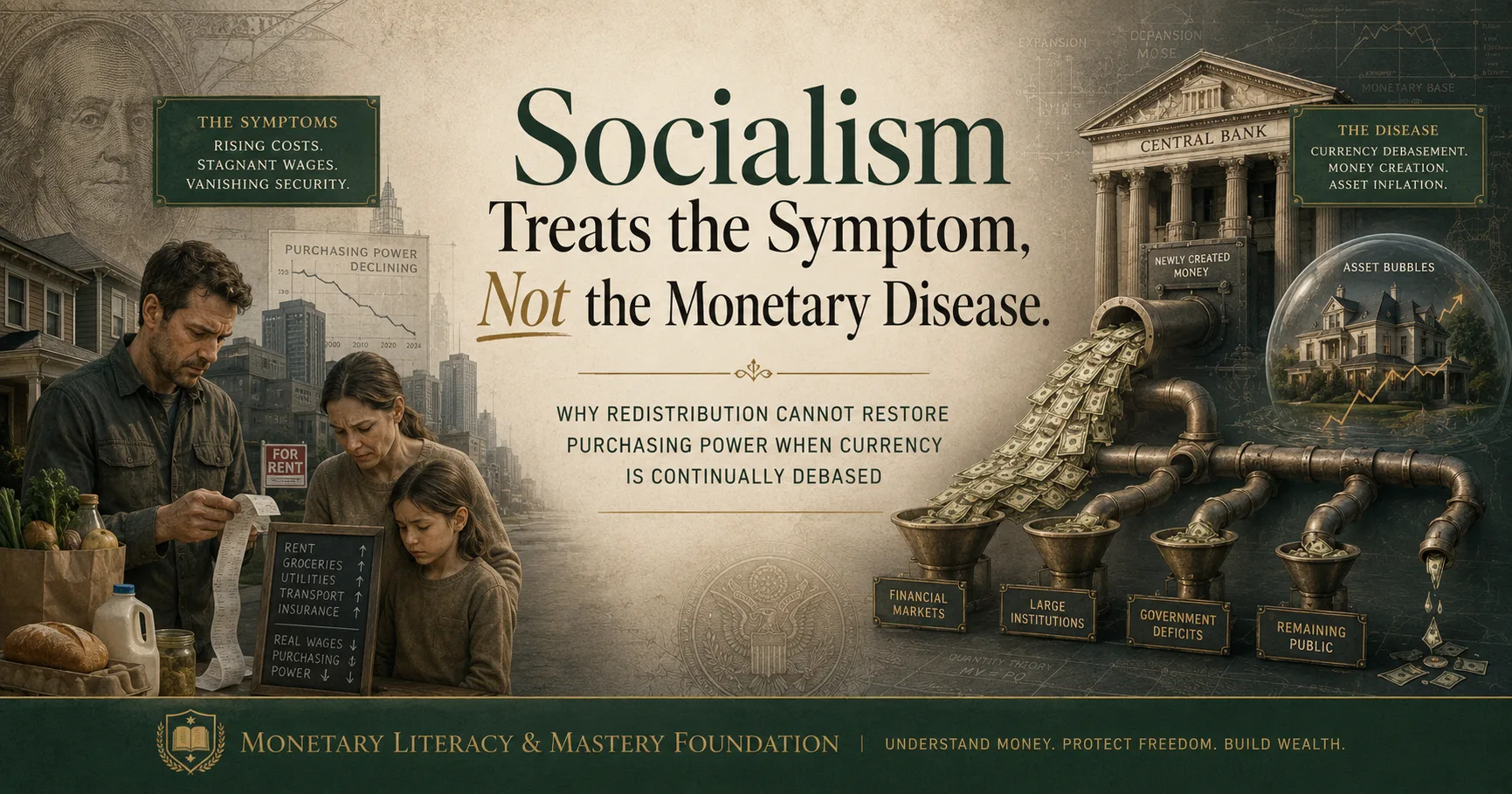
Socialism treats the symptom, not the disease.

Socialism treats the symptom, not the disease.

Socialism treats the symptom, not the disease.

Socialism as Symptom Treatment: Why It Cannot Cure Monetary RotMost people sense that something fundamental has gone wrong. Wages rise on paper yet the grocery bill rent and the cost of a modest home keep pulling further ahead. Savings feel fragile. The middle class appears to shrink even as officia...

Read the full article →

MoneyMan ·Economic Roundtable ·2 months ago
Mises Institute

Mises Institute

Mises Institute

View Link

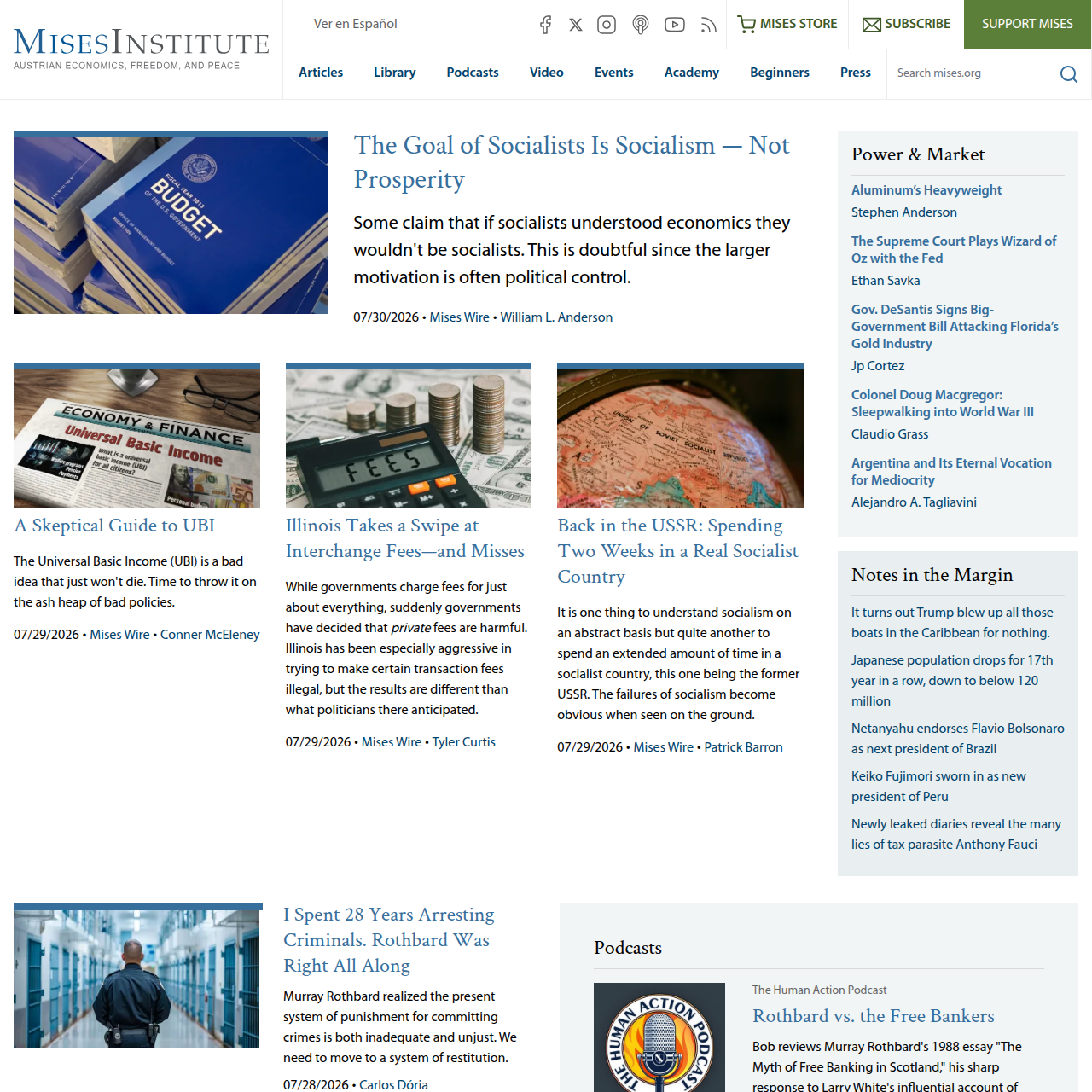
The Mises Institute is a non-profit organization that exists to promote teaching and research in the Austrian School of economics, and individual freedom, honest history, and international peace, in the tradition of Ludwig von Mises and Murray N. Rothbard. These great thinkers developed praxeology, a deductive science of human action based on premises known with certainty to be true, and this is what we teach and advocate. Our scholarly work is founded in Misesian praxeology, and in self-conscious opposition to the mathematical modeling and hypothesis-testing that has created so much confusion in neoclassical economics.

5 replies 258 Read more →
J JennyorAlice ·Economic Roundtable ·4 months ago
How much.....?

How much are you putting into your retirement? Do you think you have enough? Why or why not?

2 replies 324 Read more →
MoneyMan ·Economic Roundtable ·4 months ago
Who is Ludwig von Mises?

Ludwig Heinrich Edler von Mises (1881–1973)

One of the most notable economists and social philosophers of the twentieth century, Ludwig von Mises, in the course of a long and highly productive life, developed an integrated, deduct­ive science of economics based on the fundamental axiom that in­dividual human beings act purposively to achieve desired goals. Even though his economic analysis itself was “value-free” — in the sense of being irrelevant to values held by economists — Mises concluded that the only viable economic policy for the human race was a policy of unrestricted laissez-faire, of free markets and the unhampered exercise of the right of private property, with government strictly limited to the defense of person and property within its territorial area.

For Mises was able to demonstrate (a) that the expansion of free markets, the division of labor, and private capital investment is the only possible path to the prosperity and flourishing of the human race; (b) that socialism would be disastrous for a modern economy because the absence of private ownership of land and capital goods prevents any sort of rational pricing, or estimate of costs, and (c) that government intervention, in addition to hampering and crippling the market, would prove counter-productive and cumulative, leading inevitably to socialism unless the entire tissue of interventions was repealed.

Holding these views, and hewing to truth indomitably in the face of a century increasingly devoted to statism and collectivism, Mises became famous for his “intransigence” in insisting on a non-inflationary gold standard and on laissez-faire.

Effectively barred from any paid university post in Austria and later in the United States, Mises pursued his course gallantly. As the chief economic adviser to the Austrian government in the 1920s, Mises was single-handedly able to slow down Austrian inflation; and he developed his own “private seminar” which attracted the out­standing young economists, social scientists, and philosophers throughout Europe. As the founder of the “neo-Austrian School” of economics, Mises’s business cycle theory, which blamed inflation and depressions on inflationary bank credit encouraged by Central Banks, was adopted by most younger economists in England in the early 1930s as the best explanation of the Great Depression.

Having fled the Nazis to the United States, Mises did some of his most important work here. In over two decades of teaching, he inspired an emerging Austrian School in the United States. The year after Mises died in 1973, his most distinguished follower, F.A. Hayek, was awarded the Nobel Prize in economics for his work in elaborat­ing Mises’s business cycle theory during the later 1920s and 1930s.

Mises was born on Sept 29, 1881, in the city of Lemberg (now Lvov) in Galicia, where his father, a Viennese construction engineer working for the Austrian railroads, was then stationed. Both Mises’s father and mother came from prominent Viennese families; his mother’s uncle, Dr Joachim Landau, served as deputy from the Liberal Party in the Austrian Parliament.

Entering the University of Vienna at the turn of the century as a leftist interventionist, the young Mises discovered Principles of Economics by Carl Menger, the founding work of the Austrian School of economics, and was quickly converted to the Austrian emphasis on individual action rather than unrealistic mechanistic equations as the unit of economics analysis, and to the importance of a free-market economy.

Mises became a prominent post-doctoral student in the famous University of Vienna seminar of the great Austrian economist Eugen von Bohm-Bawerk (among whose many accomplishments was the devastating refutation of the Marxian labor theory of value).

During this period, in his first great work, The Theory of Money and Credit (1912) Mises performed what had been deemed an impossible task: to integrate the theory of money into the general theory of marginal utility and price (what would now be called integrating “macroeconomics” into “microeconomics.”) Since Bohm-Bawerk and his other Austrian colleagues did not accept Mises’s integration and remained without a monetary theory, he was therefore obliged to strike out on his own and found a “neo­-Austrian” school.

In his monetary theory, Mises revived the long forgotten British Currency School principle, prominent until the 1850s, that society does not at all benefit from any increase in the money supply, that increased money and bank credit only causes inflation and business cycles, and that therefore government policy should maintain the equivalent of a 100 percent gold standard.

Mises added to this insight the elements of his business cycle theory: that credit expansion by the banks, in addition to causing inflation, makes depressions inevitable by causing “malinvestment,” i.e. by inducing businessmen to overinvest in “higher orders” of capital goods (machine tools, construction, etc.) and to underinvest in consumer goods.

The problem is that inflationary bank credit, when loaned to business, masquerades as pseudo-savings, and makes businessmen believe that there are more savings available to invest in capital goods production than consumers are genuinely willing to save. Hence, an inflationary boom requires a recession which becomes a painful but necessary process by which the market liquidates unsound investments and reestablishes the investment and production structure that best satisfies consumer preferences and demands.

Mises, and his follower Hayek, developed this cycle theory during the 1920s, on the basis of which Mises was able to warn an unheeding world that the widely trumpeted “New Era” of permanent prosperity of the 192Os was a sham, and that its inevitable result would be bank panic and depression. When Hayek was invited to teach at the London School of Economics in 1931 by an influential former student at Mises’s private seminar, Lionel Robbins, Hayek was able to convert most of the younger English economists to this perspective. On a collision course with John Maynard Keynes and his disciples at Cambridge, Hayek demolished Keynes’s Treatise on Money, but lost the battle and most of his followers to the tidal wave of the Keynesian Revolution that swept the economic world after the publication of Keynes’s General Theory in 1936.

The policy prescriptions for business cycles of Mises-Hayek and of Keynes were diametrically opposed. During a boom period, Mises counseled the immediate end of all bank credit and monetary expansion; and, during a recession, he advised strict laissez-faire, allowing the readjustment forces of the recession to work themselves out as rapidly as possible.

Not only that: for Mises the worst form of intervention would be to prop up prices or wage rates, causing unemployment, to increase the money supply, or to boost government spending in order to stimulate consumption. For Mises, the recession was a problem of under-saving, and over-consumption, and it was therefore important to encourage savings and thrift rather than the opposite, to cut government spending rather than increase it. It is clear that, from 1936 on Mises was totally in opposition to the worldwide fashion in macroeconomic policy.

Socialism-communism had triumphed in Russia and in much of Europe during and after World War I, and Mises was moved to publish his famous article, “Economic Calculation in the Socialist Commonwealth,” (1920) in which he demonstrated that it would be impossible for a socialist planning board to plan a modern economic system; furthermore, no attempt at artificial “markets” would work, since a genuine pricing and costing system requires an exchange of property titles, and therefore private property in the means of production.

Mises developed the article into his book Socialism(1922), a comprehensive philosophical and sociological, as well as economic critique which still stands as the most thorough and devastating demolition of socialism ever written. Mises’s Socialism converted many prominent economists and social philosophers out of socialism, including Hayek, the German Wilhelm Ropke, and the Englishman Lionel Robbins.

In the United States, the publication of the English translation of Socialism in 1936 attracted the admiration of the prominent economic journalist Henry Hazlitt, who reviewed it in the New York Times, and converted one of America’s most prominent and learned Communist fellow-travelers of the period, J.B. Matthews, to a Misesian position and to opposition to all forms of socialism.

Socialists throughout Europe and the United States worried about the problem of economic calculation under socialism for about fifteen years, finally pronouncing the problem solved with the promulgation of the “market socialism” model of the Polish economist Oskar Lange in 1936. Lange returned to Poland after World War II to help plan Polish Communism. The collapse of socialist planning, in Poland and the other Communist countries in 1989, left Establishment economists across the ideological spectrum, all of whom bought the Lange “solution”, mightily embarrassed.

Some prominent socialists, such as Robert Heilbroner, have had the grace to admit publicly that “Mises was right” all along (the phrase “Mises was Right” was the title of a panel at the annual 1990 meeting of the Southern Economic Association at New Orleans).

If socialism was an economic catastrophe, government inter­vention could not work, and would tend to lead inevitably to socialism. Mises elaborated these insights in his Critique of Interventionism (1929), and set forth his political philosophy of laissez-faire liberalism in his Liberalism (1927).

In adition to setting himself against all the political trends of the twentieth century, Mises combated with equal fervor and eloquence what he considered the disastrous dominant philosophical and methodological trends, in economics and other disciplines. These included positivism, relativism, historicism, polylogism” the idea that each race and gender has its own “logic” and there­fore cannot communicate with other groups), and all forms of irrationalism and denial of objective truth. Mises also developed what he considered to be the proper methodology of economic theory--logical deduction from evident axioms, which he labeled “praxeo­logy”, and he leveled trenchant critiques of the growing tendency in economics and other disciplines to replace praxeology and histor­ical understanding by unrealistic mathematical models and statistical manipulations.

Emigrating to the United States in 1940, Mises’s first two books in English were important and influential. His Omnipotent Government (1944) was the first book to challenge the then-standard Marxian view that fascism and Nazism were imposed upon their nations by big business and the “capitalist class.” His Bureaucracy (1944) was a still unsurpassed analysis of why government operation must necessarily be “bureaucratic” and suffer from all the ills of bureaucracy.

Mises’s most monumental achievement was his Human Action (1949), the first comprehensive treatise on economic theory written since the first World War. Here Mises took up the challenge of his own methodology and research program and elaborated an integrated and massive structure of economic theory on his own deductive, “praxeological” principles. Published in an era when economists and governments generally were totally dedicated to statism and Keynesian inflation, Human Action was unread by the economics profession. Finally, in 1957 Mises published his last major work, Theory and History, which, in addition to refutations of Marxism and historicism, set forth the basic differences and functions of theory and of history in economics as well as all the various disciplines of human action.

In the United States as in his native Austria, Mises could not find a paid post in academia. New York University, where he taught from until 1945 until his retirement at the age of 88 in 1969, would only designate him as Visiting Professor, and his salary had to be paid by the conservative-libertarian William Volker Fund until 1962, and after that by a consortium of free-market foundations and businessmen. Despite the unfavorable climate, Mises inspired a growing group of students and admirers, cheer­fully encouraged their scholarship, and himself continued his remarkable productivity.

Mises was also sustained by and worked together with free­-market and libertarian admirers. From its origin in 1946 until his death, Mises was a part-time staff member of the Foundation for Economic Education at Irvington-on-Hudson, New York; and he was in the 1950s an economic advisor to the National Association of Manufacturers (NAM) working with their laissez-faire wing which finally lost out to the tide of “enlightened” statism.

As a free trader and a classical liberal in the tradition of Cobden, Bright, and Spencer, Mises was a libertarian who champ­ioned reason and individual liberty in personal as well as eco­nomic matters. As a rationalist and an opponent of statism in all its forms, Mises would never call himself a “conservative,” but rather a liberal in the nineteenth-century sense.

Indeed, Mises was politically a laissez-faire radical, who denounced tariffs, immigration restrictions, or governmental attempts to enforce morality. On the other hand, Mises was a staunch cultural and sociological conservative, who attacked egalitarianism, strongly denounced political feminism as a facet of socialism. In contrast to many conservative critics of capitalism, Mises held that personal morality and the nuclear family were both essential to, and fostered by, a system of free-market capitalism.

Mises’s influence was remarkable, considering the unpopularity of his epistemological and political views. His students of the 1920s, even those who later became Keynesians, were permanently stamped by a visible Misesian influence. These students included, in addition to Hayek and Robbins, Fritz Machlup, Gottfried von Haberler, Oskar Morgenstern, Alfred Schutz, Hugh Gaitskell, Howard S. Ellis, John Van Sickle, and Erich Voegelin.

In France, General DeGaulle’s major economic and monetary adviser, who helped swing France away from socialism, was Jacques Rueff, an old-friend and admirer of Mises. And part of post-World War II Italy’s shift away from socialism was due to its President Luigi Einaudi, a distinguished economist and long-time friend and free-market colleague of Mises. In the United States, Mises was scarcely as influential. Under less promising academic conditions, his students and admirers included Henry Hazlitt, Lawrence Fertig, Percy Greaves, Jr., Bettina Bien Graeves, Hans F. Sennholz, William H. Peterson, Louis M. Spadaro, Israel M. Kirzner, Ralph Raico, George Reisman, and Murray N. Rothbard. But Mises was able to build a remarkably strong and loyal following among businessmen and other non-academics; his massive and complex Human Action has sold extraordinarily well ever since the year of its original publication.

Since Mises’s death in New York City on October 10, 1973 at the age of 92, Misesian doctrine and influence has experienced a ren­aissance. The following year saw not only Hayek’s Nobel Prize for Misesian cycle theory, but also the first of many Austrian School conferences in the United States. Books by Mises have been reprinted and collections of his articles translated and published. Courses and programs in Austrian Economics have been taught and established throughout the country.

Taking the lead in this revival of Mises and in the study and expansion of Misesian doctrine has been the Ludwig von Mises Institute, founded by Lle­wellyn Rockwell, Jr. in 1982 and headquartered in Auburn, Alabama. The Mises Institute publishes scholarly journals and books, and offers courses in elementary, intermediate and advanced Austrian economics, which attract in­creasing numbers of students and professors. Undoubtedly, the collapse of socialism and the increased attractiveness of the free market have greatly contributed to this upsurge of popularity.
5 replies 457 Read more →
J JennyorAlice ·Economic Roundtable ·4 months ago
Emergencies?

Do you keep money set aside for emergencies? Why or why not?

4 replies 350 Read more →
MoneyMan ·Economic Roundtable ·4 months ago
Monetary and Economic Q&A

If there happens to be some question weighing on your mind, or something you don't quite understand that isn't clicking pertaining to monetary operations or economics, ask here! I'll do my best to answer and maybe others here will have answers too!

8 replies 514 Read more →
R Ravenfreak ·Economic Roundtable ·4 months ago
Is it worth hiring a financial advisor?

I work at a bank in operations, and my manager got on the subject of having a financial advisor in a meeting she had with myself and a few other people who were new to the department. She mentioned that she has one, it makes sense to have one right? Or are you better off just managing your spending and budgeting on your own?

6 replies 565 Read more →
H Henry ·Economic Roundtable ·3 months ago
What is the best way to raising business capital?

When it comes to generating capital that is used for certain businesses, there are a lot of ways that one can do it. As a person who has a business, what was the best way that you used to build capital for the business that you are doing at the moment?

H Henry ·Economic Roundtable ·3 months ago
What is the major factor for business successes?

There are different factors that businesses can lay their hands upon as the reason that they became successful. For some, it is the situation where they applied what they learnt from other businesses doing well where as for those, consistent marketing does it for them. As a person, what would you say is the major reason businesses excel around your area?

H Henry ·Economic Roundtable ·3 months ago
How much do you know about taxation as a business owner?

Taxation is a key part of government revenue. Governments all over the world use taxation as a means to generate revenue that they use in handling certain key projects in the economy.

As one who is planning to start a business or already have one, how much do you know about taxation, and which ones do you need to pay?

Nomad ·Economic Roundtable ·4 months ago
Do you like to use credit card or debit card?

Even though I have debit card as well as credit card, I like to use credit card more than debit card. With credit card, I can use bank's money for 45 days for free. secondly, I also get cash backs and points for using credit cards, I can use cash backs towards purchases and convert points into purchase credit. Why should I use my money when I can use bank's money for free for 45 days?

5 replies 431 Read more →
J Ja sa bong ·Economic Roundtable ·3 months ago
What is the biggest amount you've invested on a coin?

Cryptocurrency is a very risky investment project because of how volatile it can be. A coin might be pumping high now and the next minute, it's dumping hard. This makes investors lose so much money within a short period of time. If you're investing in cryptocurrency, it's better to invest smart and with caution.

What is the biggest amount you've invested on a coin?

1 reply 368 Read more →
J Ja sa bong ·Economic Roundtable ·3 months ago
Do you think survey is a good side hustle?

Survey websites are still one of the oldest means students or anyone can make money from if they have the time to answer those questions. Some people consider it a waste of time because most survey websites doesn't pay well.

Have you ever used any survey website? How much did you earn form it?

1 reply 263 Read more →
Load more
ForumSpark © 2023 - 2026 · ForumSpark.net · Terms