Join the Monetary Literacy & Mastery Foundation to understand how money, banking, inflation, and central banking really work. Free educational resources, community discussions, and structured learning for sound money principles.
He claims he went there and all of the gold was there, but do you think he actually did a thorough audit? I don't, but I believe he saw all of the gold there.
How does Paris get fed? Frédéric Bastiat famously explained in Economic Sophisms (1845) how market exchange reliably provisioned the (then) million people of Paris with agricultural produce from the countryside that they were able to enjoy "peaceful slumbers...not disturbed for a single instant...."
In stark contrast, Bastiat predicted that there would be "much suffering within the walls of Paris - poverty, despair, perhaps starvation..." if a presumptuous minister decided to replace the market with their own decision-making for what "should be produced, transported, exchanged and consumed...."
We can appreciate Bastiat's observation about the miraculous functioning of the market even more when we look at a time when Paris actually went hungry.
France's Experiment in Forced Provisioning
Leading up to the French Revolution in 1789, France found itself in a precarious fiscal position. It had accumulated crippling debt from the Seven Years' War and its support for the American colonies during their War of Independence. This heavy debt burden left the kingdom woefully unprepared to withstand the economic shocks that followed.
Economic shock came in the form of the eruption of the Laki volcano in Iceland in 1783, which contributed to climatic disruptions and poor harvests in France in the years that followed. These problems were compounded by a severe hailstorm in 1788 that devastated crops and livestock, raising prices, especially for bread, which was the main staple at the time. Increased demand for grain to support the military and its draft animals, when France declared war on Austria in 1792 (followed by war with Great Britain), pushed prices even higher. When France implemented a draft that drew agricultural workers into the military and then began requisitioning agricultural horses and wagons, the supply of grain was further reduced.
Henry Bourne, writing a two-part article in the Journal of Political Economy in 1919 about this era, notes that in the fall of 1792, "One of the longest and most important debates [of the National Convention] was upon the best method of insuring a supply of bread at a reasonable price." This was a problem that especially loomed over the major city of Paris. Bourne argues that the threat of starvation fueled not only the French Revolution, but the mob mentality and interventionism that followed. As Bourne writes, "People, in a panic because they do not know where next week's bread, meat, and coal are to be found, are not likely to apply the rules of evidence to every rumor." The French clamored for state intervention on the "fixed idea that dearness and scarcity were the result of speculation" rather than underlying economic conditions.
Transporting grain became a risky enterprise as mobs sprang up to seize it, further decreasing the supply of grain to Paris. To add insult to injury, the transportation of grain to major cities was further suppressed by inflation, which made the issued assignats unappealing to country farmers.
The National Convention and the Paris Commune turned to "a series of ventures in price-fixing and food control" to solve the problem. Bourne notes that "price-fixing became one of the characteristic features of the Reign of Terror." In 1793, the National Convention imposed a maximum price, or what economists today call a price ceiling, on grain. In a futile attempt to warn of the potential consequences, Pierre Vergniaud, who later that year was executed under the accusation of the radical Jacobin Maximilien Robespierre, urged that "If you destroy commerce, you decree famine."
French attempts to deny the economic reality reflected by market prices, by attempting to suppress them, resulted in severe shortages and long lines.
"The scheme not only failed to encourage the farmer, it threatened him with ruin," Bourne noted. "His expenses for tools, draft animals, and wages were steadily rising, but his profits were cut down, with the prospect of further losses every succeeding month."
But politically savvy politicians blamed these disappointing outcomes on greed and used them to justify further interventions backed by the threat of imprisonment and death. The National Convention created a Commission of Subsistence and Provisioning to be the "Food Director" of France. Swarms of officials were commissioned to survey farmers' inventories and fields in an attempt to enable government officials to redirect grain to where it was needed. Rules were issued detailing the precise percentage of bran that millers could extract and even dictated the one type of bread that would be allowed. A bread card rationing system was created but was abused as families failed to report the death of family members to continue receiving the same allotment. Bourne reports that in 1794, rations fell to a single pound of bread for each laborer and three-fourths of a pound for others, and that "it was practically impossible to obtain meat, butter, eggs, oil, and other articles of food commonly regarded as necessary," as price ceilings were extended to these items as well.
Officials attempted to appeal to the higher motives of the people, telling them that they were "brothers and that they should help" even if it meant turning over the grain needed for their family, for storage for future use, or even the seed necessary to plant the next year's crop. This proved insufficient, however, so the officials eventually turned to force.
Bourne writes that "An attempt was made to provide for Paris by compelling every farmer to furnish within twenty-four hours sixteen bushels of wheat for each hide of land." French dragoons were soon released upon the countryside to "scour the country" for food and to arrest any suspected hoarders. As Bourne notes, "merchants were thrown into prison upon the accusation of the first intriguer who shouted out his suspicions at a popular society. The local revolutionary committees acted as judges without appeal. To escape a similar fate the other merchants hastened to dispose of their merchandise and did not restock."
If a farmer had grain in the field but no laborers to gather it, laborers were drafted by local authorities. Millers and bakers in Paris were drafted and forbidden from abandoning their work without sufficient notice. Eventually, the National Convention even attempted to extend maximum price laws to the wages of laborers as well.
Despite the substantial and systematic efforts of the National Convention and the boards of the separate departments of France, Parisians and much of the rest of France, went hungry under government control. In Cahors, people "were so poorly fed that they were falling in the street from sheer weakness." In Nord, "grain of every sort disappeared from the markets..." The people of Paris would stand "with famished eyes" for hours in line "only to be told when their turn came that nothing was left." As Bourne concludes, "If the maximum laws were meant to save the common people from want and wretchedness, they failed."
Bastiat's Market-Fed Paris
It is unclear whether Bastiat, when writing in the 1840s about the remarkable way in which free markets coordinated the efforts of countless individuals to feed Paris every day, was implicitly contrasting this outcome with the French Revolution's earlier rejection of market exchange. He almost certainly knew that revolutionary France had experienced severe food shortages and government price controls, making the contrast between the two episodes striking even if he did not intend it.
As Bastiat stressed, government officials could not replace the information and incentives provided by market prices. Orders, price controls, requisitions, forced sales, and even forced labor failed to feed Paris. When the National Convention tried to do so, it produced exactly the outcome Bastiat had predicted more than half a century later: not peaceful slumbers, but long lines, empty markets, and widespread hunger. Notably, these outcomes began to recede as the Commission was abandoned and markets were restored.
Dr. Daniel J. Smith is the Director of the Political Economy Research Institute and Associate Professor of Economics in the Jones College of Business at Middle Tennessee State University. His academic research and policy work uses Austrian and public choice economics to analyze private and public governance institutions.
I really admire people who build businesses, but the risks and uncertainty can be overwhelming. Do you think owning a business gives the best chance of building long-term wealth, or are there smarter and safer paths like investments?
I've met people who say economics is mostly math, while others disagree. Personally, I really enjoy learning about economics but advanced math is very intimidating for me.
How important do you think math is for understanding economics and making better financial decisions?
Purpose: A concise visual explanation of how today's debt-based monetary system functions.
This short documentary provides an excellent overview of the modern monetary system and serves as a practical introduction before exploring longer documentaries. It reinforces many of the concepts introduced throughout the Monetary Policy lessons, including debt-based money creation, banking, inflation, and the role of central banking.
As you watch, consider the following questions. You don't need to know every answer immediately—the goal is simply to begin thinking critically about how the monetary system operates.
Where does new money actually come from?
How does debt create new currency?
Who benefits first when new money enters the economy?
How does inflation affect purchasing power over time?
Why do many people confuse money with currency?
How does this documentary connect with what you've already learned in Lessons 1 through 6?
Which ideas presented would you like to investigate further?
DOCUMENTARY STUDY COMPANION
▶ Watch by Chapter
Explore the film by topic. Select a chapter to begin watching near that point in the video, then return to the related lessons for a deeper explanation.
Timing note: Chapter starts are approximate, reconstructed from the source film. They should be spot-checked against this edited Rumble video. If chapter JavaScript is unavailable, the links return you to the video without changing its playback position.
HISTORICAL CONTEXT
◷ Then & Now
This excerpt comes from a documentary released in 2008.
The old 10% reserve requirement +
The film uses a 10% reserve requirement and a mechanical multiplier illustration. The Federal Reserve reduced U.S. reserve requirement ratios to 0% on March 26, 2020.
CONTINUE LEARNING
📖 Related Academy Lessons
Refresh the concepts introduced in the documentary.
After watching, share your thoughts below. There are no "right" answers—the goal is to compare ideas, ask questions, and think critically about the concepts presented.
What was the most surprising thing you learned?
Did anything challenge your previous understanding of money or banking?
What questions do you still have?
Would you recommend this documentary to someone new to monetary literacy? Why or why not?
Knowledge only creates change when it is shared. The Monetary Literacy & Mastery Foundation exists to help people better understand money, history, economics, and the often-overlooked ideas that shape our financial world. Every new member who joins our community strengthens that mission.
When you tell others about the Foundation, you are doing more than promoting a forum—you are helping spread financial awareness. Many people spend years working for money without ever being taught how money truly works. By introducing friends, family members, coworkers, and online communities to our educational resources, you help create opportunities for others to learn valuable lessons that can benefit them for a lifetime.
Word-of-mouth is one of the most powerful tools for growth because it is built on trust. People are more likely to explore new ideas when they come from someone they know and respect. A simple recommendation, a shared article, or a discussion about a topic you learned here can spark curiosity and inspire someone to begin their own journey toward monetary literacy.
As our community grows, so does the collective knowledge within it. New perspectives, experiences, and research help us uncover deeper insights and preserve important information that might otherwise remain hidden or forgotten. Every member has the ability to contribute to that growth.
If you have found value in the Foundation, consider sharing it with others. Invite a friend, mention us in a discussion, or share content that helped you learn something new. Together, we can build a stronger, more informed community dedicated to sound money, lifelong learning, and the pursuit of knowledge.
One conversation can change a perspective. One recommendation can change a life. Help us spread the word.
New ECB data show gold has surpassed U.S. Treasuries as the world's second-largest reserve asset, reaching 27% of global reserves. Central banks now hold over 36,000 tonnes of gold, near Bretton Woods-era levels, as countries increasingly favor bullion over sovereign debt amid rising geopolitical tensions and sanctions concerns.
Apple builds and sells iPhones. I happen to own one of the older models, for the same reason I own a last-legs older model car. What if Apple could skip the build part and sell only the phone? The money saved would be an enormous boost to its bottom line. And if Apple passed the savings onto customers I could conceivably afford to upgrade.
Where would the phones come from? From a bookkeeping entry, of course.
Unfortunately, Apple's customers are very demanding and want the real things, so the build operations will have to stay. Perhaps their executives looked upon another business and envied their ability to sell loans without drawing down their savings. Customer with good credit wants a loan? Create the amount with a few taps on a keyboard and send him on his way.
The customer will spend his newly-acquired money, thus keeping people employed. Since he has good credit, he will be able to make monthly payments, and the lender, the bank, will normally apply his payments to extinguish the loan, with the interest being the bank's profit. Everyone's happy and the economy keeps expanding until it busts.
Experts will diagnose the bust. The usual fiends will get blamed. Government will step in to cure the problem its monetary and banking interventions helped create. The economy will slowly recover and continue on the same path as before, meaning banks will continue extending credit from ether rather than savings.
How did this racket get started? It's complicated. That's one reason it works-the crime doesn't exist if enough people don't see it.
Gold and silver coins have long served as money, until more recent times. For government, gold became an economic culprit during the Great Depression, as explained by JM Bullion,
The Great Depression officially began on October 28, 1929, when the Dow Jones Industrial Average lost 13% of its value in a single day. The following day, it dropped an additional 12%, and in a matter of weeks, it was worth half as much as before.
In response, consumer confidence plummeted, and people began withdrawing their money from banks as quickly as possible. Banks, which work with reserves and don't keep much of their deposits on hand, began closing their doors. (emphasis added)
Bank-created money was disappearing, and prices fell accordingly. Let's expand on this.
The Federal Reserve Act of 1913 required the Fed to hold gold equal to only 40 percent of the currency it issued. By adjusting interest rates, the Fed could increase or decrease its stock of gold. Higher interest rates shifted "gold from the pockets of the public (both here and abroad) to the vaults of Federal Reserve district and member banks." Conversely, lower rates drove gold from the Fed's "coffers into the hands of the public both at home and overseas."
During the panics of 1930-1931 people were losing their trust in banks. A depositor with $1,000 in a shaky local bank could protect himself from that bank's failure by withdrawing $1,000 in currency. The dollars-fully redeemable in gold coin-gave him needed purchasing power. But the bank now had $1,000 less on which to pyramid new loans.
After Britain abandoned the gold standard on September 21, 1931, foreign holders of dollar assets began converting them into gold. Americans rightly feared Roosevelt would do the same when he took office on March 4, 1933. An owner of a $1,000 note or checking account would risk losing his legal ability to convert it into gold at $20.67 per ounce.
People knew what was real and they lined up at banks demanding gold. But the dual legality of fractional reserves and the promise of 100 percent redemption of notes and deposits made banks vulnerable to a panicked crowd demanding redemption. Thirty-six hours after his inauguration, Roosevelt shut down the banks for a week (the Bank Holiday of 1933). A month later he ordered Americans to surrender their gold or face heavy fines and imprisonment.
The inflationary Fed system wasn't limited to Wall Street, though stock market margin credit played a significant role during the 1920s. Businesses, farmers, real-estate borrowers and ordinary bank customers were also drinking the elixir of Fed bank credit.
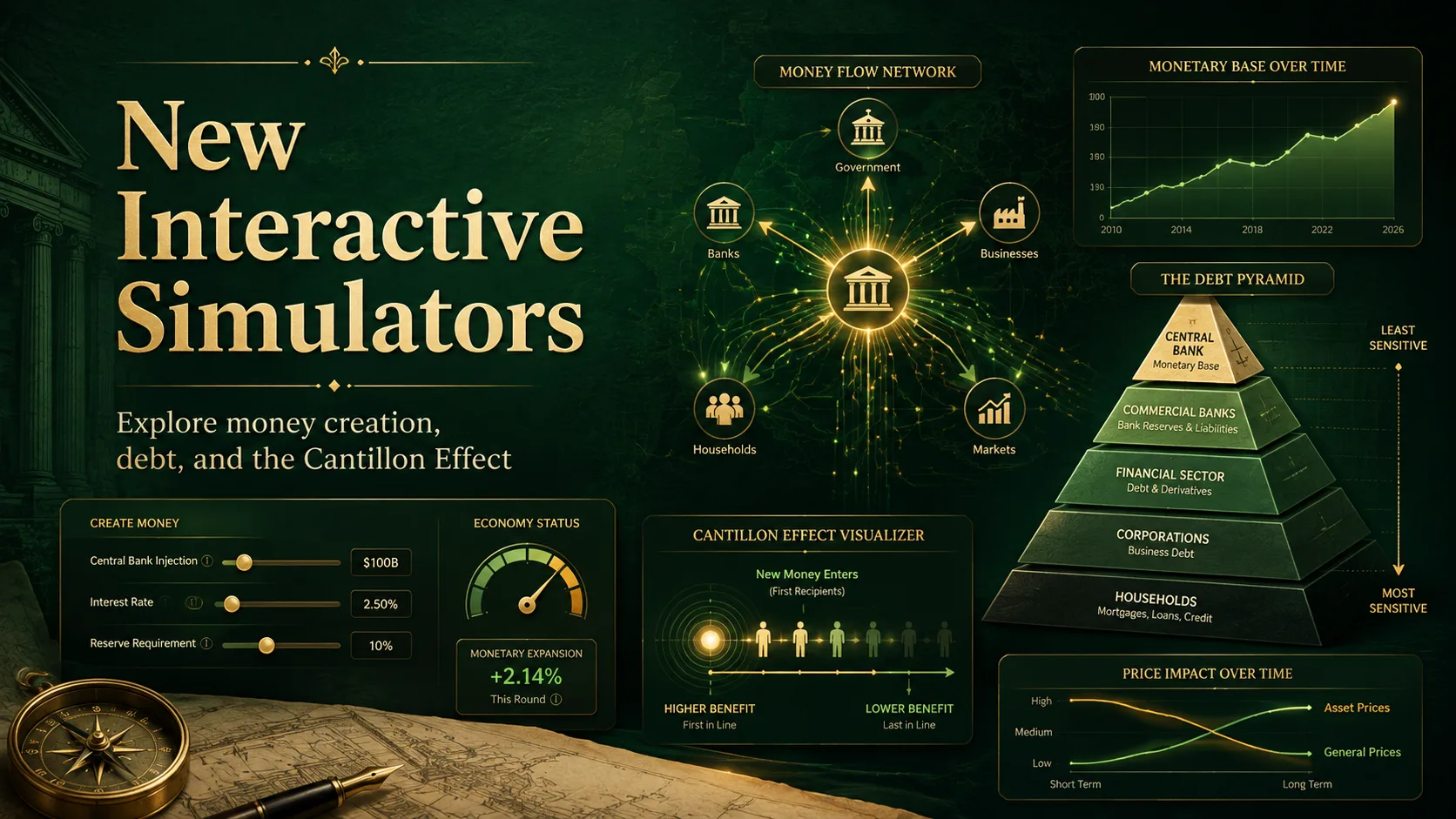
The Monetary Literacy & Mastery Foundation has introduced four interactive simulators designed to make complex monetary concepts easier to understand through experimentation.Rather than simply reading about how monetary systems work, visitors can now adjust variables, observe outcomes, and see i...
Join the Dots is your daily guide to global geopolitical events and their macroeconomic impact. With 40 years of experience — including roles in UK, US, and Swiss banks — I’ve seen it all: from calling the 1992 ERM crisis, the 2008 GFC, the Eurobond crisis of 2011, to predicting the 2008/9 Dubai Property Crash live on radio in June '08. In early 2020, I called the S&P bottom at 2000–2200 due to Covid.
How? I find and listen to the best voices. No one knows everything — but the truth is out there. This channel filters out the noise, lies, and spin to bring you clear, fact-based macro insights. I connect the dots between data, policy, markets, and geopolitics — so you don’t have to.
What you’ll find here:
1. The truth
2. Daily global economic roundups 3. Honest, independent macro commentary
August 15th is the 55th anniversary of the Nixon shock this year. This is when the last vestiges of the gold standard was ended and we went to pure debt based fiat currency.
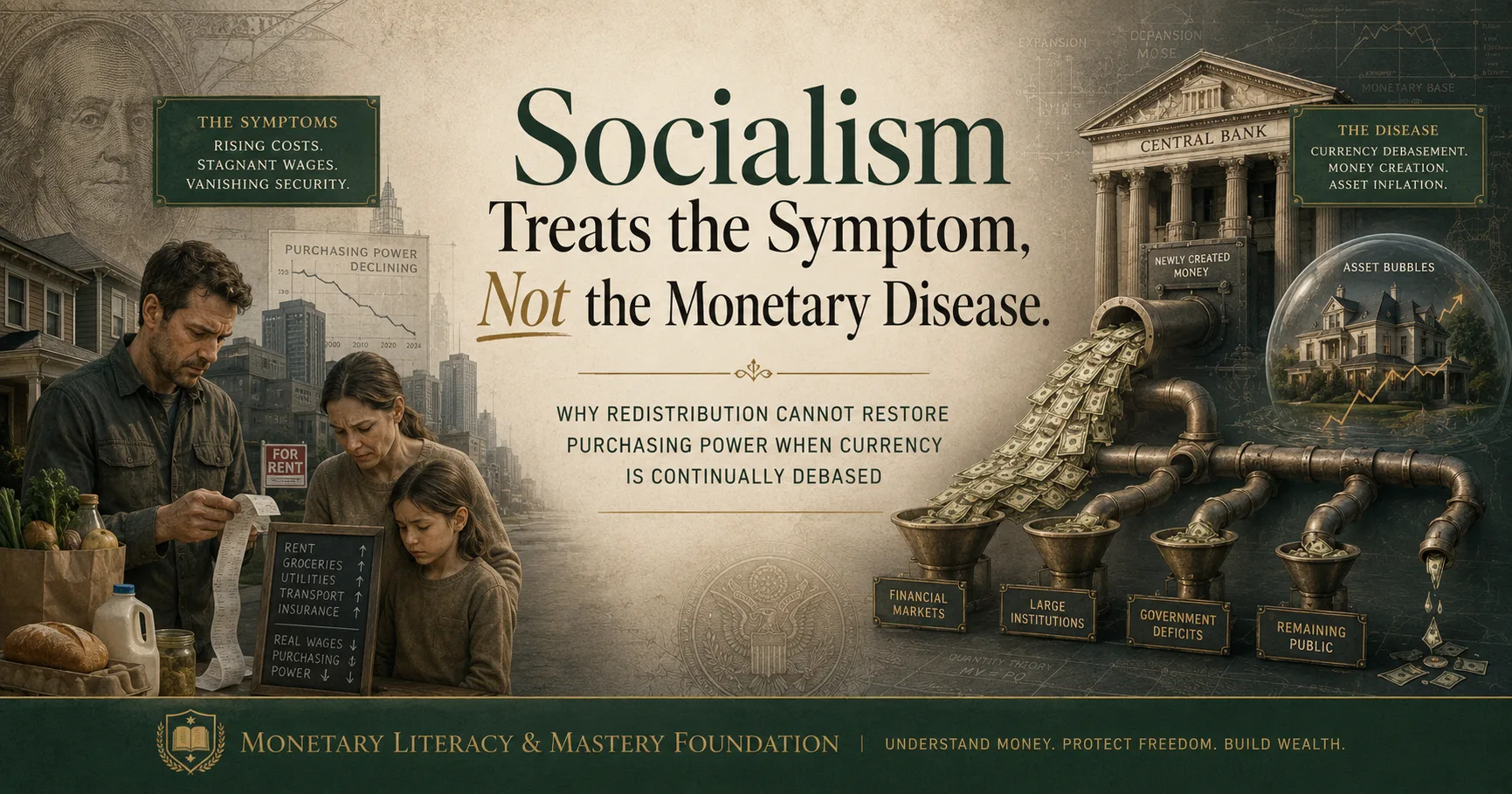
Socialism as Symptom Treatment: Why It Cannot Cure Monetary RotMost people sense that something fundamental has gone wrong. Wages rise on paper yet the grocery bill rent and the cost of a modest home keep pulling further ahead. Savings feel fragile. The middle class appears to shrink even as officia...
Recommended After: Completing the Monetary Policy section and the Sound Money lessons.
Purpose: Explore the relationship between fiat money, inflation, debt, asset markets, and purchasing power through the perspective of one of the early critics of post-Bretton Woods monetary policy.
The Invisible Crash examines the long-term consequences of abandoning sound money and transitioning to a global fiat monetary system. Written shortly after the collapse of the Bretton Woods system, James Dines argues that excessive money creation, growing government debt, and persistent inflation gradually erode purchasing power while creating the appearance of economic prosperity.
Rather than focusing on a single market crash, the book describes what the author viewed as a slow deterioration of monetary integrity—one in which inflation, debt expansion, and currency debasement quietly reshape the economy over decades. As with every book in this Academy, readers are encouraged to compare the author's arguments with other historical sources and economic perspectives.
James Dines was an American investment analyst, author, and market forecaster known for his long-term economic and commodity research. Throughout his career, he emphasized independent thinking, monetary trends, precious metals, and the importance of preserving purchasing power during periods of inflation and monetary instability.
🔗 Resources
Availability:The Invisible Crash is no longer in print. Used copies occasionally become available through online booksellers, and an archived digital edition is available for educational research.
Although written in 1975, The Invisible Crash continues to raise questions about inflation, monetary policy, and the long-term preservation of purchasing power. Take a few moments to reflect before joining the discussion below.
Reflection Questions
What argument from the book stood out most to you?
How does the author distinguish between nominal gains and real wealth?
Did the book change your perspective on inflation or asset prices?
Which historical predictions appear most significant in hindsight?
Would you recommend this book to someone studying monetary history? Why or why not?
Join the Discussion
Share your thoughts below. Discuss the book's historical context, its economic arguments, and how its ideas compare with the lessons and documentaries you've completed throughout the Academy. Respectful, evidence-based discussion is encouraged.
What if the safest place for your money isn't inside a bank at all?
In this episode, Daniel Diaz welcomes David Schlereth, the newest board member of Citizens 4 Sound Money!
David breaks down his journey into the liberty movement, why the Federal Reserve System is "the greatest scam in human history," and how everyday citizens can protect their hard-earned wealth by stepping outside the traditional banking system.
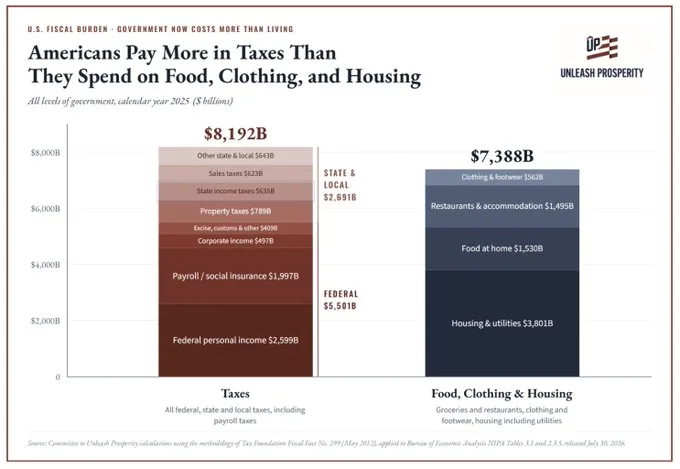
Economist Stephen Moore said Americans now pay more in taxes than they spend on food, clothing and housing combined, arguing the growing tax burden shows government has become “so big and bloated.”
In a post shared on X on Wednesday, Moore cited a chart from the Committee to Unleash Prosperity estimating Americans paid about $8.19 trillion in taxes in 2025, compared with roughly $7.39 trillion spent on food, clothing and housing combined. “Government has become so big and bloated that taxes cost more than life’s basic necessities,” Moore wrote. “Every American taxpayer should be outraged.”
Moore’s comments come as many Americans say they already feel overburdened by taxes. A Pew Research Center survey published in April found that 60% of U.S. adults believe they pay more in federal taxes than is fair, up from 56% in 2023.
What is the difference between money and currency?
In Episode 1 of Hidden Secrets of Money, Mike Maloney begins the journey by explaining one of the most important financial lessons most people are never taught: money and currency are not the same thing.
This episode explores why gold and silver have served as real money for thousands of years, why fiat currencies eventually fail, and how currency can quietly steal your two most valuable assets — your time and your freedom.
Having explored the nature of bank deposits and the
protections available to depositors, we now examine
another widely misunderstood financial relationship:
securities ownership. Most investors believe the
stocks displayed in their brokerage accounts are
legally registered in their own names. In reality,
modern securities law tells a more complicated story
involving intermediaries, beneficial ownership, and
counterparty risk. Understanding these distinctions
is essential to knowing what investors actually own
and the risks they may face.
When you purchase stock through your brokerage account, do you
actually become the legal owner of those shares—or do you merely
own a claim against someone else who does?
01
OWNERSHIP
Part 1 • What Do You Actually Own?
Most Americans believe that when they “buy” a stock, bond, or
exchange-traded fund in a brokerage account, they become the legal
owner of that security. The statement shows their name, and the
shares appear as belonging to them.
But in the modern U.S. securities system, that intuition is often
wrong in the way that matters most: legal title and control. What
most investors hold is not a directly owned asset recorded in
their name, but a contractual claim—what the law calls a
“security entitlement”—against a financial intermediary.
That may sound like semantics until one asks a simple question:
In a systemic financial collapse, who is first in line to retrieve
those securities? In other words, the difference between owning an
asset and holding a claim can determine whether investors’ assets
are legally subordinated to other claims, and whether investors
recover their assets at all.
The answer depends less on what your account statement says and
more on how Wall Street’s plumbing and a little-known uniform
state law governing securities ownership were built to perform
under stress.
BIG IDEA
In today's securities markets, most investors are not the
registered owners of the securities they purchase. Instead, they
generally possess a legal claim—known as a
security entitlement—through a chain of financial
intermediaries.
KEY DISTINCTION
REGISTERED OWNER
The party whose name appears on the issuer's
official ownership records.
VS
BENEFICIAL OWNER
The investor who receives the economic benefits
through an intermediary relationship.
02
MARKET STRUCTURE
Part 2 • The Invisible Owner of Record
For most of the history of securities markets—from English common
law through much of the 20th century—investors who bought shares
were recognized as their legal owners, often holding certificates
in their own name. Trades were slower, more cumbersome, and
paper-intensive, but ownership was straightforward. If you bought
shares, you were typically the registered owner by default.
That is no longer how most securities ownership works.
The modern system is built around a centralized clearing and
custody structure dominated by the Depository Trust Co. (DTC), a
privately owned institution controlled by the largest U.S. banks
and broker-dealers. In broad terms, major brokers and banks
“deposit” investors’ securities at the DTC, which holds them in
pooled form. The registered owner reflected on issuer records is
typically not the end investor and often not even the brokerage
firm the end investor uses. It is DTC’s nominee,
Cede & Co.
Here is the practical consequence: When you “own” a stock through
a brokerage account, you are generally what is called a
“beneficial owner” credited on your broker’s books. The owner of
record is upstream, and the securities themselves sit in a
centralized system designed to reduce costs and manage
institutional risk—rather than to preserve clear, direct
ownership for ordinary investors.
If that sounds like a technicality, think of the difference
between owning a car and leasing a car. A lease can give you many
of the benefits of use, but it is not the same legal relationship
to the underlying property. In the same way, a security
entitlement can provide financial benefits from an asset while
leaving the investor multiple steps removed from legal title and
direct control.
This distinction, quietly normalized over decades, has created a
fragile kind of “ownership” that many investors do not understand
and that policymakers have not adequately confronted. I explored
these issues in greater depth in The Next Big Crash, a
book I coauthored that examines how modern financial market
structures put investors at serious risk during moments of
systemic financial stress.
VISUAL SUMMARY · WHO REALLY OWNS YOUR STOCK?
Follow the Ownership Chain
YOU
BENEFICIAL OWNER
→
BROKERAGE FIRM
→
DEPOSITORY TRUST COMPANY
→
CEDE & CO.
REGISTERED OWNER
VISUAL SUMMARY
In the modern securities system, investors are generally
beneficial owners, while legal title is held through a centralized
chain ending with DTC's nominee, Cede & Co.
FROM THE READING ROOM
A Perspective from David Rogers Webb
“Ownership of securities as property has been replaced with a new legal concept of a ‘security entitlement’…”
— David Rogers Webb · Chapter III, Security Entitlement
Webb argues that the shift from direct registration to security entitlements changes the risks investors face when intermediaries fail. Article 8 still gives entitlement holders defined property interests and protections. The important question is how those rights operate when custody shortfalls, competing secured claims, or insolvency arise.
The Great TakingEssential Reading · David Rogers Webb (2023)
Part 3 • The Legal Structure That Decides Priority
Wall Street’s indirect holding system might be defensible if it
merely replaced paper certificates with electronic records while
preserving the investor’s core property rights. But that is not
what has happened. The deeper shift occurred in the law that
governs these relationships—Article 8 of the Uniform Commercial
Code—which has been amended and adopted by every state legislature
in the country.
In plain English, Article 8 establishes that the securities
credited to customers at a brokerage are generally not supposed to
be treated as the brokerage firm’s property. That sounds
comforting, until one reaches the key exception clauses in the
statute, which clearly state that under certain conditions, a
broker’s secured creditor gains priority over the assets of the
broker’s customer.
This is not a fringe interpretation. It is explicitly stated in
the law itself, which has been sharply criticized by leading
securities law scholars. If a broker pledges its customers’
securities as collateral and their creditor gains legal
“control,” that creditor stands ahead of the customers who bought
the securities. Crucially, this applies even if brokers have acted
improperly or illegally, as long as collusion with the creditor
cannot be proven.
To most people, that should feel backward. If you pay for an
asset, you should not lose it because your middleman used
it—properly or improperly—to fund its own survival.
But under the modern regime, what many customers have is not a
direct, registered ownership interest in a specific,
identifiable security. Instead, they have a contractual claim
defined by the intermediary system and the priority rules that
put banks first during an economic crisis.
BIG IDEA
During periods of financial stress, the distinction between
owning an asset outright and holding a contractual claim against
an intermediary can determine who has first legal priority.
⚖
VISUAL SUMMARY
Priority Chain During a Crisis
PRIORITY CHAIN DURING A CRISIS
What Happens When Intermediary Assets Are Pledged?
INVESTOR PURCHASES STOCK
→
BROKER HOLDS SECURITIES
→
SECURITIES PLEDGED AS COLLATERAL
→
SECURED CREDITOR MAY RECEIVE PRIORITY
VISUAL SUMMARY
Under certain legal circumstances, secured creditors may obtain
priority over customer claims when intermediary-held securities
have been pledged as collateral.
?
THINK ABOUT THIS
If you pay for an asset but another institution remains
the registered owner, what exactly does the word
“ownership” mean?
04
CUSTOMER PROTECTION
Part 4 • "Customer Protection" Is Not the Same as Ownership
Defenders of the current structure will point out that there are
rules intended to protect customer assets. They are right. There
are segregation requirements, reporting requirements, and
oversight mechanisms. There is an entire framework that assumes
that customer property can be kept separate from a failing firm’s
creditors.
The problem is that rules are not self-enforcing, especially in a
crisis. And history shows that when financial firms face
existential pressure, the temptation to treat customer property as
a lifeline can become overwhelming.
2008
HISTORICAL CASE STUDY
Lehman Brothers
The collapse of Lehman Brothers illustrates the danger. In the
years leading up to its failure, Lehman routinely violated
customer segregation requirements by pledging customer securities
to JPMorgan Chase to secure its own borrowing. When Lehman
collapsed in 2008, JPMorgan asserted secured claims over those
assets, freezing large quantities of customer property inside the
bankruptcy estate. Many customers did not receive their assets for
nearly five years as secured creditors litigated priority over
pledged customer assets.
2007
HISTORICAL CASE STUDY
Sentinel Management Group
Lehman was not an isolated case. In 2007, Sentinel Management
Group commingled and pledged hundreds of millions of dollars in
customer securities as collateral for a revolving credit line,
triggering years of litigation over whether a bank’s secured claim
could override investor rights. Most customers were not made whole
for nearly a decade.
2011
HISTORICAL CASE STUDY
MF Global
In 2011, MF Global filed false segregation reports and unlawfully
tapped segregated customer accounts to meet margin calls, leaving
tens of thousands of customers without access to funds they relied
on for routine operations. Even when recoveries eventually
occurred, the process took years.
COMMON THREAD
These episodes differ in detail, but they share a theme:
Protections that investors assume to be absolute can fail in
practice. And when they do, investors can be thrown into
prolonged legal uncertainty. Even a “successful” recovery can be
devastating when retirement savings, liquidity, or margin
collateral are frozen for months or years.
HISTORICAL STRESS TESTS
When Investor Protections Were Tested
SENTINEL 2007
→
LEHMAN 2008
→
MF GLOBAL 2011
→
YEARS OF LEGAL UNCERTAINTY
05
INVESTOR PROTECTION
Part 5 • The Limits of Investor Protection
Some readers may point to the Securities Investor Protection Corp.
(SIPC) as a safeguard. SIPC does provide limited insurance when a
brokerage firm fails. But like the Federal Deposit Insurance Corp.
for banks, it was designed to manage isolated insolvencies—not
systemic financial crises. Its reserves total less than $5
billion, a minuscule number compared with the tens of trillions of
dollars held at major brokerage firms. More importantly, SIPC
cannot prevent customer assets from being frozen or subordinated
while insolvency proceedings unfold.
The uncomfortable truth is that "customer protection" in an
intermediary system is not the same as being the registered owner
with clear property rights. It is a set of promises and
procedures that depend on compliance, monitoring, solvency, and
the willingness of institutions to follow the rules when doing so
is more costly than breaking them.
OWNERSHIP VS. ENTITLEMENT
DIRECT OWNERSHIP
Clear Property Rights
VS
SECURITY ENTITLEMENT
Contractual Claim Through Intermediaries
VISUAL SUMMARY
Direct ownership and a security entitlement may appear similar
during normal market conditions, but they represent fundamentally
different legal relationships.
06
PROPERTY RIGHTS
Part 6 • Why This Matters
None of this is an argument for widespread panic, nor a claim that
every investor is doomed. It is a diagnosis of a real property
rights vulnerability embedded in the architecture of modern
finance.
If policymakers want markets that are resilient in the next
crisis, they should start by being honest about what most
investors actually "own." Clear disclosure, access to direct
ownership for those who want it, and a reexamination of legal
priority rules that place intermediaries ahead of customers are
not radical demands. They are basic questions of property rights,
investor protection, and trust. Financial systems run on
confidence, and confidence cannot rest on assumptions that
quietly collapse when stress arrives.
THE CENTRAL QUESTION
What does ownership mean if your rights depend upon
an intermediary remaining solvent, compliant,
and able to honor its obligations?
Most brokerage customers are beneficial owners rather than
registered owners of their securities.
02
Intermediaries
Modern securities ownership relies on intermediaries,
contractual claims, and legal priority rules rather than
direct registration.
03
Legal Priority
During financial crises, legal ownership and contractual
claims can produce very different outcomes.
04
Historical Failures
Historical failures such as Lehman Brothers, Sentinel
Management Group, and MF Global demonstrate that investor
protections may not function as expected under severe stress.
05
Modern Financial System
Understanding how securities are legally held is an essential
part of understanding the modern financial system.
❦
LESSON TAKEAWAY
Beneficial Ownership Is Not the Same as Registered Ownership
Most investors believe they legally own the stocks shown in their
brokerage account. Modern securities law tells a more complicated
story.
FOUNDATIONS COURSE COMPLETE
Congratulations!
You have completed the Foundation curriculum covering Monetary
Policy, Banking Basics, and the Securities Sector. Together,
these lessons explain how money is created, how banks operate,
how financial markets are structured, and how legal ownership
differs from common assumptions.
These concepts provide the framework needed to better understand
inflation, banking crises, financial markets, and monetary
history. They also serve as the foundation for the documentaries,
literature, interviews, and advanced discussions found
throughout the Academy.
Continue your education by exploring the
Monetary Documentaries and
Monetary Literature sections, where many of the
ideas introduced in these lessons are examined in greater depth
from a variety of historical and economic perspectives.
✓
FOUNDATION CURRICULUM
Monetary Foundations · Banking Fundamentals · Securities Markets
❦
END OF LESSON · COMMUNITY DISCUSSION
Continue the Conversation
Have a question or another perspective? Explore the
contributions below and share what you have learned.
Monday, August 3rd, 2026. Manco 64, home of alternative economics and contrarian views. Well, today we're going to look at statists. Yes, the people who run governments, and they can be on the left or right. They all resort to legal plunder, which is a concept that Frédéric Bastiat wrote about over 150 years ago. I'm going to recommend this book and I'm going to go through the foreword later on after I talk about the current fallacy that we're seeing here in the UK. And I have to say it doesn't just apply to the Labour Party, Labour government and socialists. It applies to the Conservatives as well. They were in power for 14 years and nothing was done about the size of the state or taxation. They're just statists as well, with a different uniform. It's like football teams or soccer teams using different uniforms. They're both at the same game.
Here in the UK we have a new Chancellor of the Exchequer, who's the equivalent of Scott Bessent, or Secretary of the Treasury. His name is John Healey. I'd never heard of the guy until they appointed him. Apparently he was in the Treasury during Gordon Brown's reign as Chancellor. So that ended up really well, didn't it? Gordon Brown, the man who thought he had conquered boom and bust. The man who sold half the country's gold. But if you look at his background, he doesn't even have an economics background, this John Healey character. And he basically now is blaming private businesses for inflation.
There's an article here and it's actually coming from the Guardian. There's some other ones in the Telegraph, but I'll pick the Guardian, which is a left-leaning newspaper. It says: “Healey's profiteering warning on food and fuel risks row with retailers. Chancellor says the government wants to prevent shoppers being taken for a ride at the pump or till.”
I mean this is so rich coming from a guy who's in charge of raking in all the tax from you. I've had a look here. The total tax take of the UK government is 40% of GDP. Yes, 1.2 trillion pounds. The thing about the UK government is it's a monopoly. It's enforced by force, right? You don't pay the tax, you go to jail. But private businesses, they compete with each other. This 40% includes taxes like income taxes, National Insurance, interest income, dividends and other government income.
I've looked here at total government spending. Yes, government spending. And how do they spend? Well, they have to tax. Total government spending is around 45% of GDP. They only tax 36.3% of GDP. Well, total government receipts is 40%. So their deficit is around four to five percent of GDP. That's why the currency is going down the toilet. That's why people are struggling to buy things cheaper. Well, everything's getting more expensive because the value of the currency is going down. It's a simple law of supply and demand.
And before we go over that article, just want to bring up something that Felix Somary, who was the Raven of Zurich, said. I recommend that biography, The Raven of Zurich, Felix Somary. There's a free PDF online. He said many years ago the following: “The state alone is responsible for inflation. Inflation without government, or indeed against government, is impossible.”
Let's quickly go through this article and then I'm going to go through some more numbers that show that this guy is just having it on. He's just trying to pass the blame to private business, to people who actually compete.
John Healey, the Chancellor, has said the government is standing by to prevent the public from being taken for a ride at the pump or the till as the Iran war continues to hit prices. Well, what's hitting prices is not the Iran war. Yes, temporarily it might, but it's that four to five percent deficit spending for like 10–15 years that they do. That's what hit prices. And who started the war? Was it the supermarkets? No, it was Israel and the government of the United States, and the UK government is helping, allowing the US government to use its bases to keep this war going. So again, government to blame.
While he said that there had been no significant evidence of so-called price gouging during the crisis, he used the weekend column to tell big retailers that ministers were watching closely for any signs of profiteering. Healey faces a difficult economic balancing act as the energy price shock caused by the month-long conflict in the Middle East reignites the cost of living. Last week the Bank of England kept UK interest rates on hold as it warned that a further escalation in the Iran war could drive inflation above 4% next year, adding to the financial pressures on households.
Well, here's another institution that is the major inflation machine: the Bank of England. They were given in 1694 the power to create currency and credit out of thin air, and the banks that work with the Bank of England do the same. Yet they're blaming the Iran war for inflation. No, we've had inflation for decades and they might tinker with the prices, which is really not inflation. It's the consequence of the prices through the statistics. But we all know that things compared to 20 years ago are a lot more expensive, and that's how they do it gradually, so that people only kind of notice things. Younger people, they're born and that's what the price is. But what they don't like is the acceleration.
And I mean this is not just socialist or left-leaning governments that try to blame businesses for inflation. Remember back in the 70s Nixon put price controls, rent controls. It doesn't work of course.
So just wanted to go through some numbers here. It's quite outrageous really because I had to look at how much of the cost of fuel is taxed in VAT here in the UK. And by fuel I mean gasoline and diesel at the petrol stations or gas stations as they call it in the UK. And guess what it is? 50% is tax and VAT. It says here fuel duty is 52.95 pence per litre. VAT 20% on the entire retail price including the fuel duty. So VAT is charged on top of another duty — or well they call it a duty. It's a tax really.
For example, if the petrol costs 160p per litre at the pump, fuel duty will be 52.95. Pre-VAT price including the duty will be 133.33. VAT will be 26.67. The total tax will be 79.62. So basically half of it is government taking it from you and they're blaming the retailers. It's just outrageous really.
And I had a look as well at supermarkets. What proportion of goods sold at supermarkets in the UK are charged VAT? It says there's no official government statistic for that, but a reasonable estimate is that around 65 to 75% of supermarket sales by value are zero-rated for VAT. Well that's good, but around 25 to 35% of supermarket sales by value are subject to the standard 20% VAT. So they come to the conclusion that for every £100 you spend a week in the supermarket, you're paying about £5 to £7. That's the government right there. And I'm not even talking about all the rules and regulations, all the employment rules, all the National Insurance that the supermarkets have to pay for their employees, and the employees as well. They pay National Insurance, income tax, corporation tax for the big supermarket chains and for the petrol stations. It's just outrageous really.
And I've noticed that the new prime minister Andy Burnham is talking about nationalisation. So he wants to decrease even more competition in business. You can bet things are going to get a lot worse if he gets his way. Nationalisation. I mean even President Trump is doing that in the US. The US government is buying companies like Intel and mining companies. I mean that's crazy. What we need is more competition, not more interference.
What else is going on in terms of the government that I wanted to tell you about. So, how much net profit per pound would UK gas stations make? And the number is tiny. They make about 1 to 2% for every pound of fuel sales. So it's almost nothing. It says here that is why most petrol stations or gas stations do not rely on fuel sales for most of their profits. Fuel is often used to attract customers, while the convenience store generates much higher margins. A coffee, sandwich, snacks, or groceries can produce several times the profit of selling an entire tank of petrol.
Well, the other thing I would say as well, we have very high energy prices, not just at the pump, but electricity and gas. And why is that? Is it because of the greedy corporations? No, it's because we have this UK policy which was unanimously passed by an Act of Parliament in 2008, the Climate Change Act of 2008, which basically stops big corporations from extracting natural resources that could power our economy really cheaply, because they tell us that there's an existential crisis called climate change and that we have to stop consuming fossil fuels or whatever. I mean this country has huge reserves of oil and gas in the North Sea. We have a huge amount of coal under the ground. While the Chinese use their coal for thermal energy, we don't. So again, blame the government.
But as I was saying as well, the public is to blame. And why is that? You might find this a bit harsh, but this is where we come to Frédéric Bastiat. And I highly recommend you get this book. You can get a free PDF on the mises.org website, or you can go to the Mises website and buy the book from their shop. It's not a big book. You can read this in a day or even less, a few hours.
It says here about Frédéric Bastiat. So let's go through it a little bit. “It is impossible to introduce into society a greater change and a greater evil than this: the conversion of the law into an instrument of plunder.” So that's all it is. All these politicians, all these governments in the West these days, all they are is an organised crime syndicate where they extract almost half of your wealth. And then when people realise that they're doing that through inflation and taxation, they blame the people who actually make life a lot easier for you — the private businesses that compete. They might be big corporations. They might be small businesses, but I promise you things would be a lot worse if the current lot in power in the UK get their wish of nationalising even more businesses.
France of 1850 was in political turmoil in the aftermath of the revolution of 1848. The tide of socialism was sweeping the nation. One man stood alone against the tide. The precocious son of a merchant, Frédéric Bastiat, devoured the writings of free trade economists such as Adam Smith and Jean-Baptiste Say, rejecting the popular notions of his day. Bastiat began to speak and write against ideas he believed were undermining the natural harmonies of interest among men. First as an orator and essayist, later as a member of the legislative assembly, he became known for withering logic and devastating wit. He also became isolated politically. The struggle between left and right was for power and plunder. So you see left and right doesn't matter. Yet Bastiat believed that the only purpose of government was to guarantee individual rights and freedom. I totally agree with that. It's not democracy. Democracy is actually this left and right rubbish. It's the tyranny of the 51%.
This is what I wanted to talk about here. It's one of his most memorable epigrams and it's the reason why I said unfortunately we've only got ourselves to blame, because the vast majority of people will accept something for nothing. Yeah, they will accept help from the government but they don't realise what that really means. So this epigram says: “The state is that great fiction by which everyone tries to live at the expense of everyone else.” So there you go.
Make sure you share this far and wide, not just here if you're in the UK, but anywhere else in the world because this is something that's happening, not just here, it's happening everywhere, as I said.
So it's 6:40 a.m. London time. How are the markets doing? Well, I've checked the bond markets first. I think that's really important. The JGB market — the JGB yields are up today. Actually, the 10-year yield is up four basis points at 2.83. The 30-year is approaching 4%. So things are still not great for the Japanese bond market. But for the US Treasury market, the yields are coming off a little bit here, which is a good thing. But I think this is just a little correction in a much worse bear market where yields are going to go a lot higher. Yeah, it sounds confusing. Yields going higher is a bear market because it means that bond prices drop. Right now the 10-year yield is at 4.70. It's down about five basis points. You can probably bet there's a bit of intervention in this market by the powers that be. They use the big Wall Street banks to do that for them. The 30-year is down four at 5.23. I don't think they're going to be able to stop this because the states — and by the states I mean governments in the West — they've abused their power through spending, through inflation, through taxation, and they're going to try to keep these markets manipulated as long as possible, just like they try to keep the precious metals manipulated. And why is that? Well, because these are like barometers of monetary and fiscal corruption. And they're not going to succeed because I think people are waking up, especially the people with a lot of wealth. They're starting to realise this is not good — the smart money. Unfortunately, the public will only get involved when it's a little bit too late.
So this is what I try to do here on this channel, and I'm not trying to sell anything. I'm just trying to warn you and tell you what I've been doing over the years, i.e. making sure I have a little bit of gold and silver outside the system.
So what are gold and silver doing this morning? Well, gold is at 4,062. It's up about 20 bucks. High's been 4,088. The low is 4,040. Yes, we're a bit addicted kind of to looking at the fiat price of gold and silver. I mean, I do it. You probably do it. But I think the best thing is really to keep getting rid of the organised criminals’ currency, the fiat currency, as much as possible. Unfortunately, we need to keep some to pay their extortion fees, you know, the taxes. And if we don't, we go to jail. But at the same time, try to protect yourself. That's all gold and silver are. They're insurance with no small print. It will always pay off. Always pay off. And it never expires, right?
So, with that, I'm going to wish you all a very good rest of the day. Take care.
I'm working on a glossary for the site that has many different economic terms with pages that have articles on them. Let me know if you have any ideas or suggestions. :)
Very interesting. The reset(like what happened in Mexico) is designed to steal from people and keep inflation going. They cut off three zeros so 1,000 pesos went to 1.
This tricks people psychotically because if price of an item goes up 1000 to 2000, that's a lot, but if it only goes from 1 to 2 it makes it seem like prices are increasing slower. It also fools people due to the smaller number. People will think, "Oh it used to be 50 but now I'm only paying 2" even though it still rose the same.
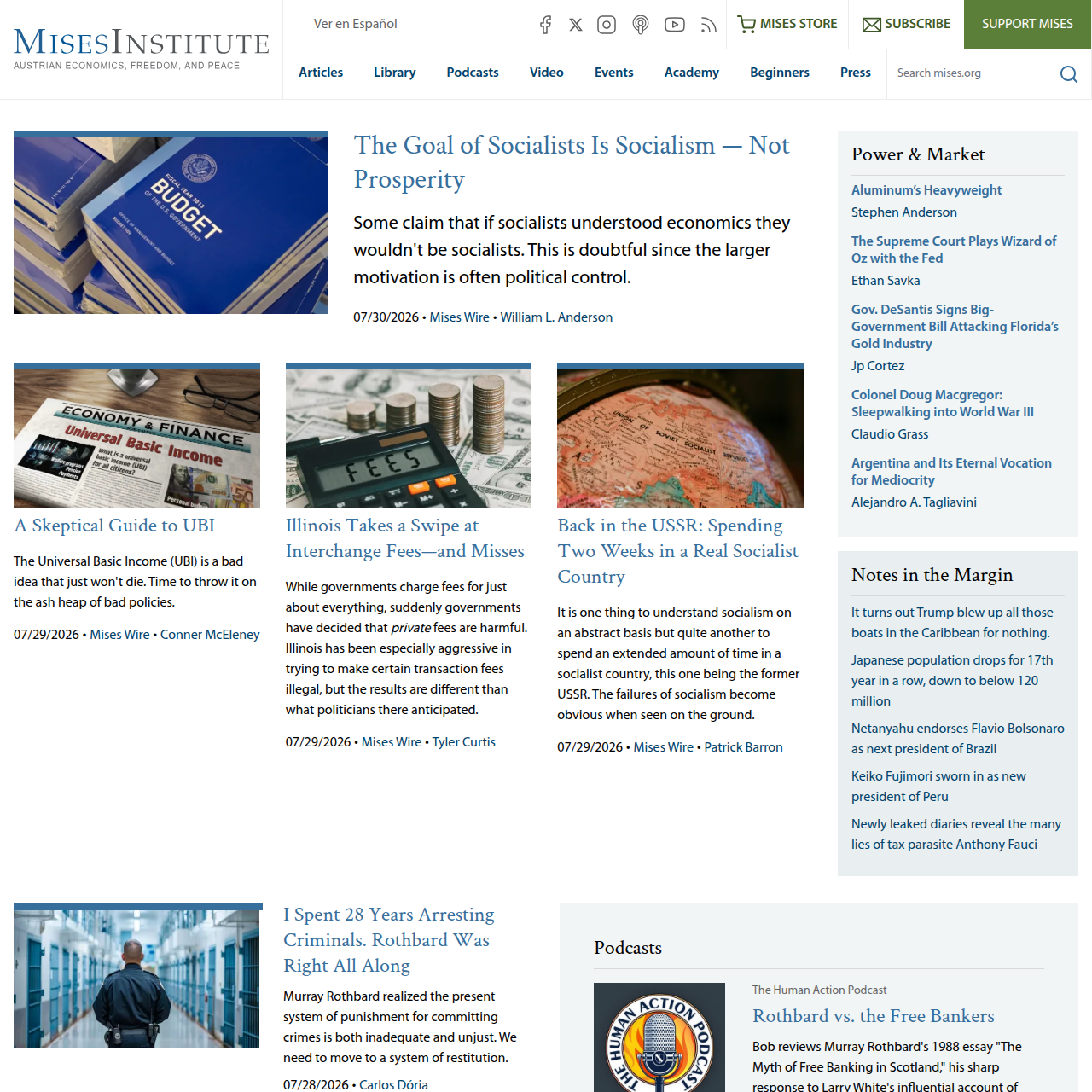
The Mises Institute is a non-profit organization that exists to promote teaching and research in the Austrian School of economics, and individual freedom, honest history, and international peace, in the tradition of Ludwig von Mises and Murray N. Rothbard. These great thinkers developed praxeology, a deductive science of human action based on premises known with certainty to be true, and this is what we teach and advocate. Our scholarly work is founded in Misesian praxeology, and in self-conscious opposition to the mathematical modeling and hypothesis-testing that has created so much confusion in neoclassical economics.

 rockfleece
·Economic Roundtable
·2 months ago