Just introducing my self my age (im in my prime) I lived in a circus for two years, I seen it all done it all now progressing on my dreams.
The earliest forms of money included salt and grain. Both were universally desirable.
But there were serious flaws with these “currencies”. Salt would dissolve in water. Grain spoiled.
And they weren’t valuable enough. So these items worked for crude barter, but that’s about it.
Around 5,000 years ago, when men began to mine and process metals, copper became money. Rings, bars, and even crude early coins.
Early on, copper was highly valuable because it could be made into knives, axes, and other tools.
In ancient China, governments even issued copper alloy knives as a form of currency. Talk about hard money…
Bronze, an alloy of mostly copper and tin, was a major tech breakthrough. It was sturdier than plain copper, making better tools, weapons, and armor.
For hundreds of years, copper and bronze ingots, coins, and bars were a common form of money.
But as mining activity increased, these metals became too common. The value was too low to carry much wealth around. You’d need a chest full of it to buy a cow.
Silver, a more rare metal, became the favored currency. It was the Goldilocks form of money. Not too rare, not too common. Just right.
And for most of the past 3,000 years, silver has been the world’s preferred form of money. With several interruptions, all of which proved to be temporary.
The Modern Gold Era
Gold has also been a form of money for thousands of years. But before industrial-scale mining, it was rare.
Only the wealthiest citizens would own a decent chunk of gold. This is even true today. Many regular people can’t afford to buy ounces of gold at $4,400 a pop.
Silver was (and is) the people’s money. It’s about 9x more common than gold. Still rare enough to be valuable, but common enough that most people can own some.
Throughout ancient history, the gold-to-silver ratio averaged around 10. Meaning gold was 10 times more valuable than silver.
Today, 1 ounce of gold is worth 67 ounces of silver. So silver is valued far lower than it was throughout history (compared with gold).
Silver has been de-monetized. Since 1965, it is no longer in our coins.
It is now a primarily industrial metal. Silver is the best electricity conductor on the planet. It also resists corrosion, making it critical for modern electronics.
The metal is particularly useful in solar panels, where it drives efficiency and long life. Solar power alone accounts for about 22% of total silver demand today. And industrial utility gives silver a lot of value by itself.
Today, gold is much more of a monetary asset than silver is. That’s primarily because central banks, like the Federal Reserve, still hold vast sums of gold as reserves.
But gold’s reign as the king of hard currency may not last forever…
Silver’s Inevitable Return
Since silver was de-monetized in 1965, it has been a rollercoaster of price action.
Throughout the 1960s, the U.S. government dumped their stockpile of silver at bargain basement prices.
The 1970s is when things got interesting. That was a period of inflation, slow growth, and financial chaos. It’s when the fiat (paper money) era began.
And periods like this are when silver shines.
Silver began 1970 trading around $1.80. By November 1971, it had fallen to $1.27. From there it went on one of the craziest bull runs in history, reaching nearly $50 in early 1980.
With high inflation throughout the 1970s, everyone looked for ways to preserve their wealth. For many people, silver fit the bill.
Yes, there was a sophisticated effort to “corner the silver market” by the Hunt Brothers, which helped drive up prices. Without them, silver wouldn’t have gotten close to $50. But the move would have been more durable. I wrote a letter on the Hunt Brothers and silver last year here.
The point is that when inflation gets nasty, ordinary people turn to silver for monetary salvation. It’s practically in our DNA.
A Silver Phoenix
Silver was the world’s favorite form of money for thousands of years. Today it’s still largely viewed as a monetary relic.
A metal that used to be money, but is now used for electronics. This will change once inflation rears its ugly head again, as we move further into the debt crisis.
People will seek out silver as an inflation hedge, store-of-value, and speculative asset. We’ve already seen hints of this, like during the silver price runup earlier this year. But that was just a hint of what’s ahead.
Because silver is primarily an industrial metal today, it is mostly priced according to that demand. Demand which is relatively predictable. Analysts model out industrial demand based on trends and surveys, and can get a pretty good idea about where the price should be headed.
But investment demand for silver is much harder to model. A full-on mania is impossible to accurately predict.
Only about 18% of silver purchased today is for investment purposes. Coins and bars. That’s why the metal is priced like an industrial input rather than a monetary asset.
But if investment demand creeps up to just 25%, that’d create fireworks. Like we saw briefly earlier this year, when silver ran from $35 to $115 in about 9 months.
And I suspect that silver will eventually make an even bigger return as the debt crisis progresses, and inflation worsens. As the world becomes more digital (and hackable), people will want a hard asset to store their wealth. And for many, gold’s out of the question. Too expensive.
Once again, silver will emerge as the metal of the people. A tool to help us preserve and grow our wealth.
Silver is currently trading at around $65 an ounce. I think that’s a fine price to buy at for long-term investors. It’s difficult to say what silver will do over the next 6 months, or even a year.
But over the next 5 years, I’m confident we’re headed much higher. And when silver inevitably goes through its next mania phase, I want plenty of exposure.
So I’m patiently holding. Waiting for the next mania phase.
The Hoover Dam Through a Garden Hose
And let’s not forget about silver miners. When the next mania phase hits, they are going to go ballistic. Check out the chart below, which shows the market cap of every silver miner ($66 billion) vs the value of big tech stocks.
As you can see, every silver miner in the world combined is worth just 1/80th of Nvidia (NVDA). So during a silver mania, a flood of money pours into a very small sector.
This reminds me of a quote from Doug Casey:
“The market capitalization of silver [miner] equities is insufficient to accommodate the inflows of capital from generalist investors when the precious metals narrative takes over.
When the generalist investors come in, the result is like trying to siphon the flow of the Hoover Dam through a garden hose.”
It’s a great reminder that silver, and the companies who mine it, are tiny. So when money rushes in, the results can be absolutely explosive.
Roosevelt and Gold Robbery
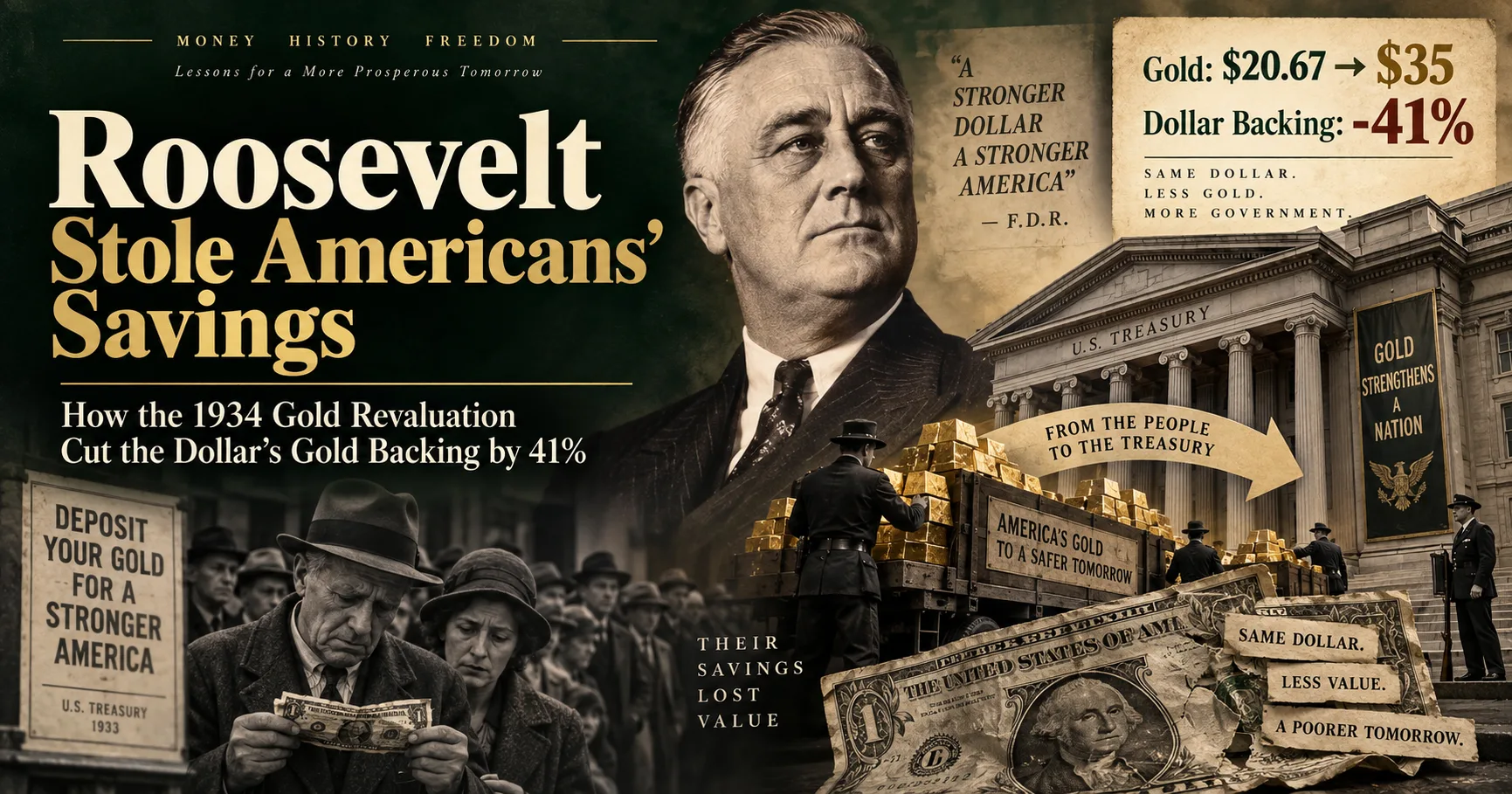
Roosevelt stole all US citizens' savings in January 1934 with one simple trick.The Gold Reserve Act handed all gold held by the Federal Reserve to the Treasury, then let Roosevelt reprice gold from $20.67 to $35 per ounce by executive proclamation. That single move cut the dollar's gold content by 4...
What countries have you not visited yet that you would like to visit?
Me personally, I'd like to visit South Korea. It has lots of rich culture.
A lot of people are finding it very difficult to save money. It's not because they don't want to save but because they have too many bills to pay which makes it impossible to have anything meaningful to save after paying for so many expenses.
Do you struggle with saving from your monthly income?
Bank of England
The Bank of England was born in 1694 to fund a war. William III needed £1.2 million to fight Louis XIV, Parliament wouldn't raise the taxes, and a group of London merchants solved the problem by creating money from nothing. That arrangement has never really ended.The mechanics were straightforward....
Monetary Literacy Assessment
Establish your monetary knowledge baseline before beginning your learning journey through the Monetary Literacy & Mastery Foundation.
Discover What You Already Know
Every day we earn money, spend it, save it, borrow it, and invest it. Yet very few people are ever taught what money actually is or how the monetary system works.
This short assessment is designed to establish your starting point before you begin the Foundation curriculum. It is not intended to determine whether you pass or fail.
Instead, it gives you a record of what you understand today so that you can compare it with what you understand after completing the Academy.
What to Expect
Assessment 1 is a short introductory quiz covering several of the monetary concepts explored throughout the Academy.
A short knowledge baseline
Designed to be completed quickly
No prior study is required
Review what you got right and wrong
Topics Covered
The questions introduce several ideas that will appear throughout your studies.
Value and monetary functions
The monetary instruments we use
Deposits and money creation
Currency and purchasing power
Monetary institutions and systems
Historical monetary language
Answer using only what you currently know.
Don't search online or look up the answers. The purpose is to discover your starting point, not to achieve a perfect score.
Take the Monetary Literacy Assessment
Complete all ten questions and submit your answers to receive your score. You'll be able to see which questions you answered correctly, which ones you missed, and review the answers afterward.
Begin the Assessment →Who Receives New Currency First? Understanding the Cantillon Effect
New currency does not reach everyone at the same time. Follow its path, compare who can spend first, and explore why the order can matter for prices, wages, and purchasing power.
Does Receiving It First Make a Difference?
The amount of new currency is one part of the story. Where it enters and how it moves can also shape the outcome.
Compare two entry pathways in the Cantillon Effect Simulator, or run a simple paper market in which learners swap who receives currency first. Keep the amount constant and ask what changes.
Designed for homeschooling, summer learning, classroom enrichment, and library groups. Choose one activity for the short session. Documentary viewing, source comparison, and assessment are optional extensions.
Trace the Entry Point
Identify who receives new purchasing power first and where spending goes next.
Compare the Timing
Explore what happens when prices and incomes adjust at different times.
Check the Explanation
Distinguish a result built into a model from evidence about an actual event.
Teach It Online or on Paper
Use the teaching plan, choose an activity, or download the printable materials attached to this topic.
Prepare the Activity
Suggested level: Ages 13–18, introductory. Learners need basic reading and division. Percentage work is optional. One adult and one learner can complete either route.
Time: Allow 5–10 minutes to prepare and about 15 minutes for one core activity and discussion. Add 5–10 minutes for the short assessment or the paper activity’s third round and percentage calculations. Allow viewing and reading time separately, followed by 15–20 minutes for the documentary worksheet.
Online route: Open the Cantillon Effect Simulator before teaching. Use student pages 1 and 4, an internet-connected device, and a pencil.
Paper route: Use student pages 2–4, pencils, and scrap paper. Read the role cards or print page 3 single-sided to cut them out. No real money is needed.
Curriculum connection: Monetary Policy, Lesson 5: The Nature of Money Creation – Cantillon Effect. Pack 01 explains loan-created deposits; Pack 02 explains the deposit as a bank obligation; Pack 03 introduces definitions and purchasing power.
Currency Reaches People in a Sequence
New currency reaches particular people or institutions before it reaches others. If early recipients spend before some prices adjust, they may buy on different terms from people whose income arrives later.
The entry point and spending path can affect relative prices and purchasing power. This is the central idea we are exploring as the Cantillon Effect. Timing can matter; the result depends on what happens to spending, production, prices, and incomes.
Predict, Compare, and Explain
0–2 minutes · Make a prediction.
Ask whether changing who receives currency first could change the outcome. Record a reason.
2–4 minutes · Introduce the activity.
Read the short explanation above, then introduce your chosen simulator or paper activity.
4–9 minutes · Run the comparison.
Compare the two simulator pathways OR complete the first two paper rounds.
9–13 minutes · Discuss the three questions.
Connect receipt order to spending opportunities, price changes, and income timing.
13–15 minutes · Complete the exit sentence.
Revisit the prediction and name one condition that could change the result.
Same Amount. Different Entry Points.
Use page 1 of the Student Worksheets PDF, or draw a comparison table on paper.
Visit the Cantillon Effect Simulator and choose Open Laboratory. Keep New Money Created at $100 Billion and Money Circulation Speed at Medium. These are model settings.
Scroll to Compare Two Monetary Pathways. Select Financial Markets for Scenario A and Direct Payments for Scenario B. Predict which will affect asset markets earlier and explain why.
Select Run Side-by-Side Comparison. Record the first receiver and distribution path in each panel. Compare the asset and consumer channels, then read the explanation beneath the panels.
What changed even though the new amount stayed the same? What did the model show, and what would need real-world evidence?
Model check: The bars represent simulated relative pressure. They are not measured inflation rates or forecasts. The “Fed” arrows are schematic; they do not mean every commercial bank loan begins with fresh central-bank money or that every government payment creates new money.
Who Can Buy What?
The fictional market: The shop starts each round with 20 identical notebooks. Buyers A and B each receive $20, at different times. The first buyer pays $4 per notebook; the second pays $5. Both spend all $20. There is enough stock for both.
Important: These numbers and the price change are invented. The allocations isolate timing; their funding is not modeled. They do not stand for a completed wage payment, asset sale, or bank loan.
Asset-owning household
Receive an allocation of $20 when the teacher calls your turn. Buy as many identical notebooks as $20 allows at the posted price. Record what you buy. You act first in Round 1 and second in Round 2.
Wage-earning household
Receive an allocation of $20 when the teacher calls your turn. Buy as many identical notebooks as $20 allows at the posted price. Record what you buy. You act second in Round 1 and first in Round 2.
Business
Begin each round with 20 identical notebooks and no receipts. Charge $4 per notebook to the first buyer. Change the posted price to $5 before the second buyer. Record receipts and notebooks left. Follow the separate rule for optional Round 3.
Recorder
Track receipt order, posted prices, purchases, and shop receipts. Check that each buyer receives only $20 per round. Reset everything between rounds. Ask whether a result was observed, calculated, or assumed by the rules.
Round 1: Give A $20. A buys at $4. Change the price to $5. Then give B $20; B buys at $5. Record both purchases, total shop receipts, and stock left.
Round 2: Reset both buyers’ balances, shop receipts, and all 20 notebooks. Reverse the order: B receives and spends first at $4; A receives and spends second at $5.
Optional Round 3: Reset again. A receives and spends before B, but keep the price at $4 for both. Each still receives $20. Does timing produce a purchasing advantage now?
Calculation: Notebooks bought = dollars available ÷ price per notebook. Use the table on student page 2.
For one learner: The adult calls the turns and acts as shopkeeper. The learner records both buyers. The household labels are roles, not fixed predictions: real people can own assets and earn wages.
Optional arithmetic: Calculate the percentage price rise from $4 to $5 and the percentage fall in what the same $20 buys. Why do the percentages differ?
Three Questions to Work Through
Use the activity’s observations and rules to explain your reasoning. Record your answers on student page 4.
Name the initial recipient in each pathway or round. Explain what earlier access made possible under the stated conditions.
Separate a larger dollar income from the amount of goods and services it can buy.
Identify one condition that could reduce, remove, or change the timing advantage.
Receiving new currency earlier can matter because … One condition that could change the outcome is …
Check Your Understanding
A. In your activity, what variable did you change and what new amount did you hold constant?
B. If both paper buyers receive $20 and both pay $4 per notebook, how many can each buy? Is there a timing advantage here?
C. A bank creates a $20 deposit by lending to a borrower. Does the borrower receive a debt-free gift? Explain.
D. Name one real-world observation you would need before claiming that a simulator result explains an actual historical event.
Watch, Compare, and Investigate
Watch: Hidden Secrets of Money, Episode 4: The IOU Machine – How Currency Is Created. Preview the film before teaching. Assign the full film or a checked excerpt; allow viewing time separately from the short lesson.
Compare: Read the opening explanation in the Bank of England’s Money Creation in the Modern Economy alongside Pack 01. Compare how the sources explain a bank loan and the creation of a deposit.
Read: In the second post of Nominal Confusion, read “What Is Nominal Confusion?” and “Wages”. Connect the difference between a dollar wage and its purchasing power to the timing question.
Use student page 5 and allow 15–20 minutes after viewing and reading:
1. Film claim: Paraphrase one claim about currency creation or who benefits. Record actual start and end timestamps.
2. Lending check: What does the film suggest happens when a bank lends? Compare this with the Bank of England explanation and Pack 01.
3. Evidence check: What observation, record, or comparison could support or challenge your selected claim? Distinguish an illustration from evidence.
4. Reading application: If living costs rise before wages, why might a later pay rise still leave a household buying less?
5. Your conclusion: What would you now explain differently? Name one unresolved question.
Historical extension: Read Cantillon, Part II, Chapter VI. Identify the early recipients in his mining example and a group whose income adjusts later. Which steps are argued, and which would require evidence?
Explain the Result and Its Conditions
Simulator: Scenario A begins with “Financial Markets & Asset Buyers” and displays Fed → Markets → Businesses → Households. B begins with “Households Receiving Payments” and displays Fed → Households. The comparison places more early simulated pressure in financial and asset channels in A. Record current labels if the interface changes.
A buys 5 notebooks at $4. B buys 4 at $5. Shop receipts: $40. Stock left: 11.
B buys 5 notebooks at $4. A buys 4 at $5. Shop receipts: $40. Stock left: 11.
Both buy 5 notebooks at $4. Shop receipts: $40. Stock left: 10. Timing gives no notebook-buying advantage under these rules.
The price rises 25%: (5 − 4) ÷ 4. The same $20 buys 20% fewer notebooks: (5 − 4) ÷ 5. The starting quantities differ.
Discussion: Earlier access may allow purchases before some prices rise. Living costs that rise before income can reduce purchasing power. More production or quicker income adjustment can change the outcome. Neither a fixed ranking of winners nor a universal price increase follows from this activity.
Assessment: A: online, the entry pathway changes while the amount stays $100 billion and speed stays Medium; on paper, receipt order changes while each buyer still gets $20. B: 5 notebooks each, with no purchasing advantage from timing here. C: the borrower also owes repayment. D: accept a relevant dated record, such as payments, prices, wages, or output, with an explanation of how it would test the claim. The teacher PDF includes an optional 8-point marking guide.
Film and reading: Look for an accurately located claim, a specific source comparison, testable evidence, and a conclusion that states its conditions. A pay rise smaller than the rise in living costs can leave purchasing power lower. Optional calculation: a 4% wage rise alongside a 5% basket-price rise gives 1.04 ÷ 1.05 − 1, approximately −0.95%.
Teaching precision: Bank lending creates a deposit and a repayment obligation; it does not simply transfer an existing customer deposit to the borrower. Lending remains constrained. Receiving a loan is not a debt-free gift, and an asset seller gives up an asset in exchange for payment. Receipt alone does not establish a net-wealth gain. See the Bank of England explanation.
Model limits: The paper price increase is a rule, not proof that new currency always produces that increase. The shop receives the same funds the buyers spend. “Closer” means access and timing, not physical distance.
Definitions: This pack uses “new currency” broadly for newly created purchasing power, including bank deposits. Central-bank sources usually call these balances deposit money; currency often means notes and coins.
Connect the Activity to Its Sources
Curriculum: MLMF Lesson 5: The Nature of Money Creation - Cantillon Effect.
Interactive activity: MLMF Cantillon Effect Simulator.
Documentary: Hidden Secrets of Money, Episode 4: The IOU Machine - How Currency Is Created.
Extended reading: Nominal Confusion: Why Rising Prices Do Not Always Mean Rising Value.
Bank lending and deposit creation: Bank of England: Money Creation in the Modern Economy (2014).
Historical argument: Richard Cantillon: Essay on the Nature of Trade in General, Part II, Chapter VI.
For younger learners: Read aloud, accept oral answers, and count notebooks without percentages.
For older learners: Choose a documented episode, define an outcome and period, and consider supply changes and other explanations before attributing the result to the currency’s entry point.
The Printable Materials
Download the Student Worksheets and Teacher Guide attached to this topic. Both are complete materials for Pack 04; no pages need to be extracted from an earlier packet.
Page 1: simulator comparison.
Page 2: paper market and calculation table.
Page 3: four role cards and price signs.
Page 4: discussion, assessment, and exit sentence.
Page 5: documentary and source comparison.
Preparation and the 15-minute plan, simulator setup and interpretation, paper activity answers, discussion and assessment marking, extension guidance, and linked sources.
Print only what you need: Online core: student pages 1 and 4. Paper core: pages 2–4. Add page 5 for the viewing and reading extension. Keep teacher answers separate; print role cards single-sided if cutting.
Follow the Currency. Then Measure What It Buys.
Next, use the Inflation and Purchasing Power Simulator to explore wages, savings, and changing prices. This leads into the planned Pack 05: When More Dollars Buy Less.
Do you have a favorite animal? I love meerkats but I would love to one day own a French Bulldog.
How many people own their place of residence and how many people rent?
Hey
It’s Gizmo. I am interested in learning more about currency and money so I thought I would join here. I already see some things are done different in the US than in New Zealand. 😮
Nice to be here.
If you're American, you are celebrating 4th of July! Any one here live in America and have plans?
Anyone here have a favorite beverage they like to consume? For me, I love coconut water. Keeps me hydrated!
Today, I believe so many people including students are still making so many mistakes with money and it's because they are not taught well how to best manage money in school. It's why some are still in debt years after they are out from school and all having worked for years.
What are the biggest mistakes young people make with money?
Have you bought gold, silver, stocks, bonds, crypto, etc? Post it here!
Welcome back. Today I'm joined by Larry Leard, champion of sound money. Larry's the founder of Equity Management Associates and the author of the book Be Print. For years, he's been warning that America's mounting debt, chronic deficits are pushing us towards a point where the Fed's first job is not controlling inflation, is keeping the financial system afloat. Larry, it is great to have you.
Great to be back with you, Peter. I've always enjoyed our conversations.
So, let's begin with your book. What is the central argument of the big print?
So the thesis is that the way our financial system is constructed requires debt and monetary expansion to keep it going and grow. It's kind of like a shark. It has to go forward or else it's not going to it won't get oxygen going through its u its gills. And um as a result of that, you know, the the um and that's based on the way money is created, which is kind of a long story and the book lays it out, but basically banks lend money into existence. And by lending money into existence, that means you're creating additional debt whenever, you know, you're you're growing your economy. And that's you know, Reagan really kind of started this uh you know, with the notion that we could take on debt, use it to grow the economy. And in the certain measure, there's some sense to that, but when it gets too far down the road, it becomes problematic. And the problem occurs when the debt gets so large and the growth in the economy doesn't match the growth in the debt. There becomes a big gap which is to say that the you know and there's a chart I used to put up on Twitter and X all the time that showed kind of the growth of the debt burden and the growth of GDP and they were diverging. And so yeah
what when that divergence occurs what happens is that something will break on the debt side and um and then the government will have to step in and print money to create more money to service that excessive debt. And we've had a lot of these breaks throughout history. I mean, you know, and these are really kind of credit bubbles that burst. You know, debt debt fuels growth gets too far ahead of the economy, it bursts, and then the economy collapses unless enough money is printed. And the first example that was actually 1929 where there was a lot of leverage and that stock market crash. But we've had other examples since then. The two more recent ones are really um 2008 and then the COVID example. And uh so in 2008 we as we all know we had a housing bubble and the debt just got so large it couldn't be supported and we woke up one morning and the entire economy was going to collapse and secretary of the treasury was uh begging you know the speaker of the house to you know give him $700 billion or else the ATMs weren't going to work and so um that I call that the first big print uh and of course they went from you know 700 billion to multiple trillion over a series of years and and you know this in doing so what government is effectively doing is they're backstopping the banks. They're putting money into in bank reserves and increasing the monetary base. And that's that's good in so far as it does stop a collapse of an overlevered system, but it's bad because all that additional money eventually works its way through the system and creates inflation, right? And so, you know, the first one was was was uh 2008 and then in COVID we did the same thing, but we did it on steroids. I mean, it was even bigger and faster. And so what my book argues is that these are a feature of the system. This is not a bug, it's a feature. And we're going to have another one [laughter] because we're going to get all levered up again and then something's going to break and then the government's going to have to come in and print a ton of money. And so we now, you know, we've now got two examples of it. So we can see that it's a pattern and we we I believe it's going to happen again. And the implication is of course that then you have to you have to try and earn forms of money that the government can't print or or hold I should say save in forms of money the government can't print. Um the natural ones in my mind are silver, gold, and bitcoin. So that's the that's the overall thesis.
Yeah, I've argued um you know I've got a bunch of articles talking about you know whether we should replace the Fed and of course we should but with what?
And the question is always what does the Fed do? And in most people's minds, it fights inflation,
right?
Right. Like usually when you read about the Fed in the newspaper, it's talking about how, you know, inflation is getting, you know, whatever. It's it's too high. And so the Fed is going to do this and that to fight it. And so I think that most voters in their minds, uh, the Fed fights inflation. In fact, there was a study of that and they found twothirds of voters think that the main purpose of the Fed is fighting inflation which is hilarious because we didn't have a Fed for the first what 130 years
right
and we had zero aggregate inflation correct
until we had a Fed so if it doesn't fight inflation what does it do and I think the answer is the main purpose of the Fed is the bailouts I think people underestimate they see the bailouts right so it was you know whatever it was in 2008 2.3 three or 2.7 of which much was allegedly paid back. Of course, there's risk adjusted and, you know, it's a transfer at the end of the day, but that's not the real, you know, goal here for Wall Street, right? The real goal is the year-to-year money printing,
correct?
That, you know, people see 2% uh inflation, but once you include, you know, productivity growth, population growth, uh usage of dollars overseas, right? Once you include all that, you're probably talking closer to 5% money printing, which is what on the order of 1 and a.5 trillion. So, most of which is captured by Wall Street. So, it's not the 2.7 trillion bailouts every, you know, 20 years. It's the trillion and a half every single year. That's what the bailout mechanism is. And that's the function.
I mean, to your to your point, there's a very interesting statistic. since 71 the money supply M2 you know I I kind of measure I'm a monitorist in and Austrian and my economic views and that means that I kind of measure you know the um inflation in terms of how much the money supply grows the broadest measure today of money supply is M2 and if you look at it from 71 it's grown in the high seven seven digit 7 point something area like call it 7.6 six or 7.7. So, you know, the government I think over that same time frame has said we've had inflation of two or 3% on average and they're just they're cooking the numbers. And so, you know, and I I think the 7% is much more in line with what the average, you know, person has experienced. I mean, if for example, you look at housing prices or price of a lot of things that are kind of stable, you know, more stable, they've grown at some percent compounded for years and years. So,
yeah. Well, and you know the gap between those that people don't take account of is that essentially all of the productivity gains since call it 1971 you know so China uh crashing manufacturing costs the stupid software thing the impact of the internet of software of container shipping right there have been all of these advances in technology that should have lowered crisis.
Correct.
Right. If we look back to the late 1800s, which was a, you know, that was also a period of enormous technological gain. Uh, the so-called Great Depression in the 1870s, which was actually economically fantastic, but prices went down. That's what depression used to mean. That's
right.
And we didn't see any of that over these past 50 years. We didn't see anything from China. The average American does not appreciate. They think China just stole the jobs. They don't understand China also slashed the real cost of manufactured goods. And the reason people don't see that is because all of it was gobbled up in money printing
correct
yeartoear as you say I think if you take the aggregate number the change in M2 since Nixon killed off the gold standard in 71 I think you're looking at what I think it's around about a trillion or more than a trillion a year. Of course that's that's that's compounded. So at this point it's probably about a trillion and a half or north of that in money printing every year. People don't understand what a massive swindle this is, right? This is not learing centers 20 million at a time, right? This is this is enormous sums of money being siphoned out of the pocket of every, you know, dollar holder, every pensioner, uh, anybody on a fixed income, anybody with a contract that, you know, that has nominal prices, which is almost everybody. Well, and that's the thing, Peter, that I think most of the world doesn't understand. I tried to address this a little bit in my book, and Austrian economists do understand is that over time, the natural course of prices is they should fall as mankind becomes more efficient and smarter and we do things better, cheaper, faster. And I mean, you can actually see that very well in an area that we're all very familiar with, which is electronics and technology. I mean, remember what you paid for your first huge flat screen TV and remember the quality of it? you know, it was thousands of dollars and it was much lower quality than today. And you can buy the same TV today for, you know, a fraction of that and it's higher quality. So, [snorts] [laughter] excuse me. That's the kind of thing that could be and should be happening in all areas. Not not entirely because some things are it's hard to make certain processes more efficient. But, as you pointed out, I mean, there have been things like the China price or or even oil. Finding oil has gotten cheaper um as a result of fracking. Do you know what I mean? and the technology to to locate oil deposits has gotten better. So, so yes, we should be living much better lives than we're living. And everyone thinks, "Oh, isn't this great? We've got all this technology. We're living pretty well." But a lot of it has been stolen and rad by the people at the top who, you know, benefit from this system. I mean there's a whole there's a term we have for called canillionaires which are basically people who know how to borrow cheaply and invest in things that are going to work and grow and you know they they get ahead and so that's why we have such enormous wealth concentration at the top whereas the average citizen is they're only four s they have two sources of borrowing one is against their house and that's a good asset and they can generally borrow at 6 7 8% or you know lower at some points in time but their second source of borrowing is a credit card and that's basically usery, you know, the credit card companies are all between 18 and 30%. So, you can't borrow at 18 30% invested things and get ahead. That's pretty hard to do. So,
um yet if you're on Wall Street, you know, you can borrow at the Fed funds rate and of course they do. So, so yeah, it's a very unfair system. It's very broken. Now the so Kevin Walsh one of the things that he he's talked about uh even before becoming Fed chair was this idea that artificial intelligence is going to be massively deflationary
right
and so that's going to create the you know
the space to cut to cut rates
space to cut rates so I guess the first question is do you think that's going to happen uh you know given all of the equities that Kevin Walsh has to deal with at this point. Number two, if it does, are we going to see a giant everything bubble? Everything is going to go up again. It's going to be like CO squared.
Yeah. Well, there's a lot in there. Um, look, I I think AI is real and I think AI is going to increase overall general human productivity. There's no doubt about it. I've experienced it myself. We've all experienced I have people who are friends who are parallegals and and so forth. I mean you can just do you know it's a great a is a great tool and you can do more better cheaper faster just like the spreadsheet was a great tool and the internet was a great tool and email is a great tool these are all things that improve productivity and so that's that's a positive is it going to completely solve the problem the way that worst describes it happen instantly and we've got this enormous boost in productivity that therefore you know prevents inflation I I don't buy that I think that's all that's a dream that's like doge is going to cut a trillion dollars out of the budget which never happen. Um, you know, it's a nice it's a nice fairy tale to talk about, but it's not realistic if you actually examine the numbers. I mean, you know, we have to basically grow this economy very rapidly or else the debt is going to overwhelm us. And the only way historically to do that is to have a lot of inflation. I mean, they did it after World War II. You know, the the thing that's interesting now is that debt to GDP now is in the 124% range and after World War II is very similar. It's about 114% range. And basically the way we got out of that after World War II was we grew we grew the economy like crazy. I mean we went from producing a million cars a year to producing 5 million. We went from you know uh 200,000 housing starts to millions of housing starts. And so you know that that kind of and and that was all good and that it it allowed us to grow the economy and reduce the size of the debt relative to the economy. The other thing they did is they balanced the budget and so the debt didn't get any bigger. I mean that got very big when they were fighting World War II but then it didn't get any bigger. Here's the thing that's important to notice is that in that period where we were growing, inflation was really high throughout the 40s and 50s, there was one year in 1952, inflation was 18% a year.
So, you know, the whole I mean, but Santa has been out there saying we're we got to grow our way out of this debt burden. And he's right. I mean, in a sense, he's right, but guess what? You can't do that without having inflation. [laughter] You know, you just can't because because you can't get 18% productivity improvement. It's just not going to happen that quickly. You're going to get some but not that much. Right.
Right. Well, the Doge example is nice uh because in theory so you know Singapore for example kept growing at 6 7% even after it was a rich country. However, if you look at the, you know, package of taxes, regulation, uh, frankly, government involvement, you know, Singapore comes in and like proactively seeks out startups and say, "How can we help you?"
Right.
Um, like what we do with, you know, people on welfare, Singapore does with startups. Right.
Right.
So, like it it, you know, like with Doge, it's a great idea to slash a trillion dollars. Yes, we should absolutely do that. What are the odds? Similarly, it's a great idea to grow at 67% like Singapore. What would it take to get from here to there? We're sitting here right now. You know, Bernie Sanders wants to ban AI. Like,
the, you know, central debate points for us on economic policy are nowhere close to where they
Well, [laughter] that's, you know,
that's right. I mean, we don't have the kind of industrial policy necessary to to drive that growth. But but you know to be fair I mean I'm I'm very supportive of growing. I mean growth is a good thing. I just think it's going to be inflationary growth and it has to be inflationary growth and that that's probably the least painful way out of this thing. I mean the other the other way to solve it would be to just let it all collapse and you know that's a a 1929 kind of scenario and and that's very destructive and a lot of people suffer in that. There's no point in doing that. So, I I think that, you know, the and really the the correct solution, Peter, I mean, I talk about this in the book, is is a one-time monetary reset where we say, "Look, we've been living off our, you know, debt too long. We need to return to sound money, and here's how we're going to do it." Now, that would have a certain very, you know, it'd be like tearing off a band-aid. It would hurt. But if we then return to a sound money standard, um, things would rearrange themselves very quickly and we'd be off to, you know, very non-inflationary growth, which would be a great thing. Um but the you know the debt means that we've got to continue growing. And the other thing that's just really disappointing is the lack of will to address the deficits. I mean
just this weekend I read you know that um another party had come out and said that if we don't spend 1.5 trillion in defense you know we're going to lose the we're going to lose the Middle East. Well you know one I'm not even sure that's true. But two you know where are we going to get the 15 trillion? I mean we're already spending 800 billion. So that's add another 700 billion and we're running a deficit of north of two trillion a year, you know, and and theoretically in a full employment or relatively full employment economy where the record high stock prices. I mean, you know, imagine if one of those things changes. Imagine if the stock market turns down or we get a business downturn, the deficits are going to get even larger. So all of these things in a big picture sense are what I call the symptoms of a sovereign debt crisis. And the United States is behaving in a way that in histo in history was much more common among smaller and emerging countries which is they spend more than they have. They borrow to do it. Eventually they can't make the debt payments and the interest payments. They print the money to do it. People realize they're printing the money to do it. They abandon the currency and the currency has super high rates of inflation and or potentially even it fails. And all of those things are now kind of occurring. And and we saw that we've seen this in Venezuela, Ecuador, Wymer, Germany, you know, Zimbabwe. I mean, there hundreds hundred examples of it. I I lay them out in the book. And and as a result of that, that's I think we're doing the same things in the United States. Now, we happen to be the biggest country with, you know, the biggest military and we're kind of the reserve currency still, even though we've lost some of that. And uh so it's going to take a little bit longer and it's not like we're going to fail overnight, but if you do the same things, you're going to get somewhat like the same results. And I think at a minimum it means we're going to get very high inflation. And you're really seeing that now. I mean look at look at the diesel pricing. You know look at the I mean at you know I mean wars came in and he was talking about how he wanted to shrink the balance sheet and he thought we could cut interest rates because of this AI productivity miracle. And of course now all the numbers have gone against him. And so he's faced with a very difficult decision. I mean this week they have a Fed meeting.
And I think the market is saying it's like an 80 or 90% chance he's going to hike. And maybe he will. I don't know. I I I actually don't think he will. I think he'll try and find some excuse not to, but but maybe he will. Um, and uh, you know, it's it's a problem. I mean, this inflation, they're not going to slay this inflation beast easily. Once it gets started, this is like the 70s. Uh, it tends to each wave tends to get bigger. So, if you own gold, and many of you do, you already understand how it protects your wealth from the insanity coming out of Washington, the inflation, the recessions, the wars. But with monetary medals, there's a way to actually earn a yield of up to 4% on your gold, paid in more ounces of gold. You retain ownership of real allocated physical gold with no storage costs while your ounces grow every month outside the banking system. If you're serious about protecting your future and building your legacy, head to monetarymetals.com/per to get started. Now, back to the show. Yeah. Before Walsh came in, uh, he was t he'd actually been talking for years about this. He calls it Robin Hood monetary policy,
right,
where they can cut rates because they're going to sell down the Fed's balance sheet, which is the stash of money the Fed's accumulated by printing money in the past. And it's
right
something like six trillion or 7 trillion.
Yeah. Yeah. 6 and a half trillion I think the balance sheet is today roughly. Yeah.
Six six and a half trillion. And so if you do that then it cancels the dollars and then in theory you can let the real economy rip with low interest rates and that's going to be soaked up by the balance sheet roll off. And I think it was about 3 or 4 months ago where they started I can't remember the mechanism you probably know this better uh but they got kind of a scare out of financial markets sort of a a uh echo of the so-called taper tantrum where essentially you know markets were seemingly unable to digest the reduction of the Fed balance sheet and so they they pivoted back to so-called not QE in other words
they call They call it reserve management and it happened in December when Powell was still Fed chair
and they said it wasn't QE and it wasn't money printing both of which are technically lies but um and and and yes so they so they did start printing money and they are printing money now admittedly not at big print like rates I mean this is I I call this right now we're kind of in small print land and then they're doing some other things around the margin which I'm sure you and your listeners have been familiar with which is to say Treasury Secretary Bassant who used a lot of money to sold a lot of bills to build up the Treasury General account has been using that account to buy back um longer term bonds because you know the real so the trigger here just for everybody to understand this is we're in potentially we're in kind of a debt doom loop where um just describe that quickly. Government runs a deficit. They have to finance the deficit by selling debt. That's more debt into a fixed number of debt buyers, which means the interest rate goes up to get that debt sold, which then and by the way, the US government's one of the largest payers of interest in the world. We pay $1.3 trillion a year in interest on our 40 trillion of debt. And so that that then gets larger. You know, the the interest payments get larger if the rate goes up. So then the deficit gets bigger. So then we got to sell more debt. You see where I'm going with this? It's a we call it a doom loop. It's recursive. And you know, it just the more interest rates go up, the bigger the deficit gets. The bigger the deficit gets, the more debt you got to sell. So, so that's the risk that they're facing and they know it. And um historically, because they've acted aggressively several times to prevent it, the real trigger rate is to see the US 10-year bond yield go through 5%. And as I look at it right now, we're almost there. In fact, we might be there this morning. We're 4.98 this morning. So, we're right on the edge of that. and um you know and and so what Bent has been doing is he's been buying back bonds to try to keep that rate from going out of control but I I'm not sure he's going to be successful. Right?
So in the late 1990s uh the tenure was running about 7%
right
in the 1980s the early 80s was running 12 a.5. Now, that was the overhang coming off the 1970s. But just taking the late 90s, why could we digest 7% in the '9s because that was the miracle economy, right? Everybody was excited. That was the dot era. That was Bill Clinton, new Gingrich.
It's a great question, a great point. The biggest the biggest difference is that we weren't running the huge deficits, Peter, and we didn't have the debt to GDP that we have now.
Yeah.
I mean, when Paul Vulkar came in, so so we had an inflation. We went off the let's just to recoup the big picture. We went off the gold standard in 71 and people started losing confidence in the dollar and they were buying gold. So gold went from 22 to $800 in the course of the decade of the 70s. It was very inflationary. Debt to GDP at the time was in the mid30 range like I think it was like 38%. Paul Vulker said look I know how to solve this problem. We're going to jack interest rates up to 20%. and we're going to create an enormous positive, you know, interest rate on the bonds and people will buy these bonds. Um, and we will we will put we will stop inflation and moni, you know, the money supply growth debt in its tracks. And he did and they could do it because the numbers the balance sheet numbers allowed that. Okay. Um, the balance sheet then, you know, came down as a percentage for some time because we really didn't run that big of deficits, you know, post that time frame. Um, and then Reagan came along and he started running deficits, but they in today's terms they're quaint. They were like, you know, hundred billion or something. I mean, we're running$ two trillion dollar deficits. I remember when Reagan's deficits first were announced, I think his first one was like 180 trillion or some billion. And everyone was like up in arms. We can't run a deficit that big. It's enormous. And now, of course, it seems quaint. Um, but you know, and in the Clinton era actually, if you recall, and it was somewhat based on accounting ledger demand, if you recall, there was actually a year where we ran a surplus. So, um, part of the reason we could do it was the debt burden wasn't so large and the and the the fiscal dominance, which is, you know, a term we can define in a minute, wasn't as present. We weren't as as monetarily out of control. And and that's really the core of the problem. I mean, yes, having a lot of debt is a bad thing, but hey, Japan's had a lot of debt for 20 or 30 years, and people said, Japan's going to collapse, right? Well, yes, but they also had a ton of savers, and they weren't running huge deficits. So, you know, the difference here is that our deficit's what's really doing us in. And and that's why when I talk to people who are looking at investing my fund, I always say that, you know, they say, "Well, what could go wrong? How do we not make money in this investment, Larry?" And I'd say, "Well, we don't make money if the government gets responsible." Of course, they always laugh, right? Because we all know that the odds of that are pretty low. But, you know, look, I mean, my investment thesis would be severely tested if the government started to get serious about balancing the budget. I mean, the reason that the reason they have to keep printing the money is that they they keep spending more than they're bringing in and issuing debt to do it. And so that's that's the real core of the problem, right? All right. So, explain fiscal dominance. So, traditionally, the alleged purpose of the Fed was to manipulate interest rates in order to get the Goldilocks economy with just enough growth and just enough inflation. you've argued and I think it's a you make a great case that the Fed is no longer that's no longer the predominant uh goal, right? Uh you know they're not they're not trying to walk the line between growth headlines and inflation headlines rather at this point their main goal is fiscal dominance. So explain what that is and how the chang.
So the Fed has had a lot of mandates if you recall when it was set up in 1913. It was set up because of the panic in 1907 when JP Morgan bailed out the banking system. And what the bankers at the time realized is that if we could get the federal government to back our play um every time we got out over our skis, they would print the money to protect us and we wouldn't go bankrupt. And so so that was the initial reason behind the Fed. you know to have a we need a permanent backs stop to secure the financial system. So that was there for quite some time. In the 70s the Fed charter got amended to focus on um you know full employment and um you know low inflation or monetary stability. Um and that that third item wasn't really talked about very much but we know it's there and I call it the Fed put. um which is yeah we want to have as you say we want to have monetary um we want to have a balanced monetary system but but if something breaks they're there um and and so what happens is once you get into fiscal dominance the the Fed really what they do really can't control things that much and by fiscal dominance I mean the point where they are spending more money than they are bringing in and the market is starting to trade interest rates and stocks and bonds and gold and and Bitcoin and all more on is this government creditworthy rather than does this interest rate compensate me for my risk. Um and and the fact of the matter is that the government the market is coming to see that they're not getting compensated for the risk. The bond market is the sucker at the table. I mean it's amazing how how much bonds have gone down in gold terms since you know we started running these huge deficits. I mean they've just been getting killed. And that goes back to my point about we we're in a sovereign debt crisis. So the history of the Fed is that when a bubble burst, they reinflate it. You know, when the.com bubble burst, I remember very clearly Greenspan saying, you know, we need to get a housing bubble going. You know, and he even advised people, go out and take out a heliloc against your house, borrow against your house. And so they got the economy going after the collapse of the dotcom bubble. And then the.com bubble burst and they took interest rates down to zero again. And they were like, well, we, you know, we got to get the economy going again. And they held him there for a long time. I mean, 0% interest rates is just an outright crime. I mean, it's a crime against capitalism to have money have no value. It implies the money is worthless, which kind of is, but um and so basically what then happened is, you know, now we've blown a bubble at the next level up. So each level, you know, with with stocks burst, we we we printed a housing bubble. Housing bubble burst, we printed a a bubble in kind of everything. COVID came along and now we're you know and that at that point in time they really took the gloves off as you know they sent out checks they handed money to you know to companies um that they didn't have to pay back. I mean, they just really let the printing rest run wild and it was, you know, it was over $5 trillion worth of stimulus. And so, you know, now what they've done is they they've called into question, you know, is the currency itself worthless. I mean, they they've always said, don't worry, you know, we Bernaki said, we we have a technology of printing press. We are not going to let deflation happen here. Even though deflation is good and natural and we want deflation, they've said they've determined that it's not good because they're Keynesians. Fine. So, if they're not going to let deflation happen, we know that at the end of the day, if things start to go sour, they're going to print more money. And the math of the situation is such that they're going to have to print a ton of money, which is why I named my book The Big Print. It's not going to be a little one. Each one's gotten bigger. I mean, in the [laughter] in the '08 example, they printed, I don't know, $3 trillion over four or five years. I mean, that was QE1 and two and QE Infinity and Bernaki. And I I remember Bernaki telling Ron Paul, "Oh, yeah, you know, the balance sheet is 1 point some trillion. We'll bring it back down." Well, They went to three, you know, and then in the COVID one, they took it from three to nine at one point. They brought it back down to six something. But um and the point is with each one of these, it gets bigger. Has to get bigger because of the way the debts compounding. So, you know, another one of these events is coming. Uh we don't know when. Um but I've never been more certain of anything because of the math. So, that's why, you know, it's just it's absolutely essential. So, I think the average person um is aware of this issue and has a piece of their savings in money that can't be printed.
A word from our sponsor. No amount of time spent learning about macroeconomics or politics can save you from the fact that our money is broken. You can protect yourself by taking full control and holding Bitcoin in 100% self-custody. Now, there's a learning curve, but it's not rocket science, and you'll be in expert hands with my friends at the Bitcoin way. They'll guide you through the process step by step from setting up your hardware wallet to running your own node one-on-one and at your pace. Download your free self-custody guide from the Bitcoin way by scanning the QR code or clicking the link below. The time to become sovereign over your wealth is now. Stocks and even gold are all over the place. If you're ready to diversify abundant mines makes Bitcoin mining simple, transparent, and human, you can deduct every penny thanks to Trump's big beautiful bill. It's a 401k for Bitcoin mining. Founded by husband and wife team Bo and Christine Marie Turner after losing half a million dollars to broken promises in the mining industry, Abundant Mines was built to protect investors. You own the machines. They make it turnkey with hosting at their facilities in Oregon. Pricing is clear with one flat monthly fee and no surprises. And they guarantee uptime so you can keep earning day in and day out. If you want easy diversification without pressure, learn more at abundantminds.com/peter to get some of your first Bitcoin mind for free as a gift to my audience. Now back to the show.
So walk us through what you think is coming next here. One of the key questions I want you to kind of put in the sequence is
timing
the next recession. So since the Fed has been created, we have recessions almost like clockwork.
That's because of the Fed's monetary manipulation. It makes rates too low and then it hikes them too high.
We're at the potentially too high stage at this point. But walk through so what happens first?
Uh is a recession necessary for that sort of doom sequence to start? It's a great It's a great question. I I don't know because we're kind of in uncharted territory. I mean,
we could just go right into what Austrian economists call a crackup boom where they just everything keeps going up,
but the inflation gets worse and worse and worse and, you know, the um we don't head towards hyperinflation, but we head towards very high inflation. Um I think that, you know, my sense is that right now real interest rates are pretty negative. um you know, inflation by my calculations, even though they reported at three or four, I think it's running closer to seven or 8%. And so, you know, if that's the case in a 10-year time frame, why would you want to own a bond that's paying you four or 5%. You wouldn't. Um, and so I I think what's going to happen is the bond market's going to be the trigger for it. And it's actually happening right now. I just looked, the 10ear actually just went through 5%. And so, you know, that's in my view eventually what's going to happen is the government is going to be forced to step in and put in what we call yield curve control, which is they're going to say, "We stand ready to buy all these bonds at 5%." And by the way, they did this in World War II. This is not something new. I mean, when they were financing World War II, they knew they were going to have to sell a ton of bonds. And they knew that if interest rates went up, that was going to be a real problem because the cost of those servicing those bonds was going to make the problem bigger. So, what did they do? They said, "Okay, short-term rates are 38 of a percent and long-term rates are 2.5%." And we stand ready to buy everything at those prices. And my sense is that's probably what's going to happen here. And when they do that, you know, the bond market's going to look at the Fed and go, "Sold to you." And so the Fed balance sheet is going to go from 6 trillion to 20 trillion. And you know, you might ask, well, okay, the bond market comes to the Fed and says, "I want to sell my bond to you because I don't like this 5% anymore." Where's the Fed going to get the money to buy that bond? Easy. They're going to print it. They're going to issue a reserve to a bank and the bank's going to buy it. Um, and so that's going to grow M2 again and the money supply is going to explode upward. And so so they will keep the system running. Um, but it will be very very inflationary, Peter. And does does it mean, you know, do we have a recession? Does the stock market go down? I don't know. Stock market's pretty overvalued. Um, but that doesn't mean it has to go down. I mean, I I've said in my letters, and I believe truly that what they're going to try probably try and do is a run it hot strategy, which is to say, I mean, if you know, okay, inflation's eating you alive, but hey, you all have jobs and the economy is still running and the stock market's making record highs in nominal terms, not in gold terms, not in Bitcoin terms, but in nominal terms. And so, my suspicion is we kind of tend towards that side of things. But, you know, along the way here, if anything goes wrong and we do have, you know, an economic downturn or something breaks, I mean, candidates for that are commercial real estate and private credit and the insurance companies and there a lot of different areas where they're a
AI debt probably.
Yeah, AI debt. I didn't thought about that one, right? I mean, got all these companies taking on enormous AI debt and now we discover the Chinese are offering the same thing for a fraction of the cost, right? And of course, you're already seeing the AI guys starting to position for how the government's going to save them or bail them out, right? I mean, it's just
it's it's just it's horrible. And so, you know, look, it it we don't know exactly how it's going to pull. We don't know the time frame, but I will make two predictions. I've said many times other podcasts, I think we're coming to a head in the next 12 months. I mean, this kind of feels to me like 20 2007. You know, some of the things that have happened, you know, with the with the, you know, the private credit guys gating their investors, etc. These kind of remind me a little bit of summer of 2007 when the the Bear Stern CRS CRS funds failed or CDE funds failed and and so if you think about summer of 7 2007 we didn't actually get the crack up until September of '08. So, you know, I kind of feel like in the next year this going to become a real problem and they're going to have to do something like yield curve control or drop interest rates substantially. I mean one way by the way you know if you think about the US government deficit right we're running a $2 trillion deficit u but you know say a trillion of that round numbers is interest expense well how do you solve that you take interest rates down to zero and you're not paying anything on your bonds you know your your deficit gets reduced and so your interest expense is much lower now in turn you know the bond market then the bond market really revolts you know what are you kidding me you know you're you're printing money and you're you know you're doing something that's massively inflationary Because don't you know don't get me wrong reducing interest rates will create borrowing which will create M2 which will lead to inflation. So if we go down that direction fine um but it's going to be massively inflationary right and so so I think within the next year it's going to come to I think within you know longer term I think within you know call it six or seven years there's a good chance the whole monetary system fails or we have to have a reset which is to say you know inflation's incredibly high it's persistent um and maybe we elect some politicians you know um like you know Thomas Massie or Warren Davidson who say Hey, we got to return to sound money. Um, so I I kind of that's that's the longer term view, but but we're not there yet. Um, you know, we're not even close to being there yet. I think I think we're at the stage where most of the world knows that inflation's a problem. Um, and I think we're in the stage where maybe 10 or 20% of the world has a sense of how to address it, which is, you know, real estate, gold, silver, and Bitcoin. But I think we're, you know, we still got 80 or 90% of the country that really doesn't understand why we've got inflation. and they and they tend to believe the Fed narrative that oh well don't worry the Fed will hike rates and we'll get this all back under control again when mathematically that's just not possible. That's the whole thing is this isn't really this isn't a valuebased judgment. It's actually based on the math you know.
Yeah. I think uh definitely uh Wall Street people at large are sort of assuming maybe they don't realize it but they're assuming that the Vulkar solution you know jacking rates up that can fix it. Don't worry about it. there's a solution to it. And as you said earlier, you know, the debt as a percent of GDP is more than three times higher than it was when Vulkar worked his magic.
Uh you [laughter] there aren't enough dollars uh to hike it to 20%. Like if you did 20%, right? If you had 20% rates at this point on 40 trillion of government debt, the government debt alone would be 8 trillion in interest expense. Right.
I think they collect something like six trillion.
Yeah, that's right.
And and then you know there's a lot of things to buy like trillion and a half defense budget. So I mean that would be enormous.
So if you just take the gap on that you're talking 7 trillion let's say.
Yeah.
And the entire money supply is 20 trillion. So that would be just naive math. 35% inflation per year.
You're absolutely right. It it just but the bottom line Peters it just doesn't work. It just mathematically doesn't work. And it's it's kind of stunning to me how obtuse so many people are that they just don't see this because it's just sitting there in plain sight. It really I mean you just laid it out very very well. I mean it it's it's sitting there in plain sight. I mean if they actually hike interest rates that's going to make it worse. Now maybe tomorrow, you know, this week he's going to there's a Fed meeting at this week. I think it's on the 16th. Maybe he's going to hike rates 25%. Maybe he's going to hike them 50%. who the hell knows and trying to establish himself as a as a inflation fighter. If he goes down that road at some point something's going to break and you know and and it's possible that that's their strategy, you know, to to hike rates, have things break, have the market break, have everything break, and then come in as the firefighter and drop rates quickly. I mean, this is what they've done in the past and and try to save everything. But in my view, that's kind of a stupid strategy. um you know, they'd be much better off to cut rates now and say, you know, we're going to let inflation run hot. Um you know, nobody likes that, but everyone will at least keep their jobs. We'll keep the economy moving forward. I mean, obviously everything will get more expensive and those on fixed incomes are going to get crushed. But um I mean the re, you know, look, the real the real solution here is to do a one-time monetary reset, but [laughter] excuse me, there's no political will for that from what I can see. So
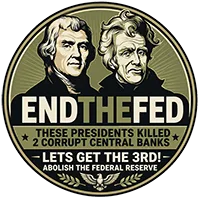
yeah, I mean generally historically it takes a crisis to get there and for better or worse we're not at a crisis and if we were at a crisis that's not necessarily a good thing for the accelerationists out there. If we look at every crisis in American history, uh you could argue Andrew Jackson was a crisis that made things better. He got rid of the Fed,
the precursor to the Fed. Every other crisis has made things substantially worse. Right? This is the crisis and leviathon ratchet book by Bob Higgs.
Y
you know every war, every 2008, every COVID, we don't come out the other end of it purified.
No,
leaner and meaner. Well, no, but but but having said that, there are cycles and you know, if you um you know, look, I mean, what Vulkar did was extremely painful, but then he did pave the way for a bunch of years of falling inflation and and generally um healthy economic growth. I mean, it would have been better if we'd been on sound money to begin with and, you know, a lot of that um, you know, the productivity increases that we enjoyed would have flown through to people, but but they kind of had it all in balance back then to some degree. Um, you know, and and that's why I mean, I think a lot of people out there are missing the fact that this is the kind of thing you got to look at in hundredyear cycles. I mean, the last we're in a sovereign debt crisis. The last sovereign debt crisis was World War I. you know, when basically the cost of the war forced all the European countries to go off the gold standard. Um, you know, and so, um, that's the model. Um, and nobody was around then is alive today. So, um, you know, everybody's using the old playbook, which is, yeah, the Fed will raise rates and we'll get inflation under control. We'll go back to it all being normal and the stock market will go on to make new highs because, hey, you know, buying the dip has worked since 1980. and it has, you know, generally uh but I I'm not so sure it's gonna continue to work. [laughter] I'll take the other side of that bet.
All right. So, speaking of which, last question here.
Yeah.
How should an ordinary American like what should they own? And a key point here, I think you're familiar with the book When Money Died. Yeah.
By uh
very good book. Yeah.
Yep. By Ferguson. and he talks about the VIAR uh episode of hyperinflation and one of the points that struck me in that book is that early on in VHimar stock markets reflect the future right and so when the hyperinflation started coming in stocks responded to it first
yeah so in terms of how people should position themselves I mean the point I make to most people I think is that um you know if you have savings um I mean and by the way if you know, if you're young and you don't have a lot of savings, I mean, it's u this is less relevant. And whatever the new money is going to be, you're going to you got your whole career in front of you to make money. But, um, the point is if you're older and you have savings, it's generally important to hold on to those savings because in your later years, you're not going to have as much earnings power and you want to have, you know, be able to live, okay? Um, and and I guess the point I try to make is that we clearly live in a period of monetary debasement and we clearly live in a period where inflation is going to be a problem. And the the best traditional protection against inflation are to own things the government can't print. So real estate qualifies, but the negative there is you've got t taxes and maintenance and a lot of issues and some areas are a bubble. So, you know, real estate's I think a poor substitute. I think probably the best pure play qualifier is gold. Um and then if you want something that's got more alpha to it and obviously has a lot more volatility, Bitcoin, uh in my opinion is great as well. My book talks about both of those. um silver works too. Um you know because these are these are forms of money that cannot be printed and I think they have you know although they've gone up a fair amount in the last year or two I think they have much much further to go as you know the governments continue to debase the currency. how you know what what you should be looking out for is if if that changes then you know maybe lighten up and and like all investments the way to deal with this I mean I happen to be about 100% in on both of these two assets but I'm a professional and I can do that um you know given my circumstance I think that most people um you know I think a lot of people just have their IRA or their 401ks in the stock market and I think the stock market is very pricey I'm not saying it's going down but I don't think it offers the riskreward benefits that gold than Bitcoin do. And I often say to people, if you don't have 20% or 30% of your savings in something that protects you from this inflation, I think in five or 10 years, you're going to have regret. Um, and and by the way, stocks kind of protect you from inflation because they, you know, they're they're productive enterprises that will go up in value over time. But traditionally, in highly inflationary periods, stocks have been kind of, you know, subpar. Like take the 70s as the last big inflationary period. stocks were kind of flat to slightly up over the whole 10-year period, whereas gold was up, you know, gold and oil, the two major commodities, were up 30% a year, compounded for 10 years. I mean, it was enormous. And I think that's the kind of environment we're going into, an inflationary environment. So, I think that people need to make a make a decision, you know, take a decision to have some of their assets in these assets that that will be protecting them from inflation. Yeah, that's a great point that you know stocks are kind of a halfway hedge. They are real things.
However, they get overvalued in the inflationary period and then uh you know that point about the 70s is great. They held value. Uh but I think housing went up quite a bit during the 70s although in 1980 it wasn't as high as you would think. I mean it did go up quite a bit but remember in 1980 interest rates were 20%. And housing was really driven by interest rates. And I remember
that's true.
You know, at the time frame and my I I saw my parents house a good example. So my parents um
bought a house in Ann Arbor in the 60s for I don't know 40,000 50,000. That's kind of what it was, right?
And uh so the 70s came along and there was enormous inflation. I think by the end of the 70s that house was worth I don't know maybe you know 150 you know so it gone up 3x which was nice
but interest rates were high and it was only 150. Well, as interest rates came down over the next, you know, from 80 to 90, that 150 became 800 or something. I mean, you know, because people can now afford, you know, the higher housing prices. So, uh, yeah, it's, um, housing is it's got a interest rate component to it.
Yeah.
All right, Larry, thank you for coming on.
Thank you. Um, if you don't mind, I want to show my book.
100% show your book. Yeah. I was going to ask, all right, how do people follow you? And please show your book.
Yeah. Okay. Well, you follow me. I'm on Twitter. It's just under my name, Lawrence Leard or X, I guess it's called now. I'll always call it Twitter. Um, the book is available on Amazon. It's the only place it's available. I didn't have a formal publisher. I self-published it. I sold about 60,000 copies of it. Um,
wow.
Yeah, it's in all Well, it's it's okay. It's in all formats. It's called the big print. It's in all formats. um you know, hard cover, soft cover, um uh Kindle and audio.
And then I I also um I run a fund and my partner and I, David Foley, we run this fund called EMA, Equity Management Associates. And so we have a website, EMA2, uh Edward Markalpha 2.com, where we publish our quarterly commentary. And that quarterly commentary is about a 15-page writeup of, you know, what happened this quarter in the monetary debasement world, more or less. and and it's free. You can sign up. There's a place if you go you scroll down on the page, there's a place you put in your email address and we won't ever spam you. And so you can read our quarterly commentary of, you know, how we see things going and and that's free. So So those are really the best ways. And um yeah, no, I I just also I'm on pods a lot so and I I'm kind of I kind of keep I'm a broken record. I keep saying the same thing over and over again, but it is coming, you know, and I think that you know I mean one one of the things we didn't cover, Peter, I think a lot of people ask me kind of where do I these prices are going? I mean, let me just give you a sense. You know, I I kind of feel like gold is going to, you know, between 6 and 10,000 in the next couple years. Um, I kind of feel like Bitcoin is going between 150 and 250,000 in the next couple years. So, and I have pretty high level of confidence in both of those. Um, but I could be wrong. I mean, I I thought Bitcoin would be higher by now than it is. So, um, I could be off, but I think they're both going higher.
Yeah. I didn't want to put you on the spot. I know that uh you know the trick as a financial uh analyst or commentator is always that if you make a concrete prediction
I'll say the time. Yeah.
Yeah. You're going to be wrong in some sense, right? Either it's going to go you know much higher than you said like like the likelihood that you know gold in 5 years is exactly what you said it is is nearly zero. It's going to be somewhere around there. And so you know there's a lot of people who uh who avoid making predictions. So yes, that is bold. You're actually putting a number on it.
Well, I'm just giving a time frame. Yeah, general rule of thumb. I mean, I I think they will both be significantly higher as this sovereign debt crisis unfolds. And it's just math. And you know, how and when it unfolds, we don't know. Um, you know, if there's some kind of big break, and I think there could be, you know, if something really breaks at some point, then, you know, the history of this, I mean, after 2008, gold, we keep in mind that in 2008, gold got hammered right in the beginning. um until they printed. And in 2020, it was the same story. And so, one of the things I would caution people who are thinking of buying these things is that you really have to be prepared for the possibility that in a in a in a something breaking scenario, you kind of get a liquidity squeeze and everybody sells everything and everything will go down.
Yes.
And so, you know, Bitcoin went down 50%, gold went down 25 and and that could happen again. Now, you know, it didn't last very long because in both instances, the Feds stepped in and printed a lot of money and 3 months, 6 months, a year later, they were both much higher than they were when the whole thing started. But, um, you know, it's a uh it is a volatile trade and I I caution people, you know, to be aware of that. I mean, you don't want to buy into these two things. See the see the market break, they go down and then you panic. you know, these are these are long-term holdings that I'm quite certain math will reward you. Um, but you've got to think in a couple of year time frame.
Yeah, really good advice. Um, specifically for anybody considering Bitcoin, it's a very common pattern that if somebody comes into Bitcoin and they don't really understand it, you know, they haven't gone through the [laughter] years of uh content to really become familiar with it, then they'll panic at the first drop. And the key on all these things is, you know, you decide what your thesis is ahead of time. And, you know, as you say, in in 2008, everything went down for a minute because the market, broadly speaking, considers dollars as out of the market. They shouldn't, but they do think of it that way. And so, you know, everybody dumped they dumped everything, right?
Correct.
Uh, but then, of course, the snap right back. And if your thesis is correct, then the snapback should be violent. Like it should be COVID level as in stuff dips for a minute. And it did dip right early in co like midFebruary there was a moment there where stocks went down that I want to say 10 or 12%.
That was more than it actually went down about 28%. And then and then POW panic and came in with just all those programs and all that money
and they just took off and you know Bitcoin as I recall was roughly eight or 9,000 and I co it dipped into the five maybe four five six area is just by memory
and then in October it went from 10 to 60
you know over the next over the next year. So I mean [laughter] um and that's that's the pattern you know they they they wait for something to break it breaks they print money and the money flows into the system and the hard the hard assets go up. So and and for the record the pattern that you're describing of you know gold and bitcoin going up. I mean in gold's case that's a 55 year trend without the system collapsing
right. So you know people you know they say ah yeah you know you've you've said the system's going to collapse for 55 years. Okay. But gold has been, you know, it was what, $23?
Oh, yeah. Or
Yeah. It was $35 in 1971. That was the last $35. So, it went from 35 to what is it today?
4,400.
Bingo. So, you you know, even even if the big print doesn't occur, if we just have another 55 years of little print, apparently that's stellar.
That's right. I mean, that's, you know, I can't say for certain that we're going to have runaway inflation. I, you know, or hyperinflation. the currency is going to collapse. Total sovereign debt crisis. But what I am extremely confident of is that given the fiscal situation, we live in an inflationary world and it will continue to be inflationary until something changes, you know, until they they cut back on spending or balance the budget.
And I don't see any evidence right now that that's going to happen.
Agreed. I think everybody listening was [laughter] that snowballs chance.
Yeah. I mean, actually, I forgot about the most recent one. I mean, how about those $5,000 checks Trump's going to send us, right? Oh lord.
Where's the money? That's $1.2 trillion. Where's the money for that coming from?
We're We're, you know, three weeks from Democrats doing 10 and why stop at 10?
Well, that's right. Yeah. Yeah. Vote for us and we'll give you 10, right?
Yep. It's just nuts. So, anyway, I really enjoyed talking to you. Thank you very much for taking the time.
Yeah, it's always great. Thanks, Larry. And folks, thanks for tuning in. Until next week, we'll be watching. See you next time.
Paramount Skydance Chairman and CEO David Ellison is exploring a potential California exit as the studio battles a multistate challenge to its $111 billion acquisition of Warner Bros. Discovery.
Politico reported late Wednesday that the studio is seeking roughly 400,000 square feet of office space in Nashville, signaling that its relocation is in the works. We have reported in the last few days and last month of Paramount's plan to exit the left-wing state (read here & here).
The studio could move at least some operations to the Tennessee capital within two to three years, according to the report. No relocation has been announced, but the search raises the risk that California could lose a major Hollywood studio headquarters. Such a loss would deepen concerns about the state's ability to retain businesses as its entertainment industry struggles and the exodus of businesses and residents shows no signs of stopping.
Starting in October, Paramount will owe roughly $7 million for each day the transaction remains incomplete, according to the report. That amounts to approximately $210 million over 30 days.
The Paramount-Warner Bros. deal faces an antitrust lawsuit from 12 states, including California, despite approval from the US Justice Department in June and regulators in more than 60 countries and jurisdictions. The trial is scheduled for March, with settlement talks in San Francisco next month.
California Attorney General Rob Bonta, who is leading the lawsuit, has called Paramount's relocation threat nothing more than "blackmail."
For Hollywood, the potential studio loss extends beyond another corporate exit; the exodus includes Chevron, Tesla, SpaceX, Oracle, Charles Schwab, and many others.
Tennessee has actively courted the studio. Nashville also has an existing Ellison family connection: Oracle, co-founded by Larry Ellison, announced plans to move its headquarters there in 2024. Larry Ellison is also financially backing his son David's Warner Bros. deal.
"I tried to warn you. LA is getting absolutely decimated by the insane communist wackos running California. Bob Bonta's jihad against Paramount is a death blow. What a corrupt piece of shit," Spencer Pratt wrote on X.
A New Home Page
A New Home for the Monetary Literacy & Mastery FoundationThe Monetary Literacy & Mastery Foundation has a new front door.Our redesigned homepage was built around a simple goal: make it easier to understand what the Foundation is, why monetary literacy matters, and where to begin.The Foundati...
I've always enjoyed supporting local businesses whenever I can but competing with multinational bigger companies isn't easy. Honestly I think the playing field simply too uneven for them to enjoy success on a big scale.
Do you think small businesses can still grow and succeed?
They Will Turn Your Money Off! Incoming Stablecoins More Dangerous Than CBDCs - Fitts
Daniela Cambone: Hi everyone, welcome back to the Dingella Camboni Show. Well, look, most people who leave Wall Street and Washington either cash out or go out quietly, but Catherine Austin Fitz did neither. She's an investment banker and former US assistant secretary of housing and federal housing commissioner. She spent years in court with the Justice Department after she started asking where the money actually went. Guess what? She won. Then she started publishing what she found. She talks about missing trillions digital money that can just be switched off and facilities most of us have never seen on a map.
Today she's here and we're not going to treat her like a curiosity. We're going to treat her like someone who used to sit in the rooms where the numbers get written. Uh it's a tremendous honor to welcome to the show Katherine Austin Fitz. Katherine,
Catherine Austin Fitts: thank you.
Daniela Cambone: So good to to have you on.
Catherine Austin Fitts: It's great to be on.
Daniela Cambone: You're remind Did Did you ever see the Hamilton show when it was on Broadway?
Catherine Austin Fitts: Of course. Multiple times.
Daniela Cambone: You're reminding me of that song, I want to be in the room where it happens. The room you you Well, I like having people on the show that are in the room where it happens. And uh that's why I was dying to get you on because you've sat on both sides of the table as an investment banker and as a United States Assistant Secretary of Housing and Federal Housing Commissioner. I mean, hello. [laughter]
When did you I mean, you know, you have these incredibly highowered positions, but then you were looking, you know, through the numbers and you realized the official numbers at Real Flows no longer matched. I mean, uh, walk us through that moment. It's the first time you're on the show. I mean, when did that light bulb moment happen for you where you're like, "No, something's seriously wrong here."
Catherine Austin Fitts: So I saw tremendous corruption when I was in the administration and that's why I had to leave because I was being ordered to break the law and I wouldn't. So I had to I had to go.
But I discovered the internet and so I decided to start a company that could use the power of new technology to help democratize basically equity investment and and liquidity. So um you know we were making software tools. One was IPO in a box where small business could form a venture pool and literally with radio dots make their perspectives.
Anyway, so so we had this whole vision of democratizing sort of equity the equity markets and um and what happened was I ran right smack into the fact that the mortgage bubble was growing. We had a contract to be lead financial adviser to the Federal Housing Administration and um and what was happening was there were real shenanigans going on with mortgage fraud as you know and certainly which came out during the financial crisis and we tried to essentially wind it down and stop the corruption inside.
And so we were targeted by the Department of Justice basically to get us out to, you know, to fire us. But also we had done so much in terms of building databases and softwares to map out how the money worked that it was exposing the fraud. And so there was a great effort to steal all of our software and databases and basically keep it under court control for many years and to shut us up.
And you know, there's a great line. I don't know if you've ever seen the movie Gladiator. It's one of my favorite movies and there's a great line where they say to the gladiator before they can kill you they have to kill your name and I had a very good reputation before the litigation started and there was tremendous effort to destroy my name and I realized oh they just can't afford for me to have credibility when it comes to you know the talking about the mortgage fraud.
And it was funny because I tried to warn people about the mortgage bubble and what was happening long before the you know all the way into the financial crisis. And what was amazing was how many people wouldn't listen because I had been discredited and yet you know and when the of course when the bubble popped then it turned out I was right and and there you were.
But it was terrible because you're trying to warn everybody about something that could bankrupt them and and yet they can't hear you and it's it's a terrifying experience.
Daniela Cambone: We'll get right back to the interview, but this is an important moment to ask yourself [music] when the next crisis hits, will you be properly positioned or wish you prepared earlier?
I've spent over two decades reporting on global economic shifts and what's [music] happening now is unprecedented. In moments like this, timely decisions are critical. That's why we've put together [music] the private wealth playbook. It's a free guide showing you how to use Gold and Silver strategically for protection, [music] privacy, and long-term performance.
Click below or visit dannyreport.com to download it now so you can move forward with clarity and confidence. [music]
Now, back to the show. I mean, there's so many questions I have for you, but I find it so commendable the fact that, you know, here you are in this highpowered position, Catherine. I mean, few people would walk away from that, but you couldn't stand it.
Catherine Austin Fitts: So, I had a chance to go back in. You know, repeatedly I would get offers to go back in. But here's the thing. There is a line between civilization and the absence of civilization.
And the interesting thing about me is if you look at the training I had, I really had tremendous training both on Wall Street and in the financial world, you know that if a financial coup starts that they're going to destroy the country. And so you can't go along because you're talking about something that is going to destroy everything that gave you and I and our families the blessings that we enjoy. You you can't you can't destroy, you know, you can't be part of that.
And it was very interesting because when I left the Bush administration, I came out and I said to the people I started the company with, I said, "Look, these guys are going to use the technology to destroy us all. We need a plan B."
And so the the goal of Hamilton Securities was let's create something that can build so much bottomup wealth that these guys don't have to destroy everything. We can find a way, you know, to get the government and the country on a financially sound basis and move forward.
So my idea was not to fight with them. My idea was to provide a pathway that could work for them and everybody. So, you know, with globalization, a way that the middle class could succeed despite globalization.
And what I didn't understand was they were so dependent on criminal cash flows that they couldn't permit that to happen. And I just didn't understand it at that point.
And the litigation was the process by which I learned about the covert side of the house and understood what the issues were in terms of creating a new model because essentially we knew the existing model would have to change. we'd have to do a reset and we're in the middle of a reset.
And my vision was let's create lots of bottomup wealth with new technology. Their vision is let's use new technology to get complete top- down control. And because they're thinking conservatively and risk managers and I'm thinking who would want to live in that world? It's psychopathic.
So um you know so so there were two different visions and I have an online book after the litigation was over I wrote an online book to explain you know the difference between the two visions and what had happened and the sort of the dirty tricks and and the targeting and it was really funny.
I've tried to publish it in hard copy three times and the first two it was sabotaged badly and the third time they threatened if I did it to kill somebody in my family.
Daniela Cambone: So I said oh my lord were you getting an anonymous note? What what the how did the how did that director get
Catherine Austin Fitts: I got three phone calls each with a message but if you put them together that was the message so it's done very it's done very tactically so if I try and you know talk about it in a court of law I won't win
Daniela Cambone: but it is it a voice
Catherine Austin Fitts: no it's three people you know you have three different conversations but they each give you a piece it's like a code and when you put the three pieces together you get the message right so so um anyway so I didn't know if they were serious or not, but I didn't want to test it.
So, I've just left the book online. It's Dylan Reed andco uh.com and it's it's called Dylan Reed in the aristocracy of stock profits. And it's all there. It's all it's not it's not suppressed. They just want it in a hard copy.
Daniela Cambone: Not not to not to not to digress, but um when we talk about, you know, threats and people trying to stop this, you know, stop the exposure of the fraud. Um do you believe it's happening at the government level or is this, you know, talk of deep state stuff? like what what level are we talking about here that we're trying to listen?
Catherine Austin Fitts: You have sort of a permanent government of the intelligence agencies and the enforcement agencies um that's veryworked and and they have both private and public capacity and then you have the political representation which tends not to be the deepest part.
Um and and but you also have tremendous private interests and we've seen much more um privatization of the intelligence and enforcement capacity into you know in into literally corporations that have teams of intelligence agencies working for them.
Daniela Cambone: Okay. I'm I'm going to circle back on exposing the fraud, but let's get into the nitty-gritty here because you talk about $21 trillion that can't be accounted for, right? you know, walk us through that in in plain language of how something I mean, we're not talking about a couple of bucks here, right? How does something that large disappear without the public noticing, Catherine?
Catherine Austin Fitts: So the federal government has never obeyed the or or a new round of laws were passed in the Bush administration in 1991 and then 9293 to institute uh financial disclosure uh for the federal government and a process began in 1996 whereby the federal government announced it wasn't going to obey the law.
So the federal government since 1996 has never once obeyed the laws related to financial disclosure. They are required to have audited financial statements and to publish the audited financial statements and they have never done that. They have refused to do that.
Now you and I both know if a company refused to do that the stock exchange would shut them down. Their bankers wouldn't make their transactions. They wouldn't be able to raise capital in the markets. Right.
Daniela Cambone: Right. Of course.
Catherine Austin Fitts: Right. Okay. But the federal government can keep on borrowing and the federal government bank accounts which are run by the New York Fed and its members as agents for the New York Fed keep running its bank accounts and keep borrowing money in the Treasury market. Right?
So, so you've got a financial entity that doesn't have to obey the financial management laws or provide, you know, proper financial disclosure, which means anything's possible because if I can issue securities without putting it on my balance sheet and I can do, you know, sort of non-disclosed transactions and my banks will do it, of course, anything's possible.
Okay, so here's what happened. In 1995, there was an effort to get the financial uh system and the federal credit on a sound basis, particularly with respect to the baby boomer retirement obligations. The effort failed. It turned out to be a three-w weekek very bitter shutdown of the government.
And that period was later described to me by the president largest pension fund in the country saying, "You don't understand. They've given up on the country. They're moving all the money out starting in the fall."
And what happens the right after that the um the Fed and the New York Fed bought shares in the Bank of International Settlements and then proceeded um starting at the beginning of uh well it was October 1st 1997 large amounts of money started going missing from the federal government.
So it's called undocumentable adjustments and and the Fed the federal government had to publish supposedly financial statements. What they would do every year is publish, we're not going to produce audited financial statements and we have this much in undocumentable adjustments.
Now, what the coverup artists will tell you is, oh, well, those could just be accounting entries. But the reality is if if the department of the army has six times more undocumentable adjustments than they have budget, something is very wrong.
If your church had an annual budget of $500,000, but it was missing $6 million in a year and they said, "Don't worry, it's just accounting transactions," you would force them to produce audited financial statements. Right.
Daniela Cambone: Right. Of course.
Catherine Austin Fitts: Right. So, so what happened was from uh 1998 fiscal year to 2001, uh $4.4 trillion went missing from the federal government. And we all have heard about it because the the day before 911, Donald Rumsfeld got up and said, "There's 2.3 trillion missing from the Pentagon." Remember that? Okay, that was the missing money.
And in fact, on 911, many of the buildings that blew up had records on either the securities, the Treasury market, or the accounting. Um, you know, if you look at the office at the, uh, at the Pentagon was said to be the office where the O and I was doing an investigation on the missing money.
Anyway, so, so, um, after 9/11, people stopped worrying about the missing money. I kept talking about it, but it was not a hot topic coming into the financial crisis.
And then with the financial crisis, people started to realize the extent of the fraud. And um, and not only did you have money going missing from the federal government, but then you added 29 trillion of bailouts. And so people knew something was very wrong.
And and if you look at the size of the bailouts, it was more than three times all the single family mortgages in the country.
Daniela Cambone: So So wow.
Catherine Austin Fitts: So whatever was going on, it wasn't just mortgage fraud. Okay. So So money kept going missing.
And then finally in 2015, in the last year of Obama, um there was an announcement that there were 6.5 trillion missing from the Pentagon, which was the biggest annual number yet.
And I started, you know, I kept talking about it on the radio because at that point I had up to 12 trillion dollars of missing money. And a professor from MSU heard me and uh called me and he heard me on the radio and said, "She has to be wrong."
So he went to the Pentagon and looked at their financial statements and realized, "Oh, I was right." So the money was going missing from the Pentagon and HUD where I had used to work and I knew the financial operation at HUD, you know, inside and out.
Anyway, so so Skidmore called Dr. Skimmore called me and he said, "Can I help?" And I said, "Yeah, let's get your students and do a complete survey of all these years at at DoD and HUD."
We did and he got the number. I had it up to 12 trillion. He found another um he found another 9 trillion so we got it up to 21 trillion and that was at the end of 2015.
So there was tremendous pressure at that point with this kind of attention to get the Pentagon and HUD to produce audited financial statements.
Well, what happened next? You're going to love this, was a little known policy. Remember Kavanaaugh hearings, the Supreme Court hearings with all the sex?
Daniela Cambone: Oh, yeah.
Catherine Austin Fitts: Yeah. Oh, yeah. Okay. Very distracting, very attention getting.
While that was happening, and you will appreciate this, the Congress and the executive branch working together, Democrats and Republic, passed a little known policy called Federal Accounting Standards Advisory Board Statement 56, which basically said, I have a big article up about it if you're interested, but it basically said that the federal government by a secret process and a secret group of people could take a secret amount of the financial statement out of the financial statements and keep it secret and not only do it for the 24 covered agencies but for 150 plus governmental entities.
And wait get this with the national security laws and the classification uh classified laws they can then add the big banks and contractors who do business with the federal government.
Now what you will understand because of your background and the show that you do that means the vast majority of the issuers in the US bond market and the large cap stock market
Daniela Cambone: have secret books
Catherine Austin Fitts: right secret books. So I used to plow through the financials of the US government and HUD and DoD and from that time on I stopped looking because who knows what it means? You don't know. It's like that it's make believe.
Daniela Cambone: Well, I I I Well, I'm wondering, well, who's who's lining their who lined their pockets the most?
Catherine Austin Fitts: So, uh, so, so there are a couple things going on. The first thing is you you've grown since the 47 and 49 act, you've grown something called the black budget, which is a secret or covert part of the economy. And it's grown and grown and grown. That's number one.
And it's, you know, it's there's so much that's secret and and as it's grown, it's benefited a huge number of people. Like a lot of the technology in Silicon Valley, I believe, based on understanding the black budget was transferred, you know, was financed by the ta taxpayers, but transferred to these corporations.
So, they're real issues as to, you know, who should really own what. But, um, so this part of the secret part of the economy has grown and grown and grown.
But then in 1995, I think what happened was they gave up on the current structure of the government and they literally decided to engineer a coup.
And the way you do that is you you keep the existing system going, but you transfer as many assets as possible into a new system and then you bring up the new system and then you slowly, you know, dissolve the existing system.
And and the way I would describe that is in the existing system the bankers run monetary policy and fiscal policy. In the new system the bankers want to run both monetary and fiscal policy. So they want control of the fiscal side of the house and they want to keep a lot of the economy secret.
Daniela Cambone: and and and and that's where we are today Katherine.
Right. And I don't I don't want to forget this question because um you spoke of these distractions and that's how they were able to do it like psychops if that's another word you want whenever they're selling like the Kavanaaugh hearings I'm like what are they really doing right what what's the what what do you think is the equivalent in today's environment okay of a news that we're being fed that's the Kavanaaugh moment
Catherine Austin Fitts: there there are two things that we need to know first of all the game with energy And if you go to Celier, we have something called the energy timeline and trade bottlenecks. You can look at it and it will describe everything.
The the energy gain going on in the planet is co 2.0. It's a way of dramatically shifting market share out of the little guys into the big guys and centralizing power. And it's part of the US moving from a an open trade model globally to a closed trade model. And it it revolves around controlling energy.
So, so you know, COVID 1.0 was health. Now we're doing energy. Yeah. Okay. And it it's all about, you know, who controls what and so, uh, take a look at that energy timeline. I think that's the important one important thing to understand.
The second important thing to understand is we are watching the organi the legal organization and preparation of the largest bubble-blowing machine we have ever seen in the financial markets with the implementation of programmable money and digital tokens.
And if you look at what they're planning to do, you know, people who say the bubble's about to collapse, the bubble's about to collapse. And the bubble right now is ridiculous.
But if you look at the bubble machinery they are building and they are planning on launching at the beginning of next year. I don't know if it'll work because this is the most outrageous bubble plan I have ever seen in my life.
And I have seen a lot of bubbles. I've seen a lot of bubbles. But and if this succeeds, if this succeeds, you are going to see a tsunami of you're going to see explosive bubbles all over the planet.
And and here's what I'm going to describe it. I'm going to give you a brief overview and then we can dive in. Okay?
Daniela Cambone: And that was nervous laughter, by the way, on my part. Okay?
Catherine Austin Fitts: So So retail is leaving the Treasury market, right? And and so we see Norway saying they're going to sell government sovereign bonds including treasuries blah blah blah. So so institution is selling.
If you look at what the Treasury plans to do with stable coins, they plan to market stable coins into retail all over the planet in a way that will bring in they think by the end of the decade three to four trillion dollars into the treasury market.
Now, that's not a lot of treasury market, but you're talking about drawing retail in in a way that you create crypto accounts. It's crypto rails and you can pump out enormous leverage to all four billion customers, right?
So, if you remember, you're probably too young to remember the way that the Germans unified Germany after the wall came down in '89. They just offered a sweet premium for the tender and for the for the East Germans and the East Germans overnight got like a stock tenders for another company.
The West Germany tendered for the Eastern Germans through the currency and boom, they unified overnight.
The US is planning on marketing dollars through crypto rails all over the planet to anybody they can reach on Google Pay, Apple Pay, mobile payment phones. And my suspicion is they're going to be exceptionally generous with leverage.
Think of this as the pallets of cash that went out to Iraq, except this time it's going out on the crypto rails.
Now, hold that thought for a second. They are working to build digital tokens for stocks and bonds. Coinbase has said, you know, and some of the other crypto firms, we're going to offer the big cap US stocks with 20 times margin on digital tokens.
So imagine four billion people and and Armstrong has said we can we can bring four billion new people into the US stock markets.
So imagine you're offering 20 time margin on the crypto rails. You bring in four billion people to the US stock and bond market.
Mark Andre about a month ago tweeted out, you know, uh our current stock market is 68% of the global stock market. Unless something goes horribly wrong, you know, within a reasonable period of time, we're going to be 90%.
That's what he means. He means we're going to go out and try and get people all over the world into our channel.
Daniela Cambone: Okay. So, two two points I find. Okay. Let's talk. A lot of your thesis is centered around digital central bank digital currencies. Um,
Catherine Austin Fitts: no stable coins through stable coins. stable coins and digital tokens.
Daniela Cambone: I feel uh and tell me if you agree with me or not. At one point, you know, and the ECB has spoken, you know, Christine Lagarde has spoken about uh moving to moving the euro to digital currency.
And in the US, we were speaking about it heavily at one point, I would say, under the Biden administration. And all of a sudden, it really uh kind of went away magically. people stop talking about it, right?
But you see it coming as soon as possibly next year, Katherine.
Catherine Austin Fitts: So, no, it's here. It's here. So, you know,
Daniela Cambone: but the use of it, the use of it.
Catherine Austin Fitts: Yeah. So, so let's talk about So, so programmable money that is used to control us is the problem. And it doesn't matter whether it comes in the form of a CBDC or it comes in the form of a stable coin or it comes in the form of a Visa credit card that can be used in the same way.
We don't really care. We just don't want to be controlled, right?
So, so there are a couple problems with the CBDC. One is a CBDC requires authorizing legislation for Congress and in this kind of environment, you're not going to get it. That's number one.
But number two, uh, if you can do programmable money through stable coins, which are privately issued, the problem with the CBDC is the Fed is a creature of Congress and if they do something that Congress doesn't like, Congress can pull the rug out from under them, shut them down, require disclosure, and under the law, they have public policy obligations.
If if instead rather than going through the central bank, I go through private stable coins.
Daniela Cambone: Yes.
Catherine Austin Fitts: where they are mandated to do whatever Treasury tells them to do in terms of applying the central controls and the rules. Then I have the same as Twitter censorship.
I have government control, but I have private issuers that can say, "Well, I'm not subject to p public policy obligations. I'm not subject to FOIA. I'm not subject to any of these rules."
And you've got something which is far more dangerous because then the people who control them can griff to their hearts content and skim and do a whole lot of stuff that would be much harder to do with central bank digital currency.
So the stable coin plan has turned out to be far more dangerous. I mean I hate CBDC but the stable coins are far more dangerous than CBDC.
Daniela Cambone: Um if I could put you in a room alone with Scott uh Bessant, right? No microphones, no cameras, nothing. What's the one thing you'd want to tell him?
Catherine Austin Fitts: Well, I'd want to ask him questions.
Daniela Cambone: Ask him. What would you want to ask him?
Catherine Austin Fitts: I would say, if you're planning on marketing$4 trillion dollars of stable coins to the world, why did you brag about being able to seize the wallets of a billion dollars, a billion dollars worth of wallets of Iranian wallets?
Why why would you market that way? What's what was that about? That's what I would ask him.
And then I'd ask him why he illegally gave Musk all the data from IRS and the payment systems.
Daniela Cambone: Interesting. Interesting.
Catherine Austin Fitts: I'm pretty sure I know why he did, but you know, I'd still ask him.
Daniela Cambone: I I want to I always want to give my audience tools, right? They walk away from this like let's say if we have a family of four watching, they have $8,000 in savings, let's say a mortgage.
What do you think? What would you tell them is the single most useful thing they could do this month?
Catherine Austin Fitts: Here's what they must do. They What's important is not what the price of your asset is. What's important is that it's your asset and it doesn't have a leash and somebody can take it away, right?
So when you think about portfolio strategy and managing your assets, you want to focus on what are the assets that are very hard. You you don't want to make it easy for people to take your stuff, right?
The first thing you need to do that the kind of auto I call it the automatic third lock which is what they're trying to put into place with respect to our currency or our digital assets what you want to do is you want to keep the system from going all digital.
Okay. So if there's one thing you want to do you want to preserve cash and you want to preserve analog systems. you know, whether you're trading, you know, gold coins or you're doing barter or you're using cash, right? Whatever your systems are, that's number one.
Number two, we have a book at Ceri called Coming Clean. It's free. You can come in and you can download it and it's full of uh it's like a buffet of all the things you can do to get the bad guys out of your head, out of your home, out of your heart, out of your wallet, out of your life.
And you want to build as much personal resiliency in terms of food, in terms of health, in terms of who you depend on, who you associate, where you bank, etc., etc. to give yourself as much personal resiliency as possible.
So, I'll get I'll tell you a funny story.
During the litigation before it started, I had gifted, you know, I was on Wall Street. I had a great career. I loved making money, made a ton of money. And whenever anybody in my family was in trouble or needed help, I would just help them. It's like that's what you have money for, to help your friends, right?
So, so when the litigation started, I they tried to cut off all my credit, all my, you know, completely control me and cut off my resources, cut off my income.
And my family got together and and I had an uncle who bought some of my farmland from me. He was wealthy. And so they targeted him and showed up at his door in the middle of the night with a subpoena and tried to scare him into not helping me.
And so the family had a a big pow-wow by phone. Yeah.
And everybody said, "Well, we're going to drop her because otherwise they're going to target us."
And Michael said, "I'm not going to drop her because she always helped us. If we were in trouble, she helped us. And now if she's in trouble, I'm going to help her."
Well, it turned out that I had I didn't even know how much I'd gifted her loan, but I had gifted her loan 250,000 to family and friends. And over the next 11 years, 200 they either paid back or gifted back exactly 250,000.
I didn't realize it until we won the litigation. I got the money in and I said, "Okay, I'm going to pay everybody back that helped."
And I did the numbers and I realized I had loaned or gifted 250,000 and then for 11 years that money had been repaid or gifted back and if it wasn't for that money I wouldn't have made it. I would have been dead. There was no way I would have made it without that money.
So when the money came in I had had a 401k that I'd had to bust and pay half the money in taxes and fees and it was 500,000. I had to pay 225,000 of taxes and fees to get it.
And um and my CPA said, "Let's fund up the 401k."
And I said, "No, I'm going to take that 500,000 and I'm going to bonus it out on the people bank because that is the only bank I trust. That is the only bank when the you know what hits the you know what that that they can't shut off."
And so one of the things I learned as an investment advisor, we're trained to put all of our money in the brokerage account and not help our kids or our grandkids or our family.
Wrong. You want to identify the people in your life that you can trust and you want to support and back them and that's what gives us resiliency.
So I just have to say this because I was telling you how much I love the Italian people. You can't do to the Italian people what you can do to the Americans because the Italians they support and and finance their families internally.
They have much more resilience because you can't bust those family ties. Right. And that's why Right. Right. They they know how to play the game. They've lived through up and down empires. They know.
Daniela Cambone: Oh, hell yes.
Catherine Austin Fitts: And that's what Americans have to learn. Americans have to learn, you know, we're in a war and we need to circle up with each other and and find the people we can trust and build resiliency together.
Daniela Cambone: And because so true, right? If you look at the things we need, food, health, you know, finance, all these things, what you need are people you can trust in the health area, people you can trust in the food area.
You're talking about building that community. And it's so true that the Italian people, you know, I I I witness it and I'll have a funny story I'll tell I'll tell you one day.
Um, but because we can't stop this programmable money train, Katherine. So, you talk about
Catherine Austin Fitts: I I'm an optimist. So I think we can for two reasons. One is it is possible to put up guard rails legislatively within states to do so.
It is also possible to keep the financial system from going all digital. If we can keep enough analog alive that they can't go all digital, we create options.
But the third reason, and this is a longer term reason, if you look at what they're trying to do in terms of central control, I absolutely believe it will fail because the notion that you can use digital technology to control the entire universe is absurd.
And and I just think their model is going to fail. So, but I don't
Daniela Cambone: I think that's the only thing we can bank on.
Catherine Austin Fitts: Right. Right.
Daniela Cambone: Because you're proof. You're proof. You're someone who went into government hoping to make a difference, you know, with with good intentions, and those people get cut out. The moment you start exposing fraud or, hey, something's fishy over here, you're out.
Catherine Austin Fitts: Well, but here's the thing.
Daniela Cambone: So, how am I supposed to have any faith in the system?
Catherine Austin Fitts: Well, I I don't have faith in in the existing institutions. With rare exception, I do have faith in people, and I do have faith in what people can do if they organize in effective ways.
So, so let me give you an example. If I was to go to a data center, our third quarter wrap-up's going to be on data centers.
If I was to go to a data center protest, I would see a thousand people and if I said to them, give me a copy of your IRA and 401k. What I could prove to them is they're financing the data centers, right?
But here's the thing. If they get smart, and this is going to be in our third quarter wrap-up, how to do it. If they got smart and said, you know something, I'm going to stop financing the data centers. I'm going to stop financing the companies that are poisoning my kids.
I'm going to stop and instead I'm going to start financing companies that are productive and are making money or good companies, right?
And I shifted my money. If we shifted our bank deposits away from the banks that did the financial crisis and did the 21 trillion missing money, if we fa we stopped financing the companies that are poisoning our kids or poisoning us.
If we stopped financing the bad guys and started financing, you know, things that would provide us with the food and health and other things we need are just good companies.
There's a there's a ton of good companies in the world. If we would finance the good guys and stop financing the bad guys, there would be a revolution. There would absolutely be a revolution.
We can't vote our way out of it, but we can shift our money and that could have a profound impact.
Daniela Cambone: Um, just one final point. I know we went over time with you today, Katherine. I know you have limited time. I would I'm going to have to bring you back, but um just your point about the bubbles of all bubbles.
You've seen many um is this just your thoughts on is that what leads to this financial reset that many experts feel is inevitable or do you feel we're already in?
Catherine Austin Fitts: So, we're in the in the res the reset started in August 2019 with the going direct reset. We have a big wrap-up and and a summary on Cileria on the going direct reset.
So the central bankers met in Jackson Hole in August of 2019, reviewed a plan prepared by a group of central bankers through the Black Rockck Investment Institute called the going direct reset and co one point you know co the pandemic was sort of a first big piece because they injected five to six trillion into the economy and then they shut down the small business and farms.
Yeah. to create the offsetting deflation and that meant you know Wall Street I'm grossly oversimplifying could take the six trillion and go buy all the assets the people had been shut down and were in a corner. So it was a way of consolidating control upstairs.
Right now we're in what I call CO 2.0 with the energy game, but it's it's a you know it's a it's a long-term fundamental re-engineering.
I have a wrap-up that I published in 2018 called um uh the state of our currencies and it's about the end of currencies and what they were going to do with the digital control grid and I described the resets historically so I knew a reset was coming and then when you know when it started in 2019 I was like okay here it is.
But this is an old game because every hundred every 80 to 120 years the central banks do a reset and every time they go into a reset they try you know um assert control of capital of labor and travel and then centralize uh you know capital and and and do a reset.
The thing about this reset though is this is the end of currencies if they get a complete digital control grid. And so we're talking about com, you know, the end of financial liquidity available to the majority of the population which I for one am going to do everything I can to prevent.
Daniela Cambone: Katherine Austin Fitz, you are a force. You are a dynamo. And uh thank you so much for your time today. Please come back.
Catherine Austin Fitts: I definitely will. This was a pleasure. It was a pleasure to finally get to meet you in person. Well, not really in person, but
Daniela Cambone: as good as it gets. Katherine Alston Fitz, thank you so much. And thank you all for watching. And of course, uh if you have any questions, reach out to my wonderful team at ITM Trading.
We spoke so much about the importance of owning uh physical gold through through everything that's coming our way. Uh we'll see you soon.
Money vs. Currency What’s the Difference?
A banknote, a bank balance, a piece of gold, and a debit card can all seem like “money.” But do they perform the same job? Compare how they work today and what they might buy tomorrow.
Easy to Spend. Reliable to Save?
Something can work well for payment without preserving the same purchasing power over time.
This activity connects the Foundation’s money-versus-currency lesson to a simple market exercise. Learners identify what each item is, decide how it can be used, and test why a balance or a physical weight does not tell the whole story.
Use it for homeschooling, summer learning, classroom enrichment, or a small-group session. The core activity works on paper. Documentary viewing and the purchasing-power worksheet are separate extensions.
Identify What You Hold
Distinguish physical currency, a bank claim, a commodity, and a tool used to make payments.
Test Purchasing Power
Compare what an amount can buy instead of relying on its printed number or weight.
Compare Definitions
Explain how the curriculum and other sources use the words money and currency.
Teach It Online or on Paper
Read the teaching plan, use the student activity, or download the printable materials attached to this topic.
Prepare the Activity
Suggested level: Ages 13–18, introductory. Learners need basic reading and arithmetic. Percentage work is optional.
Time: Allow about 5–10 minutes to prepare. The core session takes around 15 minutes. Add 10–15 minutes for the purchasing-power worksheet. For the documentary extension, allow the full film runtime plus 15–20 minutes for writing and discussion.
Materials: Print pages 1–2 of the Student Worksheets PDF, or read the cards below and write answers on paper. Supply pencils; a calculator is optional. Print single-sided if you want to cut out the cards. No real currency, gold, or account details are needed.
Curriculum connection: Begin with Monetary Policy Lesson 2: Why We Are Confused: Money vs. Currency. Teaching Pack 01 and Teaching Pack 02 provide useful background on deposits, but are not prerequisites.
What Do We Mean by Money?
The same word can carry different meanings. Explain which definition is being used before asking learners to classify an item.
Money includes cash and spendable bank deposits. Currency often refers specifically to notes and coins, although people also use the word for a monetary unit such as the dollar.
MLMF Lesson 2 uses a stricter sound-money distinction, emphasizing the preservation of purchasing power over time. Present this standard explicitly when discussing its conclusions.
Medium of exchange: an accepted way to pay. Unit of account: the unit used to quote prices. Store of value: a way to carry purchasing power into the future.
Something may serve as a store of value with varying success. Being classified as money does not guarantee constant purchasing power, and physical durability alone does not prove stable value.
Compare the Reserve Bank of Australia’s explanation and the Bank of England’s introduction with MLMF Lesson 2. In Pack 01, “bank-created currency” refers to what central-bank sources call deposit money.
Gold used and widely accepted in exchange is an example of commodity money. In a setting where sellers do not accept it directly, a gold holding serves a different role. Metal prices and purchasing power can change; the CFTC and FINRA guide explains the importance of price changes and costs.
Buying Today and Buying Later
Buying something today and preserving spending power for later are different tests. Our market accepts dollars, in cash or through bank accounts. A debit card is a way to use an account. Gold has other uses and a monetary history, but these stalls do not take it directly.
Now ask what each item could buy at a later date. Does its printed number, account balance, or physical weight answer that question by itself?
Predict, Compare, and Explain
0–2 minutes · Make a prediction.
Read the fictional market rules below. Ask which card would be easiest to use to buy a $5 notebook and why. Keep the prediction for comparison.
2–4 minutes · Read the four cards.
Read Cards A–D and introduce the three functions. Point out that the debit card accesses the same deposit as Card B.
4–8 minutes · Complete the comparison.
For each card, identify what it is and whether it can pay a stall directly under the stated conditions. Learners can work alone or in pairs.
8–13 minutes · Discuss the three questions.
Compare the pricing unit, the account balance, and purchasing power. Briefly revisit the two uses of “money” in Section 02.
13–15 minutes · Write the exit sentence.
Ask learners to explain the difference between a means of payment and a reliable store of value.
Which One Can You Spend Here?
The fictional market: All prices are in dollars. Every stall accepts cash and bank-account payments. None accepts gold directly. Ignore interest and fees. These conditions are part of the exercise, not a claim about every real-world seller.
Predict: Which card would be easiest to use to buy a $5 notebook here? Explain your choice.
You hold a $20 banknote. In this fictional market, every stall accepts it. Prices are marked in dollars. The number printed on the note stays $20; the prices of goods can change.
Think: What does the printed number tell you? What does it leave out?
Your account has a $20 spendable balance. Every stall accepts a bank transfer. The balance is the bank's obligation to you. For this activity, ignore interest and fees.
Think: Can you pay without withdrawing notes or coins?
You own a piece of gold. None of these stalls accepts gold directly, but a dealer will buy it. Its sale price can change. It has uses as a material as well as a history of monetary use.
Think: Would you need to exchange it before buying something here?
This card accesses the SAME $20 bank deposit on Card B. It is not another $20. A stall can use it to request payment from that account. It does not provide an overdraft in this activity.
Think: Is the card the balance, or a way to use the balance?
Record for each card: Is it cash, a bank claim, a commodity, or a payment tool? Can it pay a stall directly in this market? Explain how, or identify the extra step needed.
Use the comparison table on page 1 of the Student Worksheets PDF, or make the same record on paper.
Three Questions to Work Through
Use the market rules and card details to support your answers.
Are the prices measured in dollars, cards, or grams of gold? What tells you?
Do the bank deposit and the debit card give you $20 or $40 altogether? Explain.
Does being easy to spend prove something will preserve what it can buy over time?
A means of payment and a reliable store of value differ because …
Same Amount. Same Buying Power?
Use page 3 of the Student Worksheets PDF. All numbers are invented; they are not historical prices or forecasts. The basket contains exactly the same goods at both dates. Ignore interest, fees, taxes, and selling costs. Treat each example separately.
Earlier: One basket costs $5.
Later: The identical basket costs $6.25.
Calculation: Divide the dollar amount available by the price of one basket.
Earlier amount: $100.
Later amount: $100.
Calculate the number of baskets at each date.
Earlier balance: $100.
Later balance: $100.
Calculate the number of baskets at each date.
Earlier sale amount: $100.
Later sale amount: $125.
Does the higher dollar amount buy more baskets?
Suppose the same gold holding instead sells for $75 later. How many baskets could it buy? What does this reveal about an unchanged physical weight?
Stretch question: The basket price rose 25%. Did the $100 balance lose 25% of its buying power? Compare the change in baskets with the original number of baskets.
Extended reading: In the second post of Nominal Confusion, read “What Is Nominal Confusion?” Explain how the numerical exercise illustrates the difference between a dollar amount and what it buys.
Watch, Compare, and Investigate
Watch: Hidden Secrets of Money, Episode 1: Money vs. Currency - The Hidden Difference. Preview it before teaching. Allow the full film runtime separately from the 15-minute core, then 15–20 minutes for the viewing worksheet and discussion.
1. Explain the film’s distinction.
What extra quality does it use to distinguish money from currency? Describe the idea in your own words and record a timestamp.
2. Compare the definitions.
Read the opening definition and the section “What forms of money are used in a modern economy?” in RBA: What Is Money?. Compare this with MLMF Lesson 2. How are cash and bank deposits classified? Is the difference about definitions, observable facts, or both?
3. Check a claim about preserving value.
Choose a claim from the film or lesson. What dates, goods or price measure, and evidence would help test it? Would holding or selling costs affect the result?
4. Change the setting.
Imagine a market where gold pieces are widely accepted and prices are quoted in grams of gold. Which functions would gold serve there that it did not serve directly in the first market?
5. Write a careful conclusion.
Finish: “Using ______’s definition, I would call ______ money because …” Then name one question that the evidence has not answered.
Read further: What Is Sound Money? and the Bank of England’s introduction to money. Discuss how a definition, a historical observation, and a prediction require different kinds of support.
Check the Reasoning
Prediction: A, B, or D is acceptable if the learner explains how that payment works. “Easiest” depends on circumstances. C requires a further exchange in this market.
Card A: Physical cash; accepted directly.
Card B: A bank deposit, which is a claim on the bank; usable through a transfer.
Card C: A commodity holding; sell or exchange it before paying these stalls.
Card D: A payment tool accessing B’s deposit; it does not add another $20.
Discussion 1: Dollars are the unit of account because prices are quoted in dollars.
Discussion 2: B and D give access to $20 altogether.
Discussion 3: Acceptance today does not establish stable purchasing power later.
Sample exit: “A means of payment lets me complete a purchase; a reliable store of value helps preserve what I can buy later. The first does not guarantee the second.”
Purchasing-power answers: Cash and the deposit each buy 20 baskets earlier and 16 later, a loss of 4 baskets. The gold example buys 20 baskets at both dates: $100 ÷ $5 = 20 and $125 ÷ $6.25 = 20. At the alternative $75 sale price, it buys 12 baskets.
Stretch answer: The price rises 25%, but the $100 amount loses 20% of its basket-buying power: 4 fewer baskets divided by the original 20. The percentages use different starting quantities.
Documentary answers: Look for the emphasis on preserving value over time, a correct account of the RBA’s classification, and a testable claim with a period and purchasing-power measure. Accept different conclusions when the definition and reasoning are clear.
The second market: Gold would serve directly as a medium of exchange, and grams of gold as the unit of account. Whether it preserves purchasing power reliably still needs evidence.
Teaching precision: Physical durability is different from purchasing-power stability. Metal prices can rise or fall; a favorable historical interval does not prove “always.” Judge the stated definition and evidence rather than requiring a particular slogan.
Connect the Activity to Its Sources
Curriculum: Monetary Policy, Lesson 2: Why We Are Confused: Money vs. Currency and Monetary Policy, Lesson 3: What Is Sound Money?.
Documentary: Hidden Secrets of Money, Episode 1: Money vs. Currency - The Hidden Difference.
Extended reading: Nominal Confusion: Why Rising Prices Do Not Always Mean Rising Value.
Definitions and modern forms: Reserve Bank of Australia: What Is Money? and Bank of England: Money in the Modern Economy - An Introduction.
Functions and inflation: Federal Reserve Bank of St. Louis: Money and Inflation - A Functional Relationship.
Price variability and costs: CFTC and FINRA: 10 Things to Ask Before Buying Physical Gold, Silver, or Other Metals.
For younger learners: Read the cards aloud, accept oral answers, and use a $20 balance with basket prices of $2 and $2.50. The results are 10 and 8 baskets; percentage work can wait.
For older learners: Compare two documented historical periods. State the selected dates and price measure, account for relevant costs, and explain what the results do and do not establish.
The Printable Materials
Download the two PDFs attached to this topic. Both include the materials needed for this pack; you do not need to extract worksheets from an earlier packet.
Page 1: market comparison and discussion.
Page 2: four comparison cards and definitions.
Page 3: purchasing-power calculations.
Page 4: documentary and source-comparison record.
Preparation and the 15-minute plan, core answers, extension answers, source links, teaching precision, and adaptations for different learners.
For the short session: Print student pages 1–2. Keep the teacher answers separate. Print single-sided if cutting out the cards. Add pages 3–4 when you are ready for the extended activities.
Ask What It Does. Then Ask What It Buys.
A useful explanation identifies the item, names the definition, and examines the evidence. Next, explore how the order in which new currency reaches people can affect their opportunities.
New Teaching Resources
New Teaching Resources: Bring Monetary Literacy Into Your LessonsThe Monetary Literacy & Mastery Foundation has launched a new Teaching Resources section, bringing together practical activities, printable worksheets, and teacher guidance for exploring how money and banking work.The first two tea...
Here's the strange thing. You and I don't own our homes. But in Missouri, gold and silver enjoy a Lloydial title now because it cannot be confiscated. That was in our bill. And the federal government, if they decide to come into Missouri and confiscate gold and silver, the state absolutely cannot help them confiscate the gold and silver. We now have actually legal tender status for gold and silver in the state of Missouri. Basically, it comes down to actually setting up an alternative transactional system. Much like the federal government likes to toy with us to get us to a cashless society.
Now, we need to actually set up infrastructure in the state for use of gold and silver as money.
Welcome back to Liberty and Finance. I am delighted to have this returning guest whom we have not had on for far too long. Patrick Holland from the Missouri Freedom Initiative joins us. Today is Friday, September 4th, 2026. Patrick, thank you for coming back on Liberty and Finance.
Don, again, thank you so much for having me back. It's been a long time and we've had an update that's been available for a while, too, that we needed to share with your audience.
Would you please tell us about the breakthrough legislation that you got passed into law in Missouri, the Constitutional Money Act?
Yep. So, the last I think we visited might have been just shy of two years ago, and we were still trying to get that across the finish line. This is a very unique bill that has since become law that happened in July of 2025. But we'll start by saying that Missouri entered the fray. We now have actually legal tender status for gold and silver in the state of Missouri. Along with that, of course, was the elimination of capital gains taxes. So there's no more state taxes on investment or anything else having to do with gold and silver. It's simply gone.
But along with that, we got many other things, and we'll go through those as we talk and everything. But one of the really exciting things—and it's something that's esoteric if we talk about this too much—and people will say, "Gosh, I don't know that." A lodidial title. Very important.
Yeah, that's when do you or do you not own your home?
That's right. And here's the strange thing: you and I don't own our homes, but in Missouri, gold and silver enjoy a loial title now because it cannot be confiscated. That was in our bill. So basically, the state can't confiscate gold and silver unless it's through due process, which was standard with everything else. And the federal government, if they decide to come into Missouri and confiscate gold and silver—much, kind of like what Roosevelt did. So we all know this. And if they try to do it, the state absolutely cannot help them confiscate the gold and silver. They can't help them.
And of course, if they do, you can zue the state, and that's actually in the bill as well. So basically, we've eliminated the taxes on gold and silver. We've made it legal tender. It's always been money, so we won't go down that road. It's always been money, always. But now it's legal tender in the state of Missouri. And also, it can't be confiscated. So basically, a loyal title, which we can't seem to get on our homes and indeed in our lives. But gold and silver enjoy that status right now in the state of Missouri.
So that was something really exciting that we got through that—and I think, for lack of a better term, for—I'm a little nervous that someone in the legislature may be watching this video when it comes out, but I don't think they understood what they were doing because they just let it through. So I would like to see another state do what Missouri did to prove whether or not this is something that they were just on board with or if it was something they simply didn't understand.
Can you walk us through the major—why this is like a grand slam home run, this bill, as far as what the major accomplishments are? Because they are multiffold. I think you just hit several of them, but help us understand the highlights because every person in every state of our country should be weted. Their appetite should be wetted to have what—the rights that the Missouri—the people of the good state of Missouri just made sure that they have going forward for themselves, their children, their—and their children after them.
Okay. Gotcha. And I'll tell you what, let me share with you a little bit of candy that we got through on the bill. And it's something that may not seem important when you first hear it, but when you understand the implications of it, it really becomes quite profound. And that is the fact that employers can in fact pay their employees now in silver and gold in compensation. That's also law in the state of Missouri. The only thing is, is the employer has to agree to it, and the employee has to agree to it, and no one can be forced.
Is there any stipulation in there about the taxable quantity assigned to that compensation, whether it's face value or market value or whatever?
Actually it would be just plain market value. So that is—it's really that simple with that. But also the only other stipulation is that if it's physical gold and silver as opposed to a UPMA deposit or some kind of electronic transfer, the responsibility remains with the employer in order to ascertain the purity of the silver and gold before it's paid out to the employee. That would be the only other stipulation.
Okay, that's a big one. Being able to pay your employees in real money, hard money, gold and silver, that will hold its value because that's been one of the—
Just like they used to, man. You see the movies that were made back in the 50s and the 40s where you're lining up for your paycheck and they were giving you like four quarters for the week and that was silver.
And that's been one of the first victims to fall in rampant degradation of the currency is the value of the working person's wages and therefore their savings as well.
Yeah, savings. But really what it was was their purchasing power. It just—it disintegrated. And of course there's a lot of subsidy—subsidizing of this through anything from food stamps to any—there's all kinds of subsidies now for employers not to actually pay a living wage. The government is the safety net for employers to actually take more profits, pay less to their—and by the way, this isn't a rich versus poor thing. I'm just saying that this was part of the system and how it evolved when we started getting away from real money.
The government had to start subsidizing the businesses by literally offering free services to people, and before then, we didn't have to do that.
So in addition to paying your employees in gold and silver in Missouri, what else did this bill—to now law—achieve?
Well, first of all, it was—it's—I would say it's groundbreaking in the way that we got a Lloyd title for gold and silver. That was a big deal. And in fact, and it's not like I'm trying to belabor the point, but I would say this to anyone who's watching this. If you have a business that vaults gold or silver, Missouri is the only state that will protect you. That's it. There's no other state that's done what we've done. So, if you vault silver and gold for a business, you might want to consider having a vault in Missouri because they can't confiscate it here.
So it—others might say, well, if you have a vault, the government knows where it is, the federal government, so they'll just go right to it. Well, technically, the government of Missouri, it's their responsibility to protect your right to own gold and silver. So basically, then we have a clash, don't we? So the—and we don't talk about that aspect of things because people start thinking, well, this is a civil war. No, it's not. It's just lay down the law in your state. Silver and gold will not be confiscated in my state. Just lay it down.
Put it on paper, get it through your legislature, and we should talk a little bit more about all the challenges we had getting that done, how long it took to get done, all because of one speaker of the house, because this bill done was popular. Everyone knew about it. It was all over the place. I mean, it was popular not only in the capital building, it was popular across the state and thousands of people were calling and emailing. There was a lot of pressure. So what the speaker of the house did was go something like this: "Good. Now I've got leverage for the things that I want to get done. I won't let this bill through unless I can get my 11 corporatist bills through. And if those go through, then we'll let the silver and gold through." So this is what happens when your bill becomes super popular in a state house or a state legislative house.
It becomes leverage.
Unintended consequences of getting involved rather than just having a sleepy sheep population that doesn't do anything and the sausage gets made in the back room of politics the way it was unhindered by the public awareness other than what you're going to tell them on the official evening news. But in this case, when you get the public actually fired up about something and actually clamoring for something, be ready. Watch out.
And that's what you're telling us is for those who are actually getting involved and getting things moving and lobbying their lawmakers in their own state and in their own counties, be aware that this can be a unintended consequence of getting involved. And you want to underscore the importance of not being thrown off your track by that.
Absolutely. In fact, actually there's heroes. There's so many heroes to the story. A lot of people might think, well, this was Pat Holland who got this done. Pat Holland might have written this and Pat Holland may have organized a lot of this, but there were thousands of people involved in getting this done. That's how popular it was. And I got to tell you a quick story because it's going to put a smile on your face because it is ironic and we like irony sometimes in the gold and silver business.
Even though it's a completely different metal, the fact is Mike Moon, who was the sponsoring senator, actually snuck this onto a banker bill as an amendment. That's how it got through. It didn't have its own time on the floor, basically as its own bill, and we were very close to the end of session, and Mike Moon saw an opportunity along with Senator Rick Bratton. So, we have another hero to talk about. And they saw an opportunity. They stuck it on the bill because they saw a bunch of things on there that everyone was going to vote yes on.
And so they didn't think the speaker, the new speaker, Jonathan Patterson, would actually stop the bill because of it, because too many people wanted it. And it sailed through that way. And so on a banker bill, no less, is how silver and gold got passed in the state of Missouri. I wish we could have the beautiful fairy tale story like they have in Arkansas where there was absolutely no grassroots support for their silver and gold bill and it sailed right through with like one no vote and like hundreds of yes votes. But it wasn't to be that way in Missouri. It was a fight.
It was a knockdown, dragged down fight from the very beginning because of the popularity and then the leverage that it was used because of its popularity.
Help us understand if that's the only reason that there was any so-called opposition was just to try to get other things in on its coattails. Help us understand what the nature of the opposition was so that people can be prepared for that in their own state as well.
Okay. The opposition that we faced mainly—and this is really stupid—was a leftright thing. So the left didn't want it because it was sponsored by the right and so they were fighting it. Do you remember, Kaiser, when I came on to your show? I may have even provided you some video snippets of it when it was on the floor in the House in 201.
We're talking the Missouri House now—was on the floor, and Pete Meredith, who was a Democrat, a senior Democrat, basically started talking about he had concerns about this bill because if gold and silver became legal tender in Missouri, he had concerns that Nazi gold would make its way to the borders of Missouri. Confederate gold would become a problem. He spoke about mega gold, whatever that is. And then he also brought up a new concept and this one was zombie apocalypse silver. Yeah. He was worried about zombie apocalypse silver.
It literally—it was like a clown show right on our house floor with the Democrats throwing up the dumbest, stupidest arguments ever against gold and silver. Literally just to burn up time. And ultimately, of course, it wasn't to be put to a vote anyway because in the Senate side, they were waiting for the Senate to put two bills on the floor that the House Speaker wanted on the Senate floor, which didn't make it to the floor because the senators were like, "We're not doing corporate garbage here. We're just not going to do it." So they let silver and gold on the floor only for the Democrats to complain about Nazi gold and then it was taken right off the floor again and it wasn't voted on.
I would have anticipated there might be some substantive push back from either traditional banking or other quarters or governments who want to be able to take advantage of the inflationary—the degradation of money supply to make it easier to pay off their debts later or something like that.
Nope, not at all. In fact, I added the inside track on that because Dirk Deon was the sponsoring representative in 2023 and he has a very close relationship with bankers in Missouri just because of his position in the House. He does the budget. And so he was talking to the bankers. They—in fact, their exact words were they were neutral—and they certainly didn't come in and fight it in any way, shape or form. Not in any hearing. I was at all the hearings. Not a single hearing did they come by and say they didn't like it or have reasons against it.
And there was no push back in any back rooms either. So the bankers were fine with—even with a loyal title. They were fine with it. So, but any rate, I wish I could tell you that there was some grand conspiracy, but there really wasn't. There was just a house speaker that was dying to get a whole bunch of legalized gambling in the state of Missouri. And that's what he was trying to get through. And he wouldn't let silver and gold go through unless they heard that on the floor of the Senate.
The other push back that we've heard in a lot of quarters is that, oh, this will be used because it's anonymous, and there—there can be misused for criminal purposes, and that therefore we can't have it. We have to—we can track and control and keep tabs on people. Any push back that came from that regard?
We did it. It was from specifically from the Democrats in the House. That's it. And that was in a hearing. They—that's exactly what they were talking about. They were worried about criminal behavior and a non-trackable money being used for criminal activity.
And how was that objection overcome?
It wasn't taken seriously by the committee—by the committee chair. No one took those concerns seriously at all.
On the topic of a loyal title, which you brought up about the nonconfiscability of gold and silver currently in Missouri: Does that only protect citizens of Missouri? Or is—or has Missouri essentially become kind of like a real money banking haven for people all over the country who want to have a safe place to store their gold and silver and maintain individual property rights of it?
That's actually a very good question and there's several ways to answer it. First off, when it comes to people who are not Missouri citizens that are in the state of Missouri, when you're inside the borders of Missouri, you're represented by the politicians that actually represent that area wherever you're at. So, if you're traveling from state to state, that's kind of a neat thing. You're actually—you could be represented by basically someone from that district you're traveling through. But when it comes to vaulting services, anyone can vault here. They don't have to be a Missouri citizen.
The gold and silver itself is what enjoys loyal title, not the business that owns the gold and silver, just the gold and silver. So basically, anyone from anywhere in the world could store gold and silver here and enjoy our non-confiscation laws here?
You mentioned the word business in that previous sentence about the business that owns the gold and silver. Does this not cover individuals or are individuals kind of considered a type of corporation and themselves? How—why do you bring up the word business all the time?
No. I brought it up just as a juosition. So the elodial title doesn't attach to a person who owns gold and silver. It simply applies to the gold and silver itself.
It's not the legal person of the owner. It's the asset itself.
Correct. Yep.
Good clarification.
So for instance, basically if you had a loidal title on your land, that means the government can't come and confiscate the land, but it doesn't mean the government can't take you out of your house and put you in jail.
In addition to those aspects of the bill, the Constitutional Money Act that has been passed into law in Missouri, other aspect you mentioned—
One more thing I forgot to mention: you can't discriminate against gold and silver. So—and this is for the state. This is a law for the state, not the people. So in other words, if it becomes normal to use gold and silver for transactions, let's say, Kaiser, you're driving through here and you're getting gas and you're going to pay for it in gold and silver. So, basically they can't discriminate at the gas station and say, "Well, since you're using gold and silver, we're going to charge you a 10% search charge." They can't do that here. You cannot discriminate. You cannot put one form of legal tender over another.
And I'm sorry I got off track there. Let me tell you something else we did. The government of Missouri will accept electronic transfers of gold and silver for payment of taxes or services. That's something else no other state's ever done before. So, we did get that done here. They don't want physical. So they've been very bold about that. We've had meetings about that during the whole process, during 3 years to get this done. They didn't want physical gold and silver, but they didn't mind necessarily electronic transfers as long as they could be easily converted into cash. So, that is specifically in there as well.
What about certain forms? Some states such as Florida have passed electronic gold and silver transactional laws or gold transactional gold laws, but they've specified restrictions such as US mint or certain forms, which really is limiting to those who have already built up assets. How permissive is Missouri about the different forms of the species of gold or silver that you hold?
I'm glad you asked that because actually we define them in our bill. And so basically, any form of gold and silver that is really formed and in function, in weight and purity—basically, that's made to be used as money—is money in the state of Missouri now. So basically, that includes everything from gold and silver coins to gold backs and to even—and the language is very specific in the bill. I was very specific that electronic gold and silver is to be treated as legal tender. We did not make electronic gold and silver legal tender in the state, but we did say it must be treated as legal tender.
So that's a very specific wording choice that I used. And although some people were a little hesitant when I said—when I was talking to them at first, when I was explaining what I was doing, they got it eventually. And it is another first. There is nothing in the constitution that says that a representation of gold and silver can be gold and silver. That's why we called it the Constitutional Money Act. Everything in our bill jives 100% with the constitution. And if we made electronic gold and silver legal tender, we would be out of bounds as far as the constitution's concerned. And this is my interpretation.
So I may talk to another person says, "That's nonsense." Basically electronic representation is really kind of the same thing, and I get it to a certain extent, but we wanted to be able to maintain the Constitutional Money Act name with our bill, so we kept it that way.
Any additional gains for the common people's constitutional rights that you see coming from this new law in Missouri?
Yes, but in a different way. Basically, it comes down to actually setting up an alternative transactional system, much like the federal government likes to toy with us. And the latest one is, of course, the Fed now program. Those of you who know about Fed Now from the Federal Reserve know that it's basically—it's more or less an infrastructure to get us to a cashless society. That's what Fed Now was really designed to do. In the case of what we did in Missouri with the Constitutional Money Act, now we need to actually set up infrastructure in the state for use of gold and silver as money.
Now that we've taken away capital gains and we've made it legal tender and we've even allowed for businesses to actually pay their employees in gold and silver, we need to start setting up the transactional system, start getting people used to it, getting them a little bit more educated, getting businesses on board with accepting gold and silver, basically for products and services. So that's kind of the next stage of the process and that's a big one. That's a—that's a big one. But one of the things that makes it really easy, I mean, some people have issues with coins. I love gold and silver coins. I absolutely love them.
And I have one of those special—I can't remember what you call it—a meology detector, something like that, where it detects the purity of the silver and the gold. And that could easily be set up at a point of sale register where you can actually verify the purity. But there's also goldbacks which are really made for transactions. And so I'm sure you're familiar with goldbacks, Dunigan.
Mhm. Yep.
Yep. So, basically, Goldbacks are starting by literally—and we're talking about the, I believe they call it the guild, the goldback guild. Businesses all around the United States are starting to accept gold backs. This is the beginning of that infrastructure. Now, it may not be the end of it, but it is certainly the beginning, and it is a start, and it is powerful, and it is actually moving and in use. So anyone could sign up that has a business—that is, sign up for free with the goldback people. Go to the guild and sign up and register your business as accepting goldbacks, and they will actually advertise your business on their website.
Not only what you're doing and what services or products you provide, but also the fact that you're accepting gold backs at your business. So, you'll start attracting probably brand new customers you never had before just cuz you are within the Goldback network.
Patrick, in addition to this bill now law in Missouri, you've been working on getting grassroots activism fermented so that you can become the leaven in the bread and you can—this can spread across farther than Missouri to the people of all the great states of the United States. Any comments from you on how you're doing that and how people who live in those states can take advantage of the work that you're doing in Missouri?
Sure. Well, first off, I did write a lot of legislation, not just for Missouri, but for other states as well. So, I collaborated with a lot of representatives and senators in other states, Nebraska, Montana, Arkansas, Mississippi. I mean, the list goes on and on—even Arizona, Minnesota, even—to try and get legislation done. But what was really lacking was any type of grassroots support. Now, Arkansas was kind of a special deal. I mean, those silver and gold bills just sail right through. It's a hot knife through butter. In Arkansas to get sound, muddy legislation done. In many states, like Missouri, it is a knockdown, drag down fight. Florida is another example.
Florida is another one of those states where it's really difficult to get something like that done, probably because it's popular and they're using it as leverage. The same thing that was happening in Missouri. So my advice to people is first off—and in fact, Dunigan, if you're good enough, please put a link at the bottom of this, in the description section, to the Missouri law that I sent you earlier. And I'll resend it to you if I need to. And basically, just take—just print that Missouri law out, and basically, you don't even need an outline anymore.
Bring it to your legislator and say, "This is what I would like to do in our state." It's really simple. It's easy. It's very easy to understand. And, basically it covers pretty much every base. The only thing that we don't have in Missouri is a state depository. And I did write a bill for that as well. That was part of SB 100. And it came down to they didn't want the expense of it. That's what they were complaining about. And so the treasurer was dead set against it and said, "We'll fight you. We'll fight you on this." Basically if you keep pushing a bill where it says the treasury has to have a depository.
Well, that's because my vision of a depository is very different from other people's. The depository for the state would be for the state only, state reserves, not for the people, not as a bank, just for the state use. And we'll let the free market come into our states, like UPMA, like Glint, like Kinesis. Let those free market aspects come into our state and serve the people's needs for silver and gold and banking and let the state have their reserves in silver and gold, totally separate from the people's. And basically, if you do that, they're less likely to start—and that's another thing, too.
Oh, actually, another really interesting point about our bill. Those who read the bill will notice there's absolutely no regulation on silver and gold. And that is by design. We didn't want the state regulating silver and gold. And when we were pushing this bill, there were a lot of Democrats that said, "I am a no vote on this, Pat." And let me tell you why. Because I have absolutely no idea how this even works. And I would say to them, I said, "Well, that's because the free market's already got this. Everything that we need to transact in silver and gold, the free market already has. We don't need the state involved." So, I'm a free market guy.
I just—so that's the way I designed the bills. And in fact, I've noticed too where, in other states where I've helped construct their bills, I had to kind of pull away from it because they would add state regulations and I was like, "No, I don't want to be a part of that anymore. I don't want to say that I had anything to do with writing that." Because they wanted regulations, the state to regulate silver and gold. If the people's money and private money come together in the form of state bank that's controlled by the treasury that holds silver and gold, believe you me, they're going to start regulating it.
And you don't want that. You want the free market to come in. You want several factions of the free market to come in to serve the people's needs because then you have choice and competition.
There's one more thing that a lot of people have been asking about, is if you own gold and silver and if you've been prudent and gathered it up over time, how do you envision that it will be actually used by the people of Missouri in—now that they've been empowered to be able to do so? How do you foresee some of the most common use cases developing?
Actually, that's a very very good question in itself. But the co—most common use cases I would see are mom and pop small businesses, period. I don't see large corporations. I don't see Walmart jumping in saying, "Yeah, we want to transact in silver gold." They'll sell gold to you, but they don't want to transact in it. So basically, that is—that ties right back to what I was talking about with the goldback guild. There's a lot of guild members right here in the state of Missouri.
These are private businesses, small mom and pop businesses that are in fact in accepting gold backs and many of them accept coins as well, gold and silver coins. So, basically, like I said, this is the very beginning of the infrastructure. Something is happening and it's with the gold back guild. Like I said, it doesn't necessarily end there, but that is a really good starting place because it's organized and it's nationwide.
Any forms of things calling themselves gold or silver or companies organizing to provide services around gold and silver that you felt were like coming out of the woodworks and it gave you a feeling that people need to be cautious and wary cuz this could open up basically a whole new kind of a free field and there could be both reputable and non-reputable players on a new field? Any thoughts from you on that of people trying to be smart about taking steps forward in this and not just stumble into a pit?
Yeah, I do. I mentioned to you I have one of those detectors myself that can actually detect a purity. As gold and silver are going up in value, basically fraudulent versions of gold and silver will be coming out. It is guaranteed is going to happen. And so basically, this is the thing: if you're worried about fraud, basically there are things you can do to protect yourselves by simply checking the purity and the weight of the gold and silver. And yes, the equipment is expensive. It's $1,000 for one of those metal dete—or I call a metal detector. I'm not sure what it's called. Sigma. Made by Sigma. Yeah. Mhm.
Yeah. There you go. So, but the gold backs themselves, basically they have anti-counterfeit printed right into them. And I think a lot of it is actually on the back side, but any rate, so these are impossible to counterfeit. I do believe they've offered $20,000 to anyone who could counterfeit a gold back and no one even came close. So with the gold backs, there's features being built in. I would hate to think that we would have to put some kind of chip in our gold and silver coins, basically to verify them or anything else like that, because people have suggested that in the past.
But yes, I do think that there is a possibility of fraud coming out for fake silver and gold. People need to be careful, and there—just learn about what you do to verify the purity of the gold, and the weight too. Not just the purity, but the weight.
And I imagine not only fake silver and gold, but what about services that might end up—your long treasured gold and silver you put into whatever, and then you never see it again? As far as there's other ways of making fraud against people than fake metals.
Sure. If you don't hold it, you don't own it. Right. So, I would once again—I—transacting in silver and gold is just like transacting in cash. If you've got $400,000 worth of cash in your house, good for you, first of all, but, secondly, that's probably not the smartest way to hold on to cash. If you got that much silver and gold, you probably want to look into vaulting services. As opposed—if especially if that's your life savings and if that's your retirement. So, I would advocate for that. But, basically most people I don't think need to do that.
I mean, you can hide gold and silver in your house, or no one would ever find it. And so, it's relatively easy to do. But with a bill like Missouri's, basically with vaulting, I think, because of the anti-confiscation that we have here, I think vaulting is going to be a thing here in Missouri. I think companies are going to want to come here and start vaulting. And I don't think it's any more expensive to vault in Missouri than it is in any other state. So but you have those added safeguards and protection. Now—
Is there any protection of personal privacy or any aspects of that in the Missouri constitutional money amendment? Some people are concerned—well, there was a number of levels of concern. Some people are concerned that—that you mentioned that if you own gold and silver, you can keep it private. You don't have to tell anybody about it. And that's—some people are concerned that that right to privacy about what you already own may be going out the window if you're expected to start giving lists just like there have been lists where you have to tell the government you have this or that or the other.
Oh, no. There's no requirement in the state of Missouri to inform the government you have anything. In fact, I have a lot of silver to be honest with you. I've been a silver buff since I was 14 years old. And I've—that was one or two years ago. And so you—but I never participated in any IRA program that I could actually use it as a tax write off because I didn't want the government to know about my silver. So I forewent the tax write off in order to keep my right to privacy. So that's what I did. But to each their own.
But there is absolutely no reason you have to inform the government in our bill or in any law in Missouri that you have any silver and gold at all. And now that you know we got rid of capital gains, doubly so.
It's capital gains at the state level. Any other taxes you've—sales tax, any other types of taxes at the state level on gold and silver?
None. It's totally taxree. The only taxes on silver and gold now are literally on the federal level, as far as Missouri's concerned.
Do you want to have a free crack at the—what you think about the concept of capital gains tax on gold and silver at all, for even at the federal level, how you feel about that?
That's the dumbest thing I've ever heard. It's stupid. It's dumb. In fact, I mean, I don't want to talk about this because it was a rumor I heard about 2 years ago, but I did hear that if 15—this is a rumor I heard from the federal government. Okay, so we have to consider the source here, right? But I did hear a rumor from someone high up, someone that may be one step away from the president, that if there were 15 states that made silver and gold legal tender in their states, that Trump would ask Congress to get rid of capital gains on silver and gold.
Now, that was—that's just a rumor. I can't confirm it with anyone else. I heard it from one person, but I did hear that. But—but I do think that getting rid of capital gains on silver and gold is highly, highly important right now. And just get it done in your state. We'll worry about the federal government later. Just get rid of it because it is—it's evil and it's wrong.
If people want to support the Missouri Freedom Initiative as well as direct their lawmakers to the resources available there, where should they start?
Well, first of all, we're a very very special type of organization there. The only organization that we have technically is an email list and that's by design. We do not take donations. We do not have a membership sign up. We have nothing like that whatsoever. It's an email list that's—it's over 4,000 people in the state of Missouri that are on that email list and all of like mind and work together. And so basically that's the way we've kept it. We don't take any type of money or donations of any kind. In fact, we have a saying in the group: "Your own time, your own dime."
Is that a silver dime?
Yeah, silver dime. Yep. There you go. So it's got to be a silver dime because really the other kind isn't worth it. But so it's been—they can't bring us down. They can't bring us down. I have seen other grassroots organizations start out with the same model, and then they go, "Well, I need to make money doing this." So they start taking money and then their support evaporates very quickly because they're making money but all the supporters for that organization don't. And so they're asking them all to go up to the capital and yeah, you're getting paid to go to the capital, but I have to pay for it myself.
It's that kind of—it's squirly and it's dumb and all that fun stuff, but this is just human nature. So basically, yes, there's absolutely no money in anything that we do and they know it up at the capital. They—in fact, they regularly investigate me personally to see if I'm taking money in any way, shape or form with the Missouri Freedom Initiative donations so they can actually register me as a lobbyist. And so because the rules change on what you can do up at the capital, if you're just a regular citizen up there and not a lobbyist, you have so much freedom in the capital.
You have so much—you could do just about anything you want. When you're a lobbyist, all the rules change. And I do not want the rules to change. I want the freedom.
It's interesting. G. Edward Griffin, whom you are no doubt familiar with, who founded the Red Pill Expo and wrote The Creature from Jackal Island, a—Another Look at the Federal Reserve, talked to us about his organization, which he said is—is not leaderless, it's leaderful, meaning it's any individual and many individuals within that organization could stand up as points of coordination if the need arose. Rather than being able to do a decapitation. So I can say, we—well, we took out the honcho, and so now that organization falls apart because it's a like-minded people collaborating together.
Yep. And it's virtually the same thing. I am not a leader by any stretch of the imagination. I consider myself more of an organizer of leaders. And like I said, I would love to at some point in time shout out a thousand names of people that work their butts off to make this a reality in Missouri. And there's a ton of them. Citizens for Sound Money was helpful. Let's shout out to Isaac Gaither and his wife and his sister. Just a bunch of people that folks probably wouldn't know, but these people worked their butts off.
They believed and they helped craft and actually execute the most permissive gold and silver laws that you will see in the entire world, which we enjoy right now in the state of Missouri. No one else is even coming close. So it is. So there's a lot of leaders in our organization, is what I'm saying, and thank God for them.
Well, we're certainly grateful for you rattling the cage and saying, "Hey, we've got something we need to talk about. Let's get on and talk about it." Very grateful for your presence here with us again on Liberty and Finance. We're going to put a link to the actual law, the Missouri Revisor of Statutes official law about the Constitutional Money Act number 40801, and it will be in the description of this video, folks, if you want to check it out, if you want to get your state legislators fired up about it. You can point them to that and also to the mofree.org, the Missouri Freedom Initiative.
Any other pointers, Patrick, on people who want to get access to you and your information?
Yeah, just go to mofree.org. You can reach us through there. This is actually during the dry period because right now our legislature is not in session. We do have a veto session coming up in just over a week. And so I may go up there and do something at that time with flock cameras at data centers or something. You know how crazy I can be.
We do need you to come back and talk to us about that because that's about to get times 10 or times 100 beyond flat cameras—is this new thing about on every light pole in the country, which could be over 50 million of them, coming to a city and neighborhood near you soon. So we want to talk to you more about that soon, and—but thank you for giving us this vital update on the Constitutional Money Act being passed into law in Missouri and the fruits that are going to come from that. Patrick Holland from the Missouri Freedom Initiative. Thank you for joining us again on Liberty and Finance.
How Bank Lending Creates Currency
When a bank lends $50,000, where does the new account balance come from? Follow the records to discover what is created, who owes whom, and what happens when the loan is repaid.
The Deposit Is Created with the Loan
The bank creates the spendable balance it lends. That new deposit did not exist before the loan was made.
When a commercial bank makes a loan by crediting an account, it records a new loan and a new deposit together. It does not first have to transfer an equal deposit from another customer.
The borrower owes the bank on the loan. The bank, in turn, owes the account holder the deposit balance. This activity follows both obligations.
A note on terms: In this pack, “bank-created currency” means spendable bank deposits. Central-bank sources often call this deposit money and use “currency” more narrowly for notes and coins. Keep bank deposits, physical cash, and central-bank reserves distinct.
Identify What Is Created
Find the new deposit and the matching loan in the bank’s records.
Explain Who Owes Whom
Describe the borrower’s obligation to the bank and the bank’s obligation to the depositor.
Distinguish a Balance from Wealth
Explain why a larger account balance does not automatically mean greater net wealth.
Prepare the Activity
Suggested level: Ages 13–18, introductory. Learners need basic addition and subtraction. Use this as homeschool material, classroom enrichment, a summer learning session, or a small-group activity.
Time: Allow about five minutes to prepare before teaching. The core activity takes approximately 15 minutes. The extended option below brings the session to approximately 60 minutes.
Materials: Paper, a pencil, the student worksheet, and one shared screen with the Commercial Bank Credit Creation Simulator. A calculator is optional. A paper alternative is included below.
Curriculum preparation: Read Banking Fundamentals Lesson 1: Your Bank Deposit Is Actually a Loan, followed by Lesson 2: Whose Money Is the Bank Lending? Open the simulator and practise creating one loan before the session.
The scenario: A repair business borrows $50,000 to buy equipment. Its bank credits a new deposit account. The business has not yet spent the deposit.
Track only this transaction, ignoring fees and interest. The zero starting entries refer to this new transaction, not the bank’s entire balance sheet.
Something you own or an amount owed to you. The borrower’s deposit is a claim on the bank.
An obligation you owe. The borrower owes the loan, while the bank owes the deposit.
The amount borrowed that remains to be repaid, separate from interest and fees.
Assets minus liabilities. Consider both sides when an account balance increases.
Follow Both Sides of the Loan
The bank creates the deposit as part of making this loan. The $50,000 account balance did not exist beforehand. At the same time, the bank records the borrower’s promise to repay.
The borrower has an asset, a claim on the bank, and a debt to the bank. The bank has the loan as an asset and the customer deposit as a liability.
These entries create spending power, but they do not instantly create $50,000 of net wealth for the borrower.
Predict, Observe, and Explain
0–2 minutes · Make a prediction.
Ask: “Where will the $50,000 in the account come from?” Have learners write their prediction before explaining the answer. Introduce an asset as something owned or owed to you, and a liability as something you owe.
2–6 minutes · Create one loan.
Open the simulator and select Reset Simulation. Set Loan Amount to $50,000 and Credit Destination to Productive Investment. Select Create Commercial Loan once. Read the loan and deposit entries aloud.
6–8 minutes · Record what changed.
Complete the four records in the student activity below. Compare the new deposit with Existing Deposits Moved and Vault Cash Moved. Ask learners whether their original prediction needs to change.
8–14 minutes · Discuss the three questions.
Allow roughly two minutes per question. Work out the principal repayment in Question 3 on paper; the activity does not require a repayment control in the simulator.
14–15 minutes · Complete the exit sentence.
Ask learners to finish the sentence independently. Check whether they identify the new deposit and the borrower’s debt.
Keep the demonstration focused: The simulator’s asset-pressure and productive-growth percentages are illustrative model outputs. Use its accounting entries for this lesson. Those percentages are not measured effects or forecasts.
Teach it without a screen: Draw two records labeled “Bank” and “Borrower.” Add the entries below, then record $0 for existing deposits moved and $0 for vault cash moved. Ask the learner to explain each entry before completing the worksheet.
Loan receivable: $50,000 asset.
Customer deposit: $50,000 liability.
Bank deposit: $50,000 asset.
Loan owed: $50,000 liability.
Follow a Newly Created Loan
Write your answers on paper or use page 3 of the printable packet.
A repair business borrows $50,000. Its bank credits the business’s account. The business has not yet spent the deposit. Record only this new transaction, leaving out interest and fees.
First, predict: Where do you think the new account balance comes from?
Then, observe: For each record below, write the amount after the bank creates the loan. Keep your original prediction so you can compare it with the results.
Before the loan: $0.
After the loan: $________.
Before the loan: $0.
After the loan: $________.
Before the loan: $0.
After the loan: $________.
Before the loan: $0.
After the loan: $________.
Three Questions to Work Through
Use your recorded observations to support each answer.
Did the bank have to move $50,000 from another customer’s deposit to make this loan? What in your record supports your answer?
Who owes whom after the loan? Has the borrower become $50,000 wealthier just because the account balance increased?
On paper, repay $10,000 of principal from the unspent deposit to the same bank. What are the remaining deposit and loan balances?
The bank creates ______ when it lends.
The borrower receives ______ and owes ______.
Build a 60-Minute Session
Add guided viewing and a purchasing-power exercise to the short activity. Print pages 3 and 6 of the packet, and open the film and readings before the session.
Check the background first: The documentary’s study notes recommend completing Monetary Policy Lessons 1–6. Use the full-film session after that background, or provide guided support for unfamiliar concepts. You can also spread these activities across several days.
0–15 minutes · Complete the core activity.
Follow the short teaching sequence, including the three discussion questions and exit sentence.
15–37 minutes · Watch with a question in mind.
Watch How Our Monetary System Works, listed at 21 minutes, 17 seconds. Record one claim about bank lending or deposits and its timestamp. Save broader unfamiliar claims as questions for later investigation.
37–45 minutes · Check the claim.
Compare it with Banking Fundamentals Lesson 2 and the opening explanation in the Bank of England’s 2014 article. Identify exactly what the sources support, qualify, or leave unanswered.
45–55 minutes · Apply the idea of purchasing power.
Open Nominal Confusion. In the second post, read the section titled “What Is Nominal Confusion?” Complete the basket example below or on page 6 of the packet.
55–60 minutes · Reflect and choose a next question.
Explain how a spendable balance, a debt, and real purchasing power differ. Use evidence from both activities, then keep one unanswered question for the next lesson.
Connect the Lesson to the Evidence
Write your answers on paper or use page 6 of the printable packet.
1. Record a documentary claim.
Choose one claim about bank lending or deposits from How Our Monetary System Works. Write it in your own words and note the timestamp.
2. Compare it with a source.
Read the relevant explanation in Whose Money Is the Bank Lending? and the Bank of England article. Identify a passage that supports the claim, limits it, or leaves a question unanswered. Explain your reasoning.
3. Read and calculate.
Read “What Is Nominal Confusion?” in the second post of the Nominal Confusion topic. Then complete this separate, invented example. The contents of each basket stay the same.
Earlier: You have a $100 spending budget. One basket costs $10. How many baskets can you buy?
Later: You have a $120 spending budget. The identical basket now costs $12. How many baskets can you buy?
Compare: Does the larger budget buy more? Show your division or explain in words.
4. Make the connection.
Why are a spendable account balance, a debt, and real purchasing power different things? Use one detail from the loan activity and one from the basket example.
5. Choose your next question.
Write one question you would investigate further. Name a lesson or source that could help you begin.
Check Understanding
Expected observations: After one $50,000 loan, the loan receivable is $50,000 and the new customer deposit is $50,000. Existing deposits moved: $0. Vault cash moved: $0.
Question 1 · Was an existing deposit moved?
No equal deposit was transferred from another customer in this transaction. The bank created the new balance when it recorded the loan. The new $50,000 deposit and the $0 transfer entries distinguish creation from moving an existing balance.
Question 2 · Who owes whom?
The borrower owes the bank $50,000 on the loan. The bank owes the account holder $50,000 on the deposit. The borrower’s added asset and added liability offset at origination, so the loan alone adds $0 to net wealth in this simplified example. The deposit is spendable, but it is not earned income or a gift.
Question 3 · What happens on repayment?
After repaying $10,000 of principal from the unspent deposit to the same bank, the remaining deposit is $40,000 and the remaining loan principal is $40,000. Both the bank’s loan asset and its deposit liability decrease by $10,000. The deposit money used for that principal repayment is extinguished.
Exit sentence: Accept equivalent wording: “The bank creates a new deposit when it lends. The borrower receives a spendable balance and owes the loan principal.”
Documentary comparison: Answers depend on the claim selected. Look for an accurate paraphrase, a timestamp, a relevant source passage, and an explanation of what that passage establishes. A learner can identify an unanswered question without having to settle it immediately.
Purchasing-power example: $100 ÷ $10 = 10 baskets. $120 ÷ $12 = 10 baskets. The budget rises 20%, and the basket price also rises 20%, so the larger budget buys the same quantity. This example holds the basket’s contents constant and does not identify the cause of the price change.
Final reflection: A spendable balance is an asset the holder can use for payments. A debt is an obligation to repay. Purchasing power concerns what a balance can buy. In the loan example, the $50,000 balance comes with a $50,000 debt. In the basket example, a 20% larger budget buys no additional baskets.
Learning check: Mark each outcome as secure or revisit: identifies the new deposit; identifies both obligations; calculates the two $40,000 balances. If needed, repeat the relevant step with a $500 loan and a $100 principal repayment. Assess the explanation and evidence.
Keep the Explanation Precise
What “lending what it did not already have” means:
The bank issues a new deposit claim on itself. It creates the spendable balance provided to the borrower. This refers to the newly created deposit; the bank still needs resources to operate and meet its obligations.
Creation and settlement are different tasks:
A payment to another bank creates settlement needs. Banks also face capital and liquidity requirements, funding costs, borrower risk, demand for loans, and profitability considerations. The ability to create deposits does not make lending unlimited.
Keep the forms of money distinct:
This activity follows a loan credited to a deposit account. Physical notes and coins, central-bank reserves, and deposits created through asset purchases require separate explanations.
Separate principal from interest:
The repayment exercise concerns principal only. Interest has different accounting treatment. A one-loan example cannot establish that interest payments always require new borrowing.
Use evidence to extend the lesson:
The central-bank resources below describe their own jurisdictions. This worksheet isolates a shared accounting mechanism. Help learners distinguish an explanation of that mechanism from a policy opinion or a country-specific legal rule.
Check the Explanation
Use these resources alongside the MLMF curriculum to check the accounting relationships and investigate further questions.
McLeay, Radia, and Thomas, 2014. Explains loan and deposit creation, paired balance-sheet entries, lending constraints, and principal repayment.
A short explanation of creation and repayment, including why creating money does not itself create wealth.
A 2017 explanation of deposit creation, payment settlement, funding, and the limits on bank lending.
Distinguishes physical currency from deposits and explains that deposit balances are liabilities of financial institutions.
Support Different Learners
Keep the central accounting relationship the same while adjusting the numbers, reading, or depth of investigation.
Use $500 and a $100 repayment on paper. Read the explanation aloud and accept spoken answers or labeled drawings. Introduce “owed to” and “owes” before asset and liability.
Ask what happens when the borrower pays someone at another bank. Use the Bundesbank explanation to investigate settlement and funding.
One adult-operated screen is enough. Without internet, use the paper records and teacher notes, then complete the viewing later. Keep the worksheets as a learning record.
Use the Curriculum Companion
The seven-page How Bank Lending Creates Currency — Curriculum Companion supplied with this topic contains the printable student worksheets, teaching instructions, answer guide, and source directory.
Use the page numbers below to print the materials needed for your session.
Student worksheet with the prediction, four accounting records, three discussion questions, and exit sentence.
Add the viewing and reading record, purchasing-power calculation, and final reflection.
Overview, 15-minute teaching instructions, answer key, extended session plan, and adaptations.
Linked curriculum lessons, documentary viewing, extended reading, and primary sources.
Follow the Questions Further
Continue through Banking Fundamentals to explore deposits, lending, and the relationships behind an account balance.
For later documentary study, explore Money as Debt Part II: Promises Unleashed. Schedule it separately from this 60-minute lesson and check the study guidance on its page.
Use the replies below for questions about the activity or feedback from teaching it. Share what helped learners understand, what needed another explanation, and which question you would like to explore next.
Your Bank Deposit Is a Loan
When you deposit money, who owes whom? Follow a deposit, a payment, and a withdrawal to discover what your bank balance represents.
Your Balance Records What the Bank Owes You
An ordinary bank deposit creates a creditor relationship: the bank owes the depositor.
When you deposit cash into an ordinary bank account, you receive a claim against the bank. Your account balance records that claim. It does not identify particular notes being stored in your name.
The same deposit is an asset for you because the bank owes you, and a liability for the bank because it must meet that obligation.
This activity develops the other side of the relationship explored in How Bank Lending Creates Currency. Learners take the roles of customers and a bank, then track how those obligations change.
Identify Who Owes Whom
Explain why the depositor is the creditor and the bank is the debtor.
Read Both Sides
Recognize the same deposit as a customer’s asset and a bank’s liability.
Follow the Changes
Track what happens to cash and account balances during a payment and a withdrawal.
Prepare the Activity
Suggested level: Ages 13–18, introductory. Learners need basic addition and subtraction. The activity can be used at home, in a classroom, during summer learning, or with a small group.
Time: Allow about five minutes to prepare and approximately 15 minutes for the core activity. Schedule the reading and documentary extensions separately.
Materials: Paper, pencils, and ten paper tokens, each labeled $100. Prepare three record sheets labeled Maya, Alex, and Bank.
Curriculum preparation: Read Banking Fundamentals Lesson 1: Your Bank Deposit Is Actually a Loan. If learners have completed the first teaching pack, ask them to recall why a customer deposit appeared on the liability side of the bank’s records.
The scenario: Maya starts with $1,000 in cash. Maya and Alex have ordinary deposit accounts at the same bank, both initially showing $0. Maya deposits the cash, pays Alex $200 through the bank, and then withdraws $100 in cash.
Keep the model clear: Track only the amounts involved in this exercise. The bank’s zero starting entries do not represent an actual bank’s entire balance sheet. Ignore fees, interest, overdrafts, and other transactions.
A person or institution to whom something is owed.
A person or institution that owes an obligation.
Something owned or an amount owed to you.
An obligation you owe to someone else.
Choose Your Roles
Copy these instructions onto separate slips of paper, or read them from the screen. One learner can work through every role with an adult. In a group, assign a different person to each role.
You begin with ten $100 cash tokens and a $0 deposit balance. Record your cash separately from the amount the bank owes you.
You begin with a $0 deposit balance at the same bank. When Maya pays you, record the amount the bank now owes you.
Keep the cash tokens you receive. Maintain separate records of the amounts owed to Maya and Alex. Update those records after each instruction.
After each stage, record the bank’s cash, Maya’s deposit, and Alex’s deposit. Ask each participant to explain what changed.
The Bank Is the Debtor
When Maya deposits $1,000 in cash, the bank receives the cash and owes Maya $1,000. Maya’s account balance records that obligation.
Maya is the creditor because the bank owes her. The bank is the debtor because it owes Maya. Maya has not borrowed $1,000 from the bank by making this deposit.
From Maya’s perspective, the deposit is an asset. From the bank’s perspective, that same deposit is a liability.
Deposit, Pay, and Withdraw
0–2 minutes · Make a prediction.
Ask: “If Maya deposits $1,000, does the bank owe Maya, does Maya owe the bank, or does nobody owe anything?” Have learners explain their prediction. Introduce creditor and debtor using “is owed” and “owes.”
2–5 minutes · Make the deposit.
Maya hands all ten cash tokens to the bank. The bank records $1,000 in cash and “Owed to Maya: $1,000.” Maya records “Cash: $0” and “Bank deposit: $1,000.” Ask both participants to describe the same deposit from their own perspective.
5–8 minutes · Pay another customer.
Maya instructs the bank to pay Alex $200. Because both customers use the same bank, update the records: reduce the amount owed to Maya by $200 and increase the amount owed to Alex by $200. Leave the cash tokens with the bank.
8–10 minutes · Withdraw cash.
Maya withdraws $100. The bank gives Maya one cash token and reduces the amount owed to Maya by $100. Alex’s balance stays the same. Record the remaining cash and deposits.
10–14 minutes · Discuss the results.
Work through the three discussion questions below. Ask learners to point to the records or tokens that support each answer.
14–15 minutes · Complete the exit sentence.
Let learners finish the sentence independently. Check that they correctly identify the creditor, debtor, asset, and liability.
Follow the Bank’s Obligation
Write your answers on paper. Keep a separate record for each stage so you can compare what changed.
Before you begin: Maya has $1,000 in cash. Both customer deposit balances are $0. The bank’s cash tracked in this exercise is $0.
Your prediction: After Maya deposits her cash, who will owe whom? What do you think her account balance will represent?
Record the results: Complete the amounts below as you carry out each stage. At the end, also record how much physical cash Maya holds.
Bank cash: $0.
Deposit owed to Maya: $0.
Deposit owed to Alex: $0.
Bank cash: $________.
Deposit owed to Maya: $________.
Deposit owed to Alex: $________.
Bank cash: $________.
Deposit owed to Maya: $________.
Deposit owed to Alex: $________.
Bank cash: $________.
Deposit owed to Maya: $________.
Deposit owed to Alex: $________.
Three Questions to Work Through
Explain each answer using the records you completed.
After the cash deposit, who owes whom? Explain why Maya’s deposit is her asset and the bank’s liability. Has Maya borrowed anything from the bank?
When Maya paid Alex $200 at the same bank, what happened to each deposit balance? Did the bank hand out any cash? Did its total deposit liability change?
After Maya withdrew $100, how much did the bank owe each customer? How much cash did Maya hold? Explain what she received in exchange for the reduction in her deposit.
I am the bank’s ______ because the bank ______ me. My deposit is an ______ for me and a ______ for the bank.
Check Understanding
After the deposit: The bank holds $1,000 in cash and owes Maya $1,000. Alex’s balance is $0. Maya holds no physical cash and has a $1,000 deposit asset.
After the payment: The bank still holds $1,000 in cash. It owes Maya $800 and Alex $200. Its total deposit liability remains $1,000.
After the withdrawal: The bank holds $900 in cash. It owes Maya $700 and Alex $200, for a total deposit liability of $900. Maya now holds $100 in physical cash as well as her $700 deposit.
Question 1 · Who is the creditor?
Maya is the creditor and the bank is the debtor. Maya’s deposit is an asset because it is an amount owed to her. It is the bank’s liability because the bank owes that amount. Maya has not taken out a loan from the bank in this activity.
Question 2 · What changed in the payment?
The bank reduced Maya’s deposit by $200 and increased Alex’s deposit by $200. It changed who was owed that amount. No cash left the bank, and the total amount owed to the two depositors stayed at $1,000.
Question 3 · What did the withdrawal do?
The bank repaid $100 of its obligation to Maya in cash. Maya’s deposit fell from $800 to $700, while her cash rose from $0 to $100. Her cash plus deposit still totaled $800 immediately before and after the withdrawal. Alex’s $200 deposit was unchanged.
Exit sentence: “I am the bank’s creditor because the bank owes me. My deposit is an asset for me and a liability for the bank.” Accept equivalent wording that preserves the relationship.
Learning check: Ask the learner to explain the deposit from both perspectives without looking at the role cards. Then ask them to explain why the payment changed two balances while the withdrawal changed both cash and a deposit.
Keep the Relationships Clear
A deposit remains an asset for the customer.
Calling a deposit a loan to the bank does not mean the customer has no property or no repayment rights. The customer holds a claim against the bank, rather than ownership of particular notes identified by the account balance.
This cash deposit changes the form of Maya’s money.
Maya gives up $1,000 in physical cash and receives a $1,000 deposit. Do not count the cash now held inside the bank as additional money still held by Maya. This exchange alone has not doubled the public’s spendable money.
A cash deposit and a newly issued bank loan have different matching assets.
In this activity, the bank receives cash and records a deposit liability. In the first teaching pack, the bank records a new loan asset and a new deposit liability. This paper exercise does not establish that banks must receive an equal cash deposit before lending.
The payment stays within one bank.
That is why the activity changes two customer balances without moving cash between banks. Payments involving another bank introduce settlement requirements that can be investigated separately.
The cash totals describe this exercise.
We have not modeled the bank’s lending, investments, other funding, or other customers. The activity therefore does not show a typical bank’s ratio of cash to deposits.
Creditor status and deposit protection can coexist.
Eligible deposits may be protected by deposit insurance, subject to the rules of the relevant country and scheme. For a United States extension, use the FDIC’s explanation of deposit insurance. Protection does not change the basic accounting relationship taught here.
Connect the Activity to the Lessons
Read · Banking Fundamentals Lesson 1
Read Your Bank Deposit Is Actually a Loan. Find the explanation of a bank balance as a claim against the bank. Rewrite it in your own words using Maya’s deposit as the example.
Compare · Banking Fundamentals Lesson 2
Continue to Whose Money Is the Bank Lending? Compare a deposit created after a cash payment into the bank with a deposit created when the bank makes a new loan.
Explain the connection: In both cases, what does the deposit represent for the customer? What does it represent for the bank? What asset does the bank record in each case?
Investigate · Payments between banks
Imagine Alex uses a different bank. What additional transaction would the banks need to arrange? Use the Deutsche Bundesbank’s explanation of money creation to investigate the difference between changing customer balances and settling a payment between banks.
Examine the Promises Behind the Balances
For a later session, watch Money as Debt Part II: Promises Unleashed, the documentary linked from Banking Fundamentals Lesson 1.
Plan the viewing: The film is listed at 1 hour, 16 minutes, 45 seconds, with the banking lessons 1–3 recommended beforehand. Schedule the full film separately from the 15-minute activity. A teacher can also preview it and select a relevant excerpt, recording the chosen start and finish times.
Before watching: Write one sentence explaining what Maya owns after depositing her cash and who owes the corresponding obligation.
During viewing: Record one claim about deposits, bank obligations, or the creation of bank money. Write the claim in your own words and note its timestamp.
After viewing: Compare that claim with the relevant curriculum lesson and one of the primary sources below. Identify a passage that supports it, qualifies it, or leaves a question unanswered.
Written reflection: “What does a bank balance promise, and how did our deposit, payment, and withdrawal activity help me understand that promise?” Use one example from the activity and one detail from your reading or viewing.
Teacher review: Look for an accurate description of who owes whom, a specific example, and a relevant source passage. Assess the learner’s reasoning and evidence, rather than agreement with every argument in the documentary.
Check the Explanation
Use these sources to check the meaning of a deposit and to distinguish the accounting relationship from questions about regulation, protection, or policy.
A 2014 introduction explaining money as a form of IOU and distinguishing currency, bank deposits, and central-bank reserves.
The section on modern forms of money identifies deposit balances as liabilities of financial institutions.
Further explanation of deposits, lending, and the funding needed to settle payments.
A United States resource explaining protection for eligible deposits at insured banks and the conditions of coverage.
Support Different Learners
Keep the relationships the same while adjusting the numbers or depth of discussion.
Use ten $10 tokens: deposit $100, pay $20, and withdraw $10. Begin with “the bank owes me” before introducing creditor and liability.
Keep separate pages for the bank and each customer. Explain every change aloud before checking the answer guide.
Explore how payments work across different banks, or research which deposit protections apply in your country using an official source.
Look at Both Sides of the Balance
Each time you see an account balance, ask: whose asset is this, whose liability is it, and what transaction created or changed it?
Use the replies below for questions about the activity or feedback from teaching it. Share which step helped learners understand the relationship and which questions they would like to investigate next.