Monetary Literacy & Mastery Foundation

Monetary Literacy & Mastery Foundation

money.forumspark.net

Join the Monetary Literacy & Mastery Foundation to understand how money, banking, inflation, and central banking really work. Free educational resources, community discussions, and structured learning for sound money principles.

17 members 218 topics 931 replies
MoneyMan ·Teaching Resources ·1 week ago
Start Here: Using the Teaching Resources
Parent & Teacher Guide

Start Here: Using the Teaching Resources

Practical activities, guided discussion, and further learning for homeschooling, classroom enrichment, and group learning.

HomeschoolingClassroom EnrichmentGroup Learning
Begin Here

Welcome to the MLMF Teaching Resources

This section helps parents, educators, and group leaders teach monetary literacy through practical activities, guided discussion, and further learning.

The materials connect directly to the Monetary Literacy & Mastery Foundation's existing curriculum, documentaries, simulators, and extended studies.

Use them alongside your current schooling, as part of a homeschool program, or for a summer learning session, economics club, or library workshop.

01

Prepare

Choose a suitable topic, read the teacher notes, and gather the materials before beginning.

02

Teach

Guide learners through an activity, discuss their observations, and check their understanding.

03

Explore

Continue through the related curriculum lessons, documentaries, simulators, and extended reading.

01

Who These Materials Are For

The lesson packs are designed for parents teaching at home, teachers adding enrichment activities, and facilitators working with small groups. Independent learners can also use the activities to check their understanding.

Check each pack's suggested age, difficulty, and prerequisite knowledge before beginning. The teacher notes will help you prepare the explanation and adapt the activity to your learners.

02

What You Will Find in Each Topic

Each lesson-pack topic will bring together the teaching materials for one concept:

Lesson Overview

Learning goals, suggested level, estimated teaching time, and materials needed.

Parent or Teacher Guide

A short explanation and instructions for leading the activity.

Student Materials

A worksheet, practical exercise, or guided simulator investigation.

Discussion and Review

Questions, suggested answers, and a brief check of understanding.

Further Learning

Relevant curriculum lessons, documentary viewing, extended reading, and supporting sources.

Printable Downloads

Student sheets and teacher notes for use away from the screen.

Encourage Questions and Evidence

Ask learners to explain their reasoning, identify the assumptions in an example, and check claims against the linked sources.

When a documentary or article presents an interpretation, discuss the evidence supporting it and what further information would help assess it.

The aim is for learners to understand the mechanisms well enough to explain them, ask informed questions, and investigate further.

03

How to Use a Lesson Pack

1. Choose a topic and prepare.
Read the overview and teacher notes. Check the recommended background reading, gather the materials, and open any simulator or video you plan to use.

2. Begin with the opening question.
Ask learners what they think happens before explaining the concept. Keep their predictions so they can compare them with what they discover.

3. Complete the activity.
Follow the instructions and record the results. Encourage learners to explain what changed and why. Use the paper alternative when one is provided.

4. Discuss and review.
Work through the questions together, then let learners complete the short understanding check independently. Use the answer guide to identify anything that needs another explanation.

5. Continue learning.
Follow the linked lesson, documentary, or extended reading. Each suggested extension will include a question or task to give the reading or viewing a clear purpose.

Choose the Time You Have

Use the format that suits your learners and the time available.

01
A Short Session

Begin with the core activity, typically designed for around 15 minutes. Allow preparation time beforehand.

02
A Longer Session

Add discussion, reading, or documentary viewing. Extended sessions will generally run around 45–60 minutes; check the individual pack's schedule.

03
Several Sessions

Spread the activity, documentary, and follow-up reading across different days. Move on when learners can explain the central idea in their own words.

04

How This Connects to the Rest of MLMF

The teaching packs provide a practical way to work through material across the Foundation:

Money Mechanics provides the core lessons to read alongside the activities.

Interactive Simulators let learners change inputs and examine the results within a model.

Documentary & Video provides material for guided viewing and discussion.

Extended Studies offers further reading and questions to investigate.

Each pack will identify the specific resources that support its activity, so you can follow the connections directly.

Our First Lesson Pack
Lesson packs are being added to this section. The first pack focuses on How Bank Lending Creates Currency.
Support and Discussion

Questions or Feedback

Use the replies below for general questions about the teaching resources. For questions about a particular activity, reply in that lesson-pack topic.

If you use a pack, tell us what worked, what needed clarification, and which concepts you would like to teach next.

MoneyMan ·Financial News & Discussion ·2 weeks ago
They Need Your Money — Could YOUR Bank Deposits Be Next?

And just to show you what that can do to politicians or central bankers, do you remember the Bill Holter piece?

He said, “Who is going to finance the central banks? If they’re going to rescue the system, who is going to finance the central banks?”

Well, let me tell you what the ECB and the European Commission think about who is going to finance them.

You.

People with money in the bank are going to finance the EC Commission and the European Central Bank.

Because I’ve got a piece here. I’m going to link it.

And I’m going to ask Craig now to lift 47 seconds to 1 minute 19.

Embedded clip:

“The two most powerful leaders in Europe both just confirmed that they are coming to seize the $10 trillion sat in bank accounts in the European Union.

“I know that sounds crazy, but this clip from Ursula von der Leyen just broke the internet yesterday.

“You can see the subtitles. She said, ‘Savings are unfortunately lazy, and there is 10 trillion dollars worth of euros sat in bank accounts.’

“This clip is so insane that before I play the Christine Lagarde video I’ve got for you, I’ve gone and translated this clip from French into English for you to prove that what Ursula von der Leyen just said is real.

“Listen into this.”

Translated clip:

“Unfortunately, this saving is quite lazy indeed. 10 trillion euros of household savings continue today still in bank deposits.

“And a significant portion of European savings is invested outside our continent.

“Europe must now put it to work for the benefit of its many and diverse businesses across the entire modern economy.

“That’s the aim, uniting savings and investments.

“We’ve tabled securitization, banks and insurance investments, and market integration and supervision. They could unlock up to 470 billion euros.”

So, what the ECB is saying is that there is 10 trillion sitting in bank accounts, and it’s not doing anything.

It’s lazy.

That’s their description of your savings.

It’s lazy.

So, what they think is this money should be invested in the EU, of course. They actually say that.

Okay?

So here Lagarde is saying it should be invested in Europe. And they actually say in European businesses.

So they’re actually putting a wall up around Europe in terms of your money in your bank, in your savings account. They’re going to use it to invest within Europe, which is collapsing.

Can you see it?

Now, I would have said, “Well, that’s a rather random conversation.”

Not that politicians or central bankers have random conversations. There’s usually a big plan already behind the conversation. This is just a way of filtering it out to the public.

And then I saw another piece.

And here’s Van der Leyen talking about the same thing from the Commission.

So it’s not only the central bank, it’s now the Commission. It’s not only the bankers, it’s now the politicians saying exactly the same thing.

Embedded clip:

“More than 800 billion euros per year.

“If we want to be realistic, and if we want to deliver on our commitment under the Paris Agreement, if we want to protect ourselves from a security point of view, and if we want to move to the digital age, 15.7% of household income is actually saved.

“But where is it saved?

“It’s saved in cash. It is saved in bank deposits.

“That’s probably not the most efficient way to put your money to work.

“So I would start with that. Start with an instrument in which Europeans are reasonably comfortable investing in. Take some risk.

“The second direction I would take is make sure that money can move around. Remove the barriers. We have so much of it.

“So, in order to expand geographically where this money can be invested, we have to look at those barriers and those hurdles that we have inflicted upon ourselves.

“And the third direction that I would take as well is make sure that that money that is invested in this European instrument that can move around is actually heading in the right direction.

“And in that respect, you know, I’m not enough of an expert in venture capital and the venture capitalist approach to risks, but that’s where the money has to flow, among other things.

“We don’t have the luxury of time.”

So, we are seeing a plan that is already in place being leaked gently to the system: that the European elite are going to take the money from the banks that people have in their savings accounts and invest it in European business, which is failing badly.

Where do you go with this story?

As Bill Holter said, where do the central banks get the money from?

Well, they’re telling you.

It’s coming from bank deposits.

Now, me as a banker, if I heard this story in Europe, with the chief politician of Europe and the chief central banker of Europe both saying, “We need to activate the 10 trillion of savings that are sitting in bank deposit accounts,” I’ll take my money out.

4 replies 113 Read more →
Prospector49 ·Economic Roundtable ·2 weeks ago
It’s the Debt Stupid, Part Duh

Reuters:

Japan’s benchmark 30-year bond yield hit the 3% level for the first time since 1996 on Tuesday amid a broad-based global bond sell-off

MarketWatch:

From the UK to Japan, bond yields are jumping as US bonds tumble

Sometimes, the most obvious problems are the easiest to solve. An alcoholic has problems. His wife doesn’t understand him. His boss doesn’t like him. He needs a new car. His head aches and his friends desert him.

But his major problem: he drinks too much. This is very easy to correct. Just stop drinking. The simplicity of it makes it almost unbearable…and unthinkable.

Japan has been on a bender for 35 years. Its stock market bubble popped in 1990. Its feds have been pumping like crazy ever since, trying to get the buzz back on. They’ve inflated Japanese government debt to the largest in the world — at 250% of GDP, twice the US level — hoping to revive those glorious, intoxicating go-go years of the 1980s. That was when Japan Inc. was the envy of every business school in the world.

Back then, in the ‘80s, Japan’s industries —Mitsubishi, Toyota, Honda — dominated the financial pages. Then, after the crash, Japan continued to lead the world, but in borrowing. And now Japan has one massive hangover.

When you stop drinking your recovery begins almost immediately. But as Marc Antony said over the body of Caesar, ‘the evil that men do lives after them.’ You can stop spending, but the shadow of the past — debt — stays with you.

And Japan is not the only one living in the shade of debt. It’s been party time, worldwide, ever since Alan Greenspan revealed his ‘put option’ for the stock market. Free drinks. No closing time. Stock prices could go up all they wanted; but if they began to fall, the Fed would cut rates to catch them.

As a result, world debt is estimated at $329 trillion — or more than three times GDP. The US is right in line with more than $100 trillion in debt…or, about three times GDP. That doesn’t include the $15 trillion or so the feds are legally obligated to pay their own government retirees.

The dipsomaniac may be jolly or morose…rich or poor…smart or dumb. But until he gets that monkey off his back, he’s going to have trouble.

The US has problems too. Iran. Canada. A ‘heat dome.’ Water shortages. Hurricanes. Illegal immigrants. Obstreperousness overseas. Lawlessness at home. Mosquitoes. But the big ape on the back of the US is obvious. It’s the one neither political party wants to talk about. And no wonder; they put it there.

It’s the debt, stupid– the price of all the dumb ‘problem solving’ of the past. Who wants to remember them? Old girlfriends. Empty bottles and cigar stubs. Yesterday’s newspapers. The Gulf War of 1991…Obama’s record $1.4 trillion deficit in 2009, LA riots of 1992…Hurricane Andrew…Oklahoma City bombing…Monica Lewinsky?

All have faded from public memory…but the bills, great or small, are still unpaid. They are among the $40 trillion worth of accumulated federal debt that must be serviced every year, for ever and ever, Amen. At just 5% interest, the annual charge will soon come to $2 trillion per year, whether anyone remembers what the money was spent on or not. Federal tax receipts last year were $5.2 trillion. So, nearly half of the feds’ revenue is now headed to pay for things that were always a waste of money…and now, are largely forgotten.

Politicians don’t want to talk about it because solving the debt problem will hurt. Like cutting off a gangrenous finger without anesthetic or going ‘cold turkey’ in an asylum, neither party has the stomach for it. The voters will howl. The press will harrumph. Wall Street will quake. And, most likely, some fringy politician will take charge…and start a war to take our minds off of it.

You can ignore a debt build-up; for a long time, it will seem ‘manageable.’ But then, after a party, you end up in a ditch. Drying out (aka deflation) won’t be pleasant. People only do it because the alternative is worse.

A debt hangover is hard to shake off. Short term interest rates are lower…and closer to ‘cash.’ So, the feds moved more of their borrowing to the short end of the yield curve. This leaves them needing to ‘rollover’ their debt more frequently — even as interest rates go up. Even if they balanced the budget tomorrow, they’d still need to refinance more than $1 trillion per month.

A report from Armstrong Economics tells us that $29 trillion will be borrowed this year:

Governments and corporations are expected to borrow a record $29 trillion from global bond markets in 2026, according to the OECD. That is $4 trillion more than in 2024 and twice the amount borrowed only ten years ago. This is the Ponzi structure underlying modern government finance.

Carlo Ponzi might be proud. Practically all of the world’s post-war western governments adopted his model.

But where are we going with this? Where else, the same place it took Ponzi himself: to Hell in a handcart! Ponzi died in a charity ward in Brazil, with only $75 to his name.

And now, there is no way a society can devote half its government’s revenues to paying for the bad investments of the past…at least, not indefinitely. And the most likely ‘solution’ is the most dangerous and painful one — inflating away the debt…which is like curing the hangover with a bottle of gin before breakfast.

But we shouldn’t be too surprised if a more audacious leader — such as Jean-Luc Melenchon in France — comes along with a more radical plan. The French leftist proposes to simply renege on a portion of French debt.

And maybe that wouldn’t be such a bad idea…

Stay tuned…

https://dailyreckoning.com/its-the-debt-stupid-part-duh/

MoneyMan ·Financial News & Discussion ·2 weeks ago
U.S. Treasury Secretary Just Confirmed the Biggest Monetary Reset Since Bretton Woods

Scott Bessent warned of a “grand economic reordering” on the scale of a new Bretton Woods.

Now the pieces are snapping into place.

Bond yields are screaming: U.S. 10-years near 4.8%, Japan’s 10-year JGBs lunging toward 3%. Washington and Tokyo just ran a rare joint yen intervention after USD/JPY smashed a 40-year low near 164 and they’re still coordinating to keep FX “orderly.”

Gold has surpassed U.S. Treasuries as global reserve asset.

China is already building the alternative: 21 straight months of official gold buying, a Hong Kong vault-and-clearing network to make yuan convertible into metal, and BRICS payments rails backed by gol, designed to settle trade outside pure dollar clearing.

China also triggered the biggest gold-rush among the central banks.

In July 2026, the UK, China, Japan, South Korea and India all sold U.S. treasuries while increasing their gold holdings.

South Korea sold their Dollar Forex Reserves and started purchasing gold after 13 years.

This was exactly warned by the famous City of London banker

@LordBelgrave

at the start of year.

The City was well aware of the situation and a financial crisis will be engineered by the central banks, IMF, BIS and G-SIBs.

We’re now watching a global monetary reset happen in real time.

https://x.com/SternDrewCrypto/status/2095970159114747947/video/1

1 reply 108 Read more →
H Heatman ·Economic Roundtable ·3 months ago
Should people rely on credit cards or avoid them completely?

Are you for or against the issuing or credit card by the financial institutions? Personally, I don't have any business with using a credit card because I'm all in favor of using debit card always. Many people struggle to pay off their credit card debt because they spent more than they can afford to pay. It's why I don't like using credit cards.

Do you think credit card is good or bad news?

7 replies 385 Read more →
H Heatman ·Economic Roundtable ·3 months ago
Have you become financial independent?

Becoming financially independent is the dream of so many people all over the world. No one wants to keep looking over their shoulders all the time because of a bill they can't pay as and at when due. It's a very difficult way to survive as a human being.

What have you been doing to ensure you become financially independent?

7 replies 374 Read more →
MoneyMan ·Economic Roundtable ·2 weeks ago
Banking—A Business Model That’s Hard to Beat

"Solari Builders: Understanding Money and the Economy with Prof. Richard A. Werner"

Join us on Telegram: https://t.me/solarireport

By Ricardo Oskam

At the recent gathering in Northern Italy that concluded the Solari Builders pilot course, Professor Richard A. Werner addressed two fundamental questions: What is money? And what problem does money’s existence solve?

Werner, a recurrent guest at Solari, is a German economist who, after training at the London School of Economics and Oxford, spent his formative years in Japan—as the first Shimomura Fellow at the Development Bank of Japan and then as chief economist at the Jardine Fleming investment bank in Tokyo. In the mid-1990s, he coined the term “quantitative easing,” proposing to the Bank of Japan something rather different from what central banks later carried out borrowing the same terminology. Werner’s 2003 book, Princes of the Yen, which described how Japan’s central bankers inflated and then burst a bubble to force through reform, outsold Harry Potter in Japan for six straight weeks.

Before diving into contemporary monetary theory, Werner took the Solari Builders group through one thousand years of history. With the Builders having visited a famous Italian Duomo the day before his presentation—a cathedral that was six centuries in the making—he tackled the question of how some of Europe’s most impressive cathedrals were built. Laborers contributed to structures they knew they would never see completed in their lifetimes, making the cathedrals a true testimonial to a higher culture where one honored God with every brick laid. Today, Werner notes, we would not be able to replicate those buildings at any sane cost, despite having better technology.

Since 1992, Prof. Werner has argued that banks do not pass along existing savings but create money out of thin air—the Credit Creation Theory. Werner used empirical evidence that he painstakingly gathered (rather than rely on axioms or theoretical deductions) to prove his claim to be true and disprove other theories such as the intermediation theory of banking (which claims that banks are just financial intermediaries, both individually and collectively) or the fractional reserve theory of banking (which claims that banks are individually financial intermediaries but collectively create money through fractional reserve banking).

The common thread uniting the historical examples Werner references is the creation of money as an animating force. The stone wheel money of Yap and the split tally stick made of cheap hazelwood (the grain of its split being a unique fingerprint to identify its validity) became money because people accepted them as money. His point, arriving through the back door of history, is that our own money is the same instrument, with the promise thinned out—a claim with no commodity behind it.

The tally stick was also the original accounting method: charge on one side, discharge on the other, cash recorded as it moves, checked afterwards against the counter-rolls kept in the Treasury, making it hard to lie. Double-entry accounting came later, and in Werner’s reading of it, represented not an advance in transparency but a smokescreen. Interest was illegal in Christian Europe, and the goldsmith-bankers had more than interest to hide: they were lending out gold left in their care and writing deposit certificates for gold nobody had deposited.

To truly understand the economy, we must understand what money is and how its successful use is intertwined with our governance system and a healthy culture that supports a fundamental level of trust. Will the rapid influx of newly created money in our economy facilitate borrowing for productive purposes—leading to growth without inflation—or will it further raise consumer prices and spawn asset bubbles?

3 replies 152 Read more →
MoneyMan ·Financial News & Discussion ·2 weeks ago
Texas Keeps The Ball Rolling -- Gold & Silver Are Now Legal Tender

Since the Fed's counterfeit money funds the Empire, it's to be expected that both the monetary system and the Empire are declining together. The powers that shouldn't be will continue to fight reality, but sound money and putting America First will materialize at some point. For the benefit of the American people (and the rest of the world that is tired of being invaded and threatened) we say the sooner it materializes, the better. Texas is getting the ball rolling with sound money. Gold and silver are now legal tender in the state.

1 reply 97 Read more →
MoneyMan ·Student Feedback ·3 weeks ago
Explore Our New Inflation Calculator

Explore Our New Inflation Calculator

Explore Our New Inflation Calculator

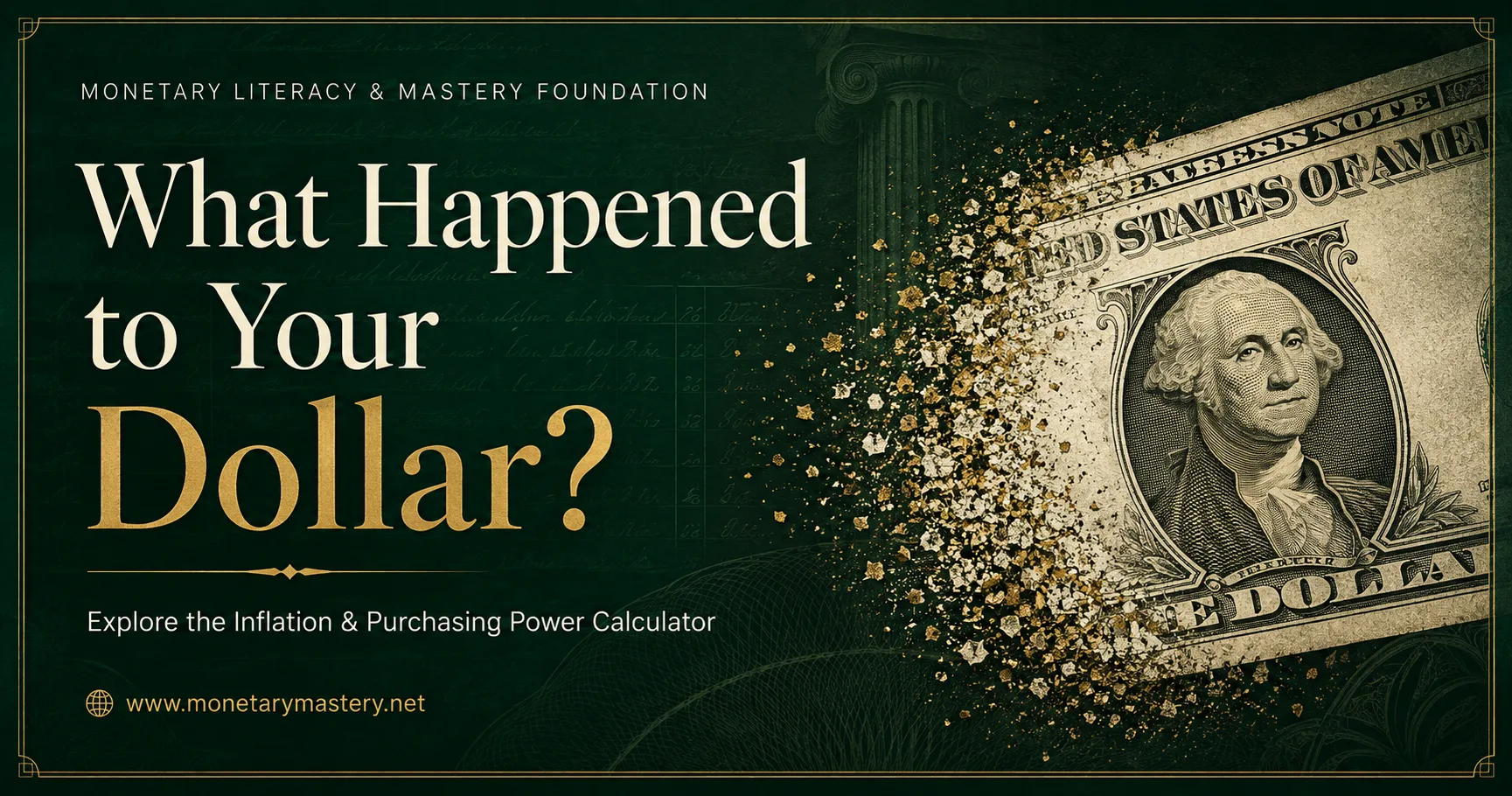
What Happened to Your Dollar? Explore Our New Inflation CalculatorThe number on a dollar bill stays the same. What it can purchase does not.A larger paycheck, a higher home price, or a growing savings balance can look like progress—but dollar amounts alone don’t tell us whether purchasing power has...

Read the full article →

5 replies 199 Read more →
MoneyMan ·Student Feedback ·1 month ago
Myth vs. Reality

Myth vs. Reality

Myth vs. Reality

Some of the most persistent misunderstandings about money and economics are not created by a complete lack of information. They come from explanations that are repeated so often that they begin to feel self-evident.That is why the Monetary Literacy & Mastery Foundation has introduced a new Myth...

Read the full article →

2 replies 172 Read more →
Prospector49 ·Economic Roundtable ·2 weeks ago
The Bankers’ Game: From Medici to BlackRock, How the House Always Wins

I found this great article recently.

Picture this: it’s 15th-century Florence, and the Medici family are strutting around like the coolest kids on the block. They’re not kings or popes, but they’ve got the ultimate cheat code—cash and lot's of it. The Vatican’s broke, begging for loans, and the Medici swoop in, lending like it’s a fire sale. They bankroll wars, fund Michelangelo’s paint-by-numbers, and even get to pick the next guy to wear the papal crown. Cosimo de’ Medici doesn’t need a throne—he’s the guy that the Pope owed big-time. This wasn’t just money; it’s power, influence and control, pure and simple.

Fast-forward to the 1800s, and the Rothschilds take the game global. Nathan, parked in London, finances Britain’s slugfest with Napoleon, while his brothers sprinkle cash across Europe like confetti. Legend has it he gamed the stock market after Waterloo, cashing in before the messengers even laced up their boots—cha-ching. Nathan himself put it best: “It matters not who sits on the throne.” Kings, emperors, whatever—they’re all just puppets when you own the keys to the vault. The Rothschilds didn’t wear crowns; they held the IOUs that made empires dance.

Now zoom to 2025, and meet the modern champs: BlackRock. With $10 trillion in assets—more than most countries’ GDPs—they’re not just playing; they’re rewriting the rulebook. They own stakes in everything—Apple, Tesco, your granny’s corner shop. Central banks like the Bank of England or the Fed play referee, tweaking rates and printing cash, but they’re in bed with the private banks. The UK’s £2.7 trillion debt? That’s BlackRock, JPMorgan, and pals holding the leash. When Liz Truss tried her tax-cut tantrum in 2022, they didn’t send a memo—they crashed the pound and booted her out in 49 days. She said it: the bankers called the shots. No ballot required.

Here’s the thing: governments need money, and bankers have it. Step out of line—like Truss—and the markets “fix” you. Currency tanks, borrowing costs soar, pensioners riot. Politicians get the memo quick: toe the line, or you’re toast. Voting? Cute, but useless. Pick Labour, Tory, Lib-Dem or Reform—it’s the same rigged Monopoly board. The Medici didn’t sweat the duke; Rothschilds didn’t blink at the PM; BlackRock doesn’t care about your pencil stub marking an X on a ballot paper every four years. They’ve got the cash, the markets, the power. You’re just rolling dice and playing a game of their making.

There are movements which spring up who see through the Matrix, take Occupy Wall Street—those scruffy protesters in 2011, camping out, chanting “We are the 99%!” They saw the game, called out the bankers, but couldn’t crack the code. Why? They failed to hook the public. People grumbled, sure—bank bailouts after 2008 stung—but the movement fizzled. No focus, no plan, just noise. The bankers shrugged, adjusted their cufflinks, and kept raking it in. Top 1% wealth in the US jumped from 27% in 1989 to 35% in 2023; UK billionaires doubled their stash since 2009. The house didn’t even flinch.

Now it won't surprise you but bankers love policies like mass migration—their golden goose. They pitch it like a cheesy ad: “More workers, more growth!” The IMF told the UK in 2023 to keep borders loose for GDP’s sake. Net migration hit 685,000—towns become unrecognisable seemingly overnight. For bankers, it’s a jackpot: cheap labour keeps wages down, more consumers pump profits, and property tycoons (their cronies) cash in. London rents up 30% in a decade? Boo-hoo, they’re fine. But you? GDP per person barely budges—£32k in 2008, £33k in 2023, adjusted. Wages lag behind 2008. The elite throw another swan on the fire; you’re stuck with a “Pay Rent forever” card.

Here’s the cherry on top: migration is phrased so as to divide us. While we’re bickering over bus seats or burqas, they’re laughing to the bank. Brexit was a rare “screw you” moment—people united, briefly—but the bankers pivoted. Migration just shifted gears, and the game rolled on. They lost mass migration from the EU, so opened the floodgates to Africa and India to put you back in your place. No united front, no problem. They don’t need to run everything; they nudge the levers, and we’re too distracted to notice. Your town’s a stranger, your rent’s a joke, and they’re buying another island. Rigged? You bet it is.

But hold up—there’s hope. Sun Tzu, that old war genius, said it: “Victorious warriors win first and then go to war, while defeated warriors go to war first and then seek to win..” Brute force won’t cut it; we’ve got to find their weakness and win before the fighting begins.

And it’s staring us in the face: physical Silver.

Why? Banks thrive on paper—debt, stocks, digital dollars. Silver’s real, finite, and they can’t print it. Back in the day, money was silver or gold; now it’s just numbers they manipulate. If we hoard physical silver—buy coins, bars, stash it—they lose control. Supply’s tight—mining’s flat at 800 million ounces a year, while demand (tech, solar, coins) hit 1 billion in 2023. Prices are climbing—$30 an ounce now, up from $10 a decade ago.

How do we exploit it? Simple: buy it, hold it, starve their system. Every ounce you own is a brick they can’t move. If enough of us do it—millions, not dozens—their paper empire wobbles. Banks over-leverage; silver’s a hard limit. Crash their confidence, and the house crumbles. It’s not a protest; it’s a heist in reverse. Occupy failed because it shouted without a plan. This? It’s quiet, smart, and hits where it hurts. Work together, work clever, and we can flip the board so that this time, the house doesn't win.

Monopoly’s banker always wins—until the players stop playing his game. The Medici funded popes, Rothschilds gamed wars, BlackRock owns the table. Voting’s a sideshow; they’ve got 600 years of wins. But silver’s our ace. Nathan was right—thrones don’t matter when they’ve got the keys to the vault. So let’s empty their vaults, one shiny ounce at a time. Next election, vote if you want to. Just don’t bet on it changing anything.

Instead, if you want to win and beat the bankers, then bet on the #SilverSqueeze movement, who you can find simply using Google. These people are smart, united, and have identified the bankers weakness and are exploiting it to outplay the house.

Now mines a pint if you're buying, if not then share this blog to your MyFace socials and consider subscribing, it's free after all.

https://xrpmanchester.substack.com/p/the-bankers-game-from-medici-to-blackrock

H Henry ·Economic Roundtable ·2 months ago
Have you bought any cryptocurrency for the longterm?

Some analysts are of the opinion that cryptocurrency is going to experience major pumps before the end of the year. That has made retailers focus on accumulating some of their favourite coins. As someone who is into the markets, which coins have you been able to acquire for long-term returns?

2 replies 207 Read more →
rockfleece ·Economic Roundtable ·1 month ago
Do you think Rand Paul audited Fort Knox?

He claims he went there and all of the gold was there, but do you think he actually did a thorough audit? I don't, but I believe he saw all of the gold there.

2 replies 117 Read more →
MoneyMan ·Economic Roundtable ·3 weeks ago
When Paris Went Hungry Under Government Food Controls

How does Paris get fed? Frédéric Bastiat famously explained in Economic Sophisms (1845) how market exchange reliably provisioned the (then) million people of Paris with agricultural produce from the countryside that they were able to enjoy "peaceful slumbers...not disturbed for a single instant...."

In stark contrast, Bastiat predicted that there would be "much suffering within the walls of Paris - poverty, despair, perhaps starvation..." if a presumptuous minister decided to replace the market with their own decision-making for what "should be produced, transported, exchanged and consumed...."

We can appreciate Bastiat's observation about the miraculous functioning of the market even more when we look at a time when Paris actually went hungry.

France's Experiment in Forced Provisioning

Leading up to the French Revolution in 1789, France found itself in a precarious fiscal position. It had accumulated crippling debt from the Seven Years' War and its support for the American colonies during their War of Independence. This heavy debt burden left the kingdom woefully unprepared to withstand the economic shocks that followed.

Economic shock came in the form of the eruption of the Laki volcano in Iceland in 1783, which contributed to climatic disruptions and poor harvests in France in the years that followed. These problems were compounded by a severe hailstorm in 1788 that devastated crops and livestock, raising prices, especially for bread, which was the main staple at the time. Increased demand for grain to support the military and its draft animals, when France declared war on Austria in 1792 (followed by war with Great Britain), pushed prices even higher. When France implemented a draft that drew agricultural workers into the military and then began requisitioning agricultural horses and wagons, the supply of grain was further reduced.

Henry Bourne, writing a two-part article in the Journal of Political Economy in 1919 about this era, notes that in the fall of 1792, "One of the longest and most important debates [of the National Convention] was upon the best method of insuring a supply of bread at a reasonable price." This was a problem that especially loomed over the major city of Paris. Bourne argues that the threat of starvation fueled not only the French Revolution, but the mob mentality and interventionism that followed. As Bourne writes, "People, in a panic because they do not know where next week's bread, meat, and coal are to be found, are not likely to apply the rules of evidence to every rumor." The French clamored for state intervention on the "fixed idea that dearness and scarcity were the result of speculation" rather than underlying economic conditions.

Transporting grain became a risky enterprise as mobs sprang up to seize it, further decreasing the supply of grain to Paris. To add insult to injury, the transportation of grain to major cities was further suppressed by inflation, which made the issued assignats unappealing to country farmers.

The National Convention and the Paris Commune turned to "a series of ventures in price-fixing and food control" to solve the problem. Bourne notes that "price-fixing became one of the characteristic features of the Reign of Terror." In 1793, the National Convention imposed a maximum price, or what economists today call a price ceiling, on grain. In a futile attempt to warn of the potential consequences, Pierre Vergniaud, who later that year was executed under the accusation of the radical Jacobin Maximilien Robespierre, urged that "If you destroy commerce, you decree famine."

French attempts to deny the economic reality reflected by market prices, by attempting to suppress them, resulted in severe shortages and long lines.

"The scheme not only failed to encourage the farmer, it threatened him with ruin," Bourne noted. "His expenses for tools, draft animals, and wages were steadily rising, but his profits were cut down, with the prospect of further losses every succeeding month."

But politically savvy politicians blamed these disappointing outcomes on greed and used them to justify further interventions backed by the threat of imprisonment and death. The National Convention created a Commission of Subsistence and Provisioning to be the "Food Director" of France. Swarms of officials were commissioned to survey farmers' inventories and fields in an attempt to enable government officials to redirect grain to where it was needed. Rules were issued detailing the precise percentage of bran that millers could extract and even dictated the one type of bread that would be allowed. A bread card rationing system was created but was abused as families failed to report the death of family members to continue receiving the same allotment. Bourne reports that in 1794, rations fell to a single pound of bread for each laborer and three-fourths of a pound for others, and that "it was practically impossible to obtain meat, butter, eggs, oil, and other articles of food commonly regarded as necessary," as price ceilings were extended to these items as well.

Officials attempted to appeal to the higher motives of the people, telling them that they were "brothers and that they should help" even if it meant turning over the grain needed for their family, for storage for future use, or even the seed necessary to plant the next year's crop. This proved insufficient, however, so the officials eventually turned to force.

Bourne writes that "An attempt was made to provide for Paris by compelling every farmer to furnish within twenty-four hours sixteen bushels of wheat for each hide of land." French dragoons were soon released upon the countryside to "scour the country" for food and to arrest any suspected hoarders. As Bourne notes, "merchants were thrown into prison upon the accusation of the first intriguer who shouted out his suspicions at a popular society. The local revolutionary committees acted as judges without appeal. To escape a similar fate the other merchants hastened to dispose of their merchandise and did not restock."

If a farmer had grain in the field but no laborers to gather it, laborers were drafted by local authorities. Millers and bakers in Paris were drafted and forbidden from abandoning their work without sufficient notice. Eventually, the National Convention even attempted to extend maximum price laws to the wages of laborers as well.

Despite the substantial and systematic efforts of the National Convention and the boards of the separate departments of France, Parisians and much of the rest of France, went hungry under government control. In Cahors, people "were so poorly fed that they were falling in the street from sheer weakness." In Nord, "grain of every sort disappeared from the markets..." The people of Paris would stand "with famished eyes" for hours in line "only to be told when their turn came that nothing was left." As Bourne concludes, "If the maximum laws were meant to save the common people from want and wretchedness, they failed."

Bastiat's Market-Fed Paris

It is unclear whether Bastiat, when writing in the 1840s about the remarkable way in which free markets coordinated the efforts of countless individuals to feed Paris every day, was implicitly contrasting this outcome with the French Revolution's earlier rejection of market exchange. He almost certainly knew that revolutionary France had experienced severe food shortages and government price controls, making the contrast between the two episodes striking even if he did not intend it.

As Bastiat stressed, government officials could not replace the information and incentives provided by market prices. Orders, price controls, requisitions, forced sales, and even forced labor failed to feed Paris. When the National Convention tried to do so, it produced exactly the outcome Bastiat had predicted more than half a century later: not peaceful slumbers, but long lines, empty markets, and widespread hunger. Notably, these outcomes began to recede as the Commission was abandoned and markets were restored.

Dr. Daniel J. Smith is the Director of the Political Economy Research Institute and Associate Professor of Economics in the Jones College of Business at Middle Tennessee State University. His academic research and policy work uses Austrian and public choice economics to analyze private and public governance institutions.

https://thedailyeconomy.org/article/when-paris-went-hungry-under-government-food-controls/

3 replies 185 Read more →
H Heatman ·Economic Roundtable ·2 months ago
Do you think entrepreneurship is the best path to wealth?

I really admire people who build businesses, but the risks and uncertainty can be overwhelming. Do you think owning a business gives the best chance of building long-term wealth, or are there smarter and safer paths like investments?

3 replies 262 Read more →
H Heatman ·Economic Roundtable ·2 months ago
Do you think math is important for understanding economics?

I've met people who say economics is mostly math, while others disagree. Personally, I really enjoy learning about economics but advanced math is very intimidating for me.

How important do you think math is for understanding economics and making better financial decisions?

3 replies 285 Read more →
MoneyMan ·Documentary & Video ·4 months ago
How Our Monetary System Works

🎬 Before You Watch

Documentary Snapshot

  • Length: 21 minutes, 17 seconds
  • Difficulty: ★☆☆☆☆ Beginner
  • Recommended After: Completing Monetary Policy Lessons 1–6
  • Purpose: A concise visual explanation of how today's debt-based monetary system functions.

This short documentary provides an excellent overview of the modern monetary system and serves as a practical introduction before exploring longer documentaries. It reinforces many of the concepts introduced throughout the Monetary Policy lessons, including debt-based money creation, banking, inflation, and the role of central banking.

📚 Concepts Reinforced

Money Creation Debt-Based Currency Federal Reserve Inflation Purchasing Power Fractional Reserve Banking Central Banking Monetary Policy

🔍 Key Questions to Consider

As you watch, consider the following questions. You don't need to know every answer immediately—the goal is simply to begin thinking critically about how the monetary system operates.

  • Where does new money actually come from?
  • How does debt create new currency?
  • Who benefits first when new money enters the economy?
  • How does inflation affect purchasing power over time?
  • Why do many people confuse money with currency?
  • How does this documentary connect with what you've already learned in Lessons 1 through 6?
  • Which ideas presented would you like to investigate further?
[VIDEO=Rumble]https://rumble.com/embed/v6t9iov/?pub=10xo9j[/VIDEO]

💬 Reflection & Discussion

After watching, share your thoughts below. There are no "right" answers—the goal is to compare ideas, ask questions, and think critically about the concepts presented.

  • What was the most surprising thing you learned?
  • Did anything challenge your previous understanding of money or banking?
  • What questions do you still have?
  • Would you recommend this documentary to someone new to monetary literacy? Why or why not?
11 replies 684 Read more →
MoneyMan ·Student Feedback ·3 months ago
Make sure to share us to others and spread the word!

Why Sharing Our Mission Matters

Knowledge only creates change when it is shared. The Monetary Literacy & Mastery Foundation exists to help people better understand money, history, economics, and the often-overlooked ideas that shape our financial world. Every new member who joins our community strengthens that mission.

When you tell others about the Foundation, you are doing more than promoting a forum—you are helping spread financial awareness. Many people spend years working for money without ever being taught how money truly works. By introducing friends, family members, coworkers, and online communities to our educational resources, you help create opportunities for others to learn valuable lessons that can benefit them for a lifetime.

Word-of-mouth is one of the most powerful tools for growth because it is built on trust. People are more likely to explore new ideas when they come from someone they know and respect. A simple recommendation, a shared article, or a discussion about a topic you learned here can spark curiosity and inspire someone to begin their own journey toward monetary literacy.

As our community grows, so does the collective knowledge within it. New perspectives, experiences, and research help us uncover deeper insights and preserve important information that might otherwise remain hidden or forgotten. Every member has the ability to contribute to that growth.

If you have found value in the Foundation, consider sharing it with others. Invite a friend, mention us in a discussion, or share content that helped you learn something new. Together, we can build a stronger, more informed community dedicated to sound money, lifelong learning, and the pursuit of knowledge.

One conversation can change a perspective. One recommendation can change a life. Help us spread the word.

3 replies 367 Read more →
MoneyMan ·Financial News & Discussion ·3 months ago
Gold Overtakes US Treasuries as Reserve Asset

New ECB data show gold has surpassed U.S. Treasuries as the world's second-largest reserve asset, reaching 27% of global reserves. Central banks now hold over 36,000 tonnes of gold, near Bretton Woods-era levels, as countries increasingly favor bullion over sovereign debt amid rising geopolitical tensions and sanctions concerns.

12 replies 661 Read more →
rockfleece ·Financial News & Discussion ·4 weeks ago
Central Banking: The Scourge Of Civilization

Apple builds and sells iPhones. I happen to own one of the older models, for the same reason I own a last-legs older model car. What if Apple could skip the build part and sell only the phone? The money saved would be an enormous boost to its bottom line. And if Apple passed the savings onto customers I could conceivably afford to upgrade.

Where would the phones come from? From a bookkeeping entry, of course.

Unfortunately, Apple's customers are very demanding and want the real things, so the build operations will have to stay. Perhaps their executives looked upon another business and envied their ability to sell loans without drawing down their savings. Customer with good credit wants a loan? Create the amount with a few taps on a keyboard and send him on his way.

The customer will spend his newly-acquired money, thus keeping people employed. Since he has good credit, he will be able to make monthly payments, and the lender, the bank, will normally apply his payments to extinguish the loan, with the interest being the bank's profit. Everyone's happy and the economy keeps expanding until it busts.

Experts will diagnose the bust. The usual fiends will get blamed. Government will step in to cure the problem its monetary and banking interventions helped create. The economy will slowly recover and continue on the same path as before, meaning banks will continue extending credit from ether rather than savings.

How did this racket get started? It's complicated. That's one reason it works-the crime doesn't exist if enough people don't see it.

Gold and silver coins have long served as money, until more recent times. For government, gold became an economic culprit during the Great Depression, as explained by JM Bullion,

The Great Depression officially began on October 28, 1929, when the Dow Jones Industrial Average lost 13% of its value in a single day. The following day, it dropped an additional 12%, and in a matter of weeks, it was worth half as much as before.

In response, consumer confidence plummeted, and people began withdrawing their money from banks as quickly as possible. Banks, which work with reserves and don't keep much of their deposits on hand, began closing their doors. (emphasis added)

Bank-created money was disappearing, and prices fell accordingly. Let's expand on this.

The Federal Reserve Act of 1913 required the Fed to hold gold equal to only 40 percent of the currency it issued. By adjusting interest rates, the Fed could increase or decrease its stock of gold. Higher interest rates shifted "gold from the pockets of the public (both here and abroad) to the vaults of Federal Reserve district and member banks." Conversely, lower rates drove gold from the Fed's "coffers into the hands of the public both at home and overseas."

During the panics of 1930-1931 people were losing their trust in banks. A depositor with $1,000 in a shaky local bank could protect himself from that bank's failure by withdrawing $1,000 in currency. The dollars-fully redeemable in gold coin-gave him needed purchasing power. But the bank now had $1,000 less on which to pyramid new loans.

After Britain abandoned the gold standard on September 21, 1931, foreign holders of dollar assets began converting them into gold. Americans rightly feared Roosevelt would do the same when he took office on March 4, 1933. An owner of a $1,000 note or checking account would risk losing his legal ability to convert it into gold at $20.67 per ounce.

People knew what was real and they lined up at banks demanding gold. But the dual legality of fractional reserves and the promise of 100 percent redemption of notes and deposits made banks vulnerable to a panicked crowd demanding redemption. Thirty-six hours after his inauguration, Roosevelt shut down the banks for a week (the Bank Holiday of 1933). A month later he ordered Americans to surrender their gold or face heavy fines and imprisonment.

The inflationary Fed system wasn't limited to Wall Street, though stock market margin credit played a significant role during the 1920s. Businesses, farmers, real-estate borrowers and ordinary bank customers were also drinking the elixir of Fed bank credit.

Gold had powered the growth of civilization. "According to Herodotus, King Croesus, who ruled Lydia from around 560 to 546 B.C., was the first person to issue pure gold and pure silver coins." It only took the government-Fed cartel twenty years to get rid of it, 1913-1933.

https://mises.org/mises-wire/central-banking-scourge-civilization

J Ja sa bong ·Economic Roundtable ·2 months ago
Growth or Stability: Which Would You Choose?

For me, I would choose to have steady financial stability over enjoying rapid growth. One might be growing without being financially stable.

What matters more to you when building wealth between consistent progress or bigger risks for bigger rewards?

2 replies 276 Read more →
MoneyMan ·Student Feedback ·1 month ago
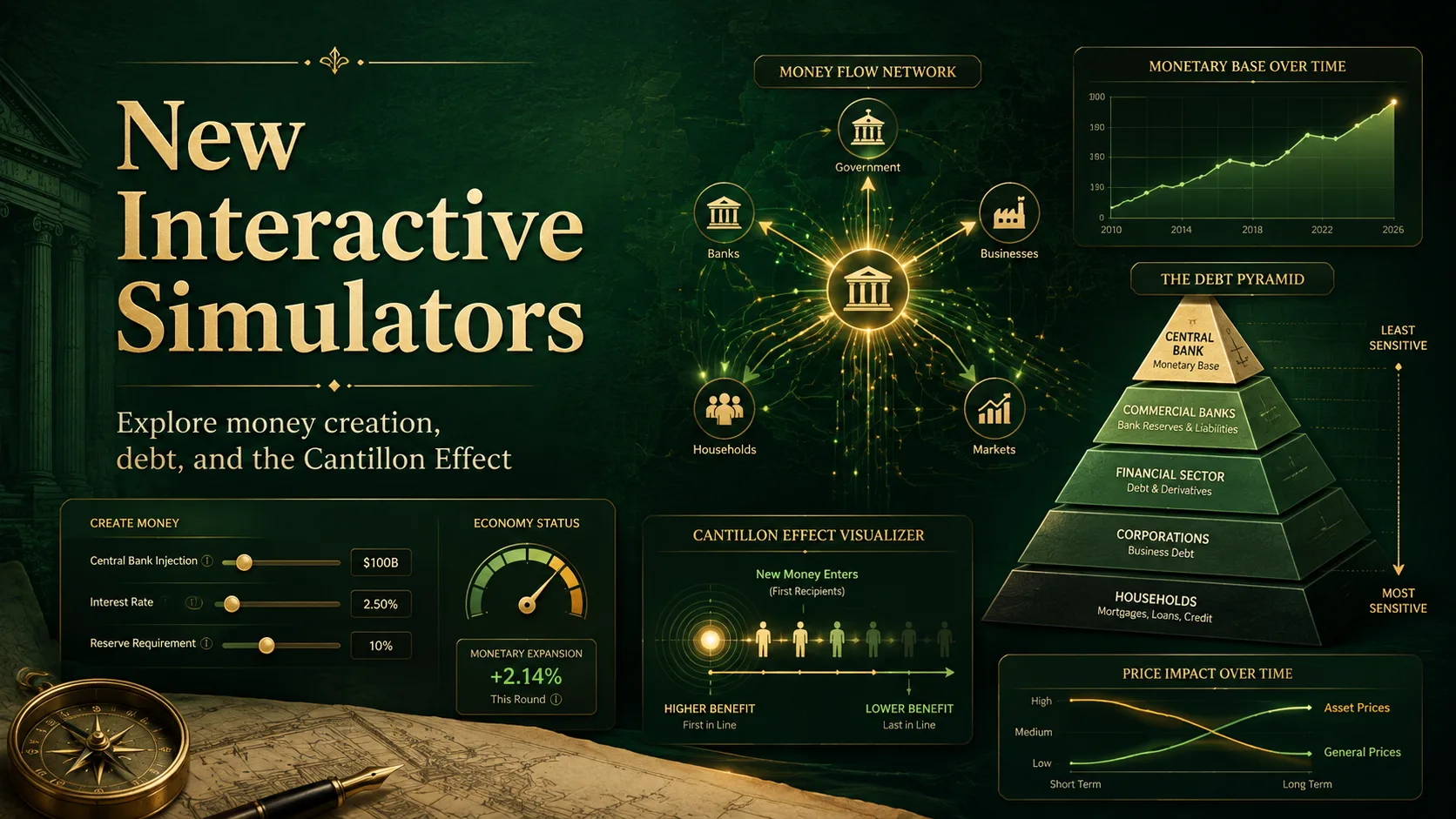
New Interactive Simulators

New Interactive Simulators

New Interactive Simulators

The Monetary Literacy & Mastery Foundation has introduced four interactive simulators designed to make complex monetary concepts easier to understand through experimentation.Rather than simply reading about how monetary systems work, visitors can now adjust variables, observe outcomes, and see i...

Read the full article →

3 replies 120 Read more →
MoneyMan ·Economic Roundtable ·1 month ago
Join the Dots: Cutting Through the Noise

Join the Dots: Cutting Through the Noise

Join the Dots: Cutting Through the Noise

View Link

Join the Dots is your daily guide to global geopolitical events and their macroeconomic impact. With 40 years of experience — including roles in UK, US, and Swiss banks — I’ve seen it all: from calling the 1992 ERM crisis, the 2008 GFC, the Eurobond crisis of 2011, to predicting the 2008/9 Dubai Property Crash live on radio in June '08. In early 2020, I called the S&P bottom at 2000–2200 due to Covid.

How? I find and listen to the best voices. No one knows everything — but the truth is out there. This channel filters out the noise, lies, and spin to bring you clear, fact-based macro insights. I connect the dots between data, policy, markets, and geopolitics — so you don’t have to.

What you’ll find here:

1. The truth

2. Daily global economic roundups 3. Honest, independent macro commentary

4. Key signals explained clearly

5. Insightful opinion grounded in experience

3 replies 177 Read more →
Load more
ForumSpark © 2023 - 2026 · ForumSpark.net · Terms